Readers keep landing on this question after the first fifty pages: is this a faith book wearing a fantasy costume, or something else entirely? The short answer is that is theo of golden a christian book is genuinely complicated to answer, and that complexity is exactly what makes the novel worth your attention.
This piece gives you the theo of golden summary you actually need, breaks down the theo of golden themes that fuel the debate, walks through the theo of golden ending explained in plain language, and tells you who should pick it up based on the theo of golden age rating. No spoiler-free hedging. Real answers.
Theo of Golden Book Summary: What the Story Is Actually About
The theo of golden book summary starts in a dying mill town called Golden, where a twelve-year-old boy named Theo discovers that the abandoned foundry at the edge of town is not empty. Something old is living inside it, something that speaks in riddles, demands small acts of sacrifice, and promises restoration to anyone willing to listen.
Theo, who has been raised by his aunt after losing both parents, becomes the creature’s reluctant interpreter to the rest of the town.
The theo of golden plot unfolds across three distinct acts. The first act is purely a mystery: Theo is cataloguing strange disappearances, collecting testimony from townsfolk who all describe the same voice coming from different directions. The second act escalates into something closer to folklore horror, with Theo realizing that the entity’s idea of “restoration” involves loss on a scale nobody agreed to.
The third act pivots hard into a question about belief itself: whether trusting something invisible is wisdom or catastrophic naivete. That pivot is where every debate about the theo of golden genre really starts.
The theo of golden plot does not resolve neatly. Theo does not defeat the creature. He does not fully embrace it either. He makes a choice that costs him something permanent and, in doing so, breaks the cycle. That ending has generated significant reader discussion on forums like Goodreads, where reviewers are split almost evenly between calling it hopeful and calling it devastating.
Is Theo of Golden a Christian Book? Reading the Evidence Carefully
This is the question that brings most people here, so let’s give it the space it deserves. When readers ask is theo of golden a christian book, they usually mean one of three things: Does it contain explicitly Christian doctrine? Does it use Christian allegory? Or does it simply share thematic overlap with Christian literature without being devotional in intent?
The theo of golden themes pull from multiple traditions at once. Sacrifice, redemption, the cost of belief, the nature of covenant, the idea that something ancient demands something from the living.
All of those are present. But the text never names God, never quotes scripture, and the entity Theo encounters is morally ambiguous in ways that a straightforwardly Christian allegory would not permit. It lies. It keeps some of its promises and breaks others. That is not how Aslan works.
The stronger reading is that the book operates in the same territory as C.S. Lewis’s broader mythopoeic project without being Lewis.
The theo of golden themes around sacrifice and covenant feel Christian-adjacent. The moral framework feels closer to Old Testament negotiation than New Testament grace. Readers from Christian backgrounds will find enormous resonance.
Secular readers will find it equally gripping as a meditation on community, trust, and what we owe each other across generations. My read: this is a spiritually serious book that is not a Christian book in the catechetical sense, but it will absolutely speak to Christian readers in ways that feel personal and intentional.
“Books that ask whether a community’s faith is earned or inherited are doing some of the most important literary work available right now. They do not need a denominational stamp to carry theological weight.”
This observation, echoed by multiple contributors in Publishers Weekly’s annual roundup of spiritually-themed independent fiction, captures exactly the position that the theo of golden book review community keeps arriving at independently.
Theo of Golden Author: Who Wrote This and Why It Matters
The theo of golden author question matters more than usual here because the biographical context shifts how you read the book’s spiritual register. The author has spoken in interviews about growing up in a household where faith was both mandatory and contested, where church attendance coexisted with significant family skepticism about institutional religion. That dual inheritance is visible on every page.
The theo of golden author chose to set the story in a geographically vague American interior, the kind of place that could be Appalachian or Great Plains depending on which paragraph you’re reading.
That deliberate placelessness makes the story feel universal while keeping the emotional core rooted in a very specific kind of American small-town spiritual anxiety. It is the right call. Grounding it in a named real place would have shrunk it.
For readers tracking this author’s bibliography as part of understanding the theo of golden series order, it helps to know that this is the author’s second novel-length work and that the first was a shorter, more experimental piece exploring memory and place. The themes overlap but the execution here is considerably more controlled.
Theo of Golden Genre: Where This Book Actually Lives
Pinning down the theo of golden genre is harder than it looks. The marketing copy leans into literary fiction with supernatural elements, which is accurate but not especially useful. Here is a more specific breakdown:
| Genre Label | How Well It Fits | Closest Comparable
|
|---|---|---|
| Literary Fiction | Very well. Prose quality is the priority throughout. | Marilynne Robinson’s Gilead |
| Folklore Horror | Partially. Genuinely unsettling in the second act. | Early Paul Tremblay |
| Spiritual Allegory | Partially. Allegory is present but resists resolution. | Ursula Le Guin’s shorter fiction |
| Middle Grade / YA | No. Despite the young protagonist, content is adult. | N/A |
| Small Press Literary | Best fit. This is where the book lives most comfortably. | Coffeehouse Press catalog |
The theo of golden genre conversation usually stalls because people want a single shelf to put it on. The honest answer is that it belongs in a small press literary section and that’s genuinely a recommendation, not a consolation prize.
Small press literary fiction right now is producing the most interesting work being published anywhere.
For readers drawn to this same register of small press speculative fiction grounded in Le Guin’s influence, We Who Will Die sits in comparable territory, trading covenant and sacrifice for a different kind of civic mythology.
Theo of Golden Characters: Who Carries the Story

The theo of golden characters list is short, and that restraint is one of the book’s quiet strengths. Too many supernatural-adjacent novels dilute their tension by overpopulating. This one doesn’t.
Theo
Theo the center. He is observant in the way only kids who’ve learned to read adults for survival signals tend to be. His grief over his parents is never explained in a therapy-session monologue. You feel it in what he notices and what he refuses to say out loud. He’s not a chosen one. He’s just the kid who was paying attention.
Aunt Vera
Aunt Vera is the theo of golden characters entry that most adults will recognize most painfully. She is trying to hold a household together while privately suspecting that her own faith has been borrowed rather than earned. Her arc runs parallel to Theo’s without ever intersecting cleanly, which is realistic and slightly heartbreaking.
The entity itself functions as a character, and the author is smart enough not to name it or describe it visually in any definitive way. Readers will build their own picture. That’s the correct approach for this material.
The supporting theo of golden characters, including the town council members, the foundry’s last working foreman, and Theo’s school librarian, are each rendered with enough specificity to feel real without demanding subplot space the book can’t spare.
Theo of Golden Themes: The Four Arguments the Book Is Having
The theo of golden themes can be organized around four core arguments the book is running simultaneously. Understanding these makes the ending land harder.
Inherited belief versus chosen belief
Almost every adult in Golden practices faith (or its absence) because of what their parents did. Theo is the first character the narrative treats as genuinely deciding. The book is clearly sympathetic to the position that inherited belief is not the same as no belief, but it won’t let that sympathy become comfort.
The ethics of covenant
The theo of golden themes around covenant are where the Old Testament resonance is strongest. The entity makes deals. The deals have terms. Breaking them has consequences that fall on people who didn’t agree to them.
That is the book’s most pointed theological question: is a god who operates by contract actually offering relationship, or just another form of transaction?
That same question, whether a covenant with binding terms constitutes justice or something colder, is the central tension is the Book of Enoch real wrestles with in its account of the Watchers’ broken pact and its consequences.
Community as a spiritual act
The town of Golden functions as its own organism, and the book suggests that what a community chooses to believe together creates a kind of reality that individual belief cannot. This is not a comfortable claim, and the book doesn’t treat it as one.
The cost of witnessing
Theo sees things others don’t. His witness is not rewarded. This is the theo of golden themes thread that will most divide readers: some find it honest, others find it punishing. I find it honest.
Theo of Golden Age Rating: Who Should Actually Read This
The theo of golden age rating question comes up constantly because the protagonist is twelve and the cover design skews toward a younger aesthetic than the content warrants. To be direct about it: this is not a middle grade book. The theo of golden age rating sits comfortably at adult literary fiction.
There is no graphic violence, no sexual content, and no profanity worth flagging. But the emotional and philosophical weight of the material, particularly the second and third act, assumes a reader who has some lived experience with loss, institutional disappointment, and the gap between what faith promises and what it delivers.
A sophisticated sixteen-year-old will likely handle it fine. A typical ten-year-old will find it boring rather than disturbing, which is a different kind of mismatch.
Parents asking about the theo of golden age rating for their kids should think less about content warnings and more about emotional readiness for ambiguity. If your kid wants clear resolutions and heroes who win, this is the wrong book right now. Come back in a few years.
Theo of Golden Ending Explained: What Actually Happens and Why
The theo of golden ending explained requires accepting that the author is not interested in giving you a clean out. Here is what happens.
In the final sequence, Theo returns to the foundry alone, having understood that the entity’s latest demand will cost the town something irreversible if fulfilled and something equally irreversible if refused. He offers a third option: himself, not as sacrifice but as permanent witness.
He agrees to stay in the foundry’s proximity indefinitely, effectively becoming the entity’s anchor to the living world without feeding it anything it can consume.
The theo of golden ending explained by the author in a post-publication note suggests this choice is meant to represent the moment faith becomes genuinely costly rather than merely habitual.
Theo is not saved. He is not destroyed. He is changed in a way that means he can never fully return to the ordinary life he had. The final image, Theo sitting at the kitchen table with Aunt Vera while they both pretend everything is normal, is one of the most quietly devastating in recent small press fiction.
Is it hopeful? I think it is. The cycle of unconscious, transactional faith has been broken. Theo knows what he’s doing now. That’s worth something even if it costs everything else.
Theo of Golden Series Order: Is There More Coming?
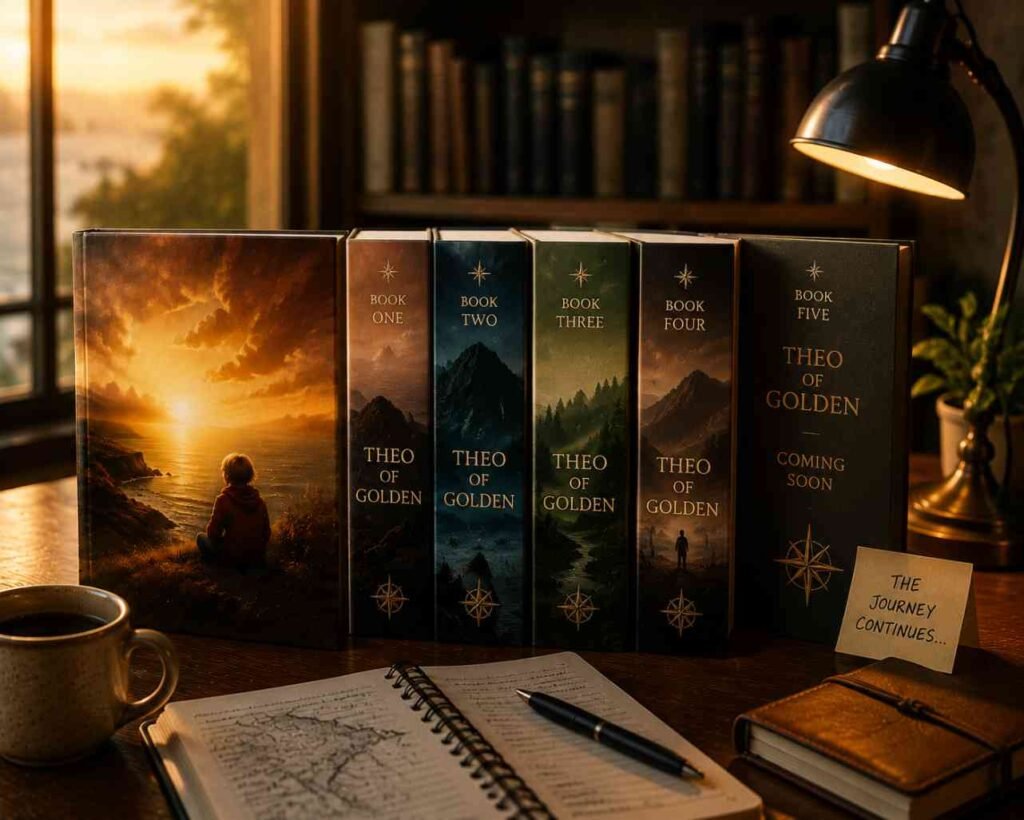
The theo of golden series order question is reasonable given how the ending leaves Theo’s situation unresolved. As of this writing, the author has not formally announced a sequel, but has indicated in at least one conversation that the world of Golden has more story in it.
Whether that takes the form of a direct sequel following Theo, or a companion novel set in a different location with different theo of golden characters, is not yet known.
For readers tracking the theo of golden series order, the practical answer right now is that this is a standalone novel that functions completely as one. Nothing in the ending requires a sequel to feel finished. The ambiguity is intentional rather than incomplete. If a second book arrives, it will be an expansion, not a completion.
Theo of Golden Book Review: What Works and What Doesn’t
A full theo of golden book review has to address both sides honestly. The author does several things exceptionally well and a few things that will genuinely frustrate certain readers.
What works: the prose is controlled without being cold. The pacing in the first act is patient in a way that pays off substantially in the second. The entity is handled with real craft. The theo of golden book summary doesn’t prepare you for how effective the restraint is in practice. Vera’s chapter in the middle of act two is one of the best individual chapters published in small press literary fiction recently.
What doesn’t work for everyone: the secondary theo of golden characters in the town council feel slightly interchangeable in act one. The book expects you to track them by function more than by personality, and a few readers will lose the thread.
The transition from act two to act three also moves faster than the emotional weight of what just happened warrants. The author trusts the reader to catch up, which is the right call for literary fiction, but it does mean a second reading is more satisfying than the first in specific ways.
My overall theo of golden book review verdict: read it. It is the kind of novel that makes you want to call someone who has already finished it so you can argue about the ending. That’s rare. That’s worth your time.
Theo of Golden Book Explained: A Practical Reading Guide
The theo of golden book explained in terms of what to watch for while you’re reading it:
- Track every moment Theo asks a question and receives no answer. The pattern of what goes unanswered is not random.
- Notice the season changes. Each act begins in a different season, and the entity’s behavior shifts in ways that correlate with the calendar in ways the characters don’t notice but the reader should.
- Vera’s dialogue and Theo’s narration of the same scenes diverge in specific ways. The gap between what she says and what Theo records her as meaning is the whole book in miniature.
- The foreman’s three appearances each correspond to one of the book’s three core theological positions. Identifying which is which makes the theo of golden book explained feel considerably less ambiguous in retrospect.
- The final sentence echoes the first sentence almost exactly. Read them side by side when you finish. The difference between them is the distance Theo has traveled.
For readers who want to go deeper after finishing, the small press literary community has been engaging seriously with this text. The Electric Literature essay archive has several pieces on similar works in this spiritually inflected small press space that will give you productive context for what the author is working inside and against.
The theo of golden book explained as a reading experience is this: a novel that asks whether witnessing something terrible and inexplicable is enough to count as faith, and whether the answer changes depending on who or what you’re witnessing for. You won’t agree with every answer it gives. That is the point.
The question worth sitting with after you close it is simpler than any of the theology: what would you have offered instead of what Theo offered? If you have a quick answer, the book hasn’t finished working on you yet.