
Roughly 300 manuscripts of this text survived across two millennia of suppression, exile, and deliberate erasure from mainstream religious canons. That alone should tell you something. The question of is the book of enoch real is one of the most searched, most argued-over questions in the entire field of ancient religious literature, and the answer is genuinely more complicated than a simple yes or no.
This article gives you the full picture: where the text came from, who wrote it, what it actually says about fallen angels and giants, why it was cut from the Bible, and what serious scholars make of it today. By the end, you’ll have a grounded, evidence-based answer rather than a YouTube rabbit hole.
Book of Enoch Summary: What This Text Actually Contains

Before you can judge whether something is “real,” you need to know what it is. Here’s a book of enoch summary that doesn’t gloss over the weird parts.
The Book of Enoch is a collection of five distinct sections, each with its own tone and focus. Scholars call these the Book of Watchers, the Book of Parables (also called the Similitudes), the Astronomical Book, the Book of Dreams, and the Epistle of Enoch.
They were almost certainly not written at the same time or by the same hand, but they circulated together and were eventually compiled into what we now call 1 Enoch, the Ethiopic version preserved by the Ethiopian Orthodox Church.
The most widely read section is the Book of Watchers, and this is where the book of enoch fallen angels narrative lives. Angels called Watchers descend to earth, take human women as wives, and produce monstrous offspring.
Those offspring are the book of enoch nephilim, giants who consume the earth’s resources and then begin consuming people.
God eventually dispatches archangels to bind the ringleader Azazel, imprison the Watchers, and initiate the flood. Enoch himself acts as a kind of cosmic mediator, conveying messages between God and the fallen angels who beg for mercy and don’t receive it.
The Astronomical Book is a surprisingly detailed treatise on solar and lunar cycles, seasons, and a 364-day solar calendar.
The Book of Dreams contains two visions, one of which retells Israelite history from creation to the Maccabean period using animals as symbolic stand-ins for nations and individuals. And the Epistle closes the collection with apocalyptic warnings directed at the righteous and the wicked.
That’s the book of enoch summary. Five sections, wildly different tones, unified by a framing narrative around the patriarch Enoch who “walked with God” in Genesis 5:24.
Is the Book of Enoch Real? The Historical Evidence
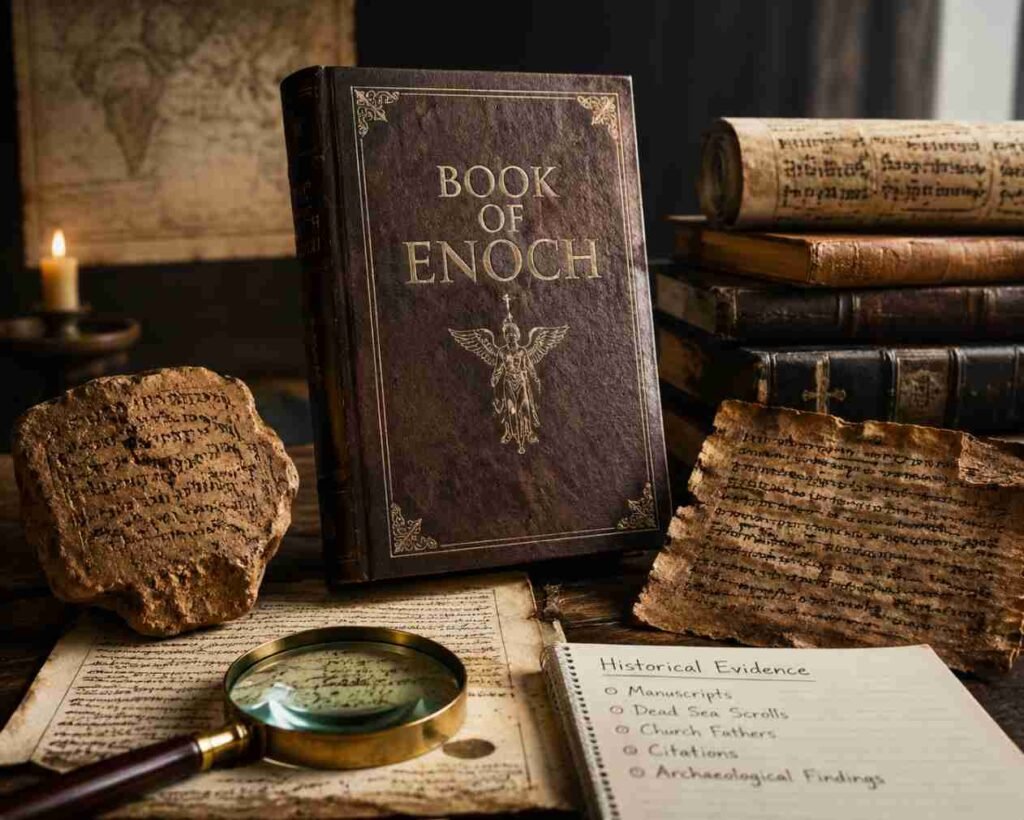
Yes, the text is real. That part isn’t debatable. Physical manuscripts exist, the oldest of which date to the 3rd and 2nd centuries BCE. When archaeologists excavated the Dead Sea Scrolls at Qumran beginning in 1947, they found fragments of 1 Enoch in Aramaic, making it one of the best-attested non-canonical texts from Second Temple Judaism. You can read about the Dead Sea Scrolls discovery and its scholarly implications at the Israel Antiquities Authority’s official Dead Sea Scrolls portal.
So “is the book of enoch real” as a physical, historical document? Absolutely. The more contested version of the question is whether it’s spiritually or theologically authoritative, and that’s where things get genuinely interesting.
The Ethiopic manuscripts, preserved by the Ethiopian Orthodox Tewahedo Church, are the most complete surviving copies. The church has treated 1 Enoch as canonical scripture for centuries, placing it within its 81-book biblical canon. That’s a significant institutional endorsement that Western Christianity tends to undercount.
Who Wrote the Book of Enoch?
Who wrote the book of enoch is a question that has occupied biblical scholars for over 150 years, and the honest answer is: multiple authors, none of them the biblical Enoch himself.
The patriarch Enoch lived, according to Genesis chronology, before the flood. The text claims to be his revelations and prophecies. But the scholarly consensus, built on linguistic analysis, historical references within the text, and comparison with other Second Temple literature, places the composition of 1 Enoch’s various sections between roughly 300 BCE and 100 CE. That’s a span of four centuries and likely five or more distinct authorial hands.
The Book of Watchers is generally dated to the 3rd century BCE. The Astronomical Book may be even older, possibly 4th century BCE.
The Book of Parables, which contains the famous “Son of Man” passages that Christian scholars have long connected to the Gospels, is typically dated to the 1st century CE, making it a near-contemporary of the New Testament.
This attribution of texts to ancient figures was a common literary practice in the ancient world called pseudepigraphy. The authors weren’t trying to deceive anyone by the cultural standards of their era. They were placing their wisdom within an authoritative tradition.
For a deeper dive into the authorship debate itself, including how scholars date each of the five sections, who wrote the Book of Enoch breaks down the case section by section.
When Was the Book of Enoch Written?
To build on the above, here’s a cleaner timeline. When was the book of enoch written depends on which section you mean:
| Section | Estimated Date (BCE/CE) | Key Content
|
|---|---|---|
| Astronomical Book | 4th century BCE | Solar/lunar calendar, cosmic order |
| Book of Watchers | 3rd century BCE | Fallen angels, Nephilim, flood origins |
| Book of Dreams | 2nd century BCE (ca. 165 BCE) | Symbolic visions of Israelite history |
| Epistle of Enoch | 2nd century BCE | Apocalyptic ethical instructions |
| Book of Parables | 1st century BCE to 1st century CE | “Son of Man” imagery, judgment scenes |
The Dead Sea Scrolls fragments align with the older dates for most sections and confirm the text was being actively copied and studied at Qumran at least as early as 200 BCE. That makes 1 Enoch older than every book of the New Testament and contemporaneous with many of the later books of the Hebrew Bible.
Book of Enoch Explained: The Fallen Angels Narrative
This is the part that genuinely grips people, and the book of enoch explained properly means sitting with the fallen angels material at length because it’s the theological core of the whole collection.
In Genesis 6:1-4, there’s a famously cryptic passage about “sons of God” taking human wives and producing Nephilim. Genesis gives you four verses and moves on.
Enoch gives you entire chapters. The text identifies these beings as the Watchers, a class of angels whose job was to observe and guide humanity.
Two hundred of them, led by an angel named Shemihaza, make a pact to descend and take wives. The text lists their names.
It lists what each one taught humanity: Azazel taught men metallurgy and weapon-making, and taught women to make cosmetics and practice sorcery. Other Watchers taught astrology, root-cutting, and the “signs of the earth.”
The book of enoch fallen angels account frames human corruption not as an internal problem but as an external infection introduced by rebellious celestial beings. That’s a very different cosmology than what made it into the final canon of the Hebrew Bible, and it’s one reason the text made certain councils nervous.
The book of enoch nephilim, the offspring of these unions, are described as giants 3,000 ells tall in some manuscripts (numbers that were clearly symbolic rather than literal). They devour all human food, then devour humans, then begin devouring one another.
They’re called the giants and then the evil spirits that arise from their slain bodies haunt the earth, which is the text’s explanation for where demons come from.
That specific cosmological move, connecting the origin of demons to the bodies of dead Nephilim, appears in no other Jewish text quite so explicitly. The book of enoch nephilim tradition was enormously influential on later Jewish and early Christian demonology.
What Does the Book of Enoch Say About Judgment?
What does the book of enoch say about how God responds to all this cosmic chaos? The text is remarkably detailed on divine justice.
God dispatches four archangels: Raphael, Michael, Sariel (or Uriel), and Gabriel. Each gets a specific assignment. Raphael is told to bind Azazel, throw him into the darkness of the desert of Dudael, and cover him with sharp and jagged rocks until the final judgment.
Gabriel is sent against the hybrid offspring. Michael is instructed to bind Shemihaza and the other Watcher leaders, bury them in the valleys of the earth, and seal them there until the Day of Judgment when they’ll be thrown into the fire.
It’s a remarkably structured vision of cosmic incarceration, and it has obvious parallels to passages in the New Testament letters of Jude and 2 Peter, both of which reference angels being held in darkness awaiting judgment.
Scholars like George Nickelsburg, whose commentary on 1 Enoch published by Fortress Press remains the field’s standard reference, argue that the Book of Watchers provided the imaginative framework for a great deal of early Jewish and Christian apocalyptic thought.
You can explore Nickelsburg’s broader academic contributions through the Society of Biblical Literature, the primary professional association for the field.
“The Book of Enoch was widely read and highly respected in Jewish circles during the Second Temple period, and it left clear marks on the New Testament. To ignore it is to read the New Testament without understanding the air its authors breathed.”
George W.E. Nickelsburg, emeritus professor at the University of Iowa and author of 1 Enoch: A Commentary on the Book of 1 Enoch, as summarized in his scholarly introduction to the text.
That framing matters enormously when you’re asking is the book of enoch true in any meaningful sense. The text’s ideas didn’t vanish when it was excluded from the canon. They show up in Jude 1:14-15, which directly quotes Enoch. They show up in the imagery of Revelation.
They show up in the Dead Sea Scrolls community’s theology. The influence is real whether or not you consider the text scripture.
Why Was the Book of Enoch Removed from the Bible?
Why was the book of enoch removed from the bible is actually the wrong question historically, but it’s the one everyone asks, so let’s address it properly.
The text was never universally “in” the Bible to begin with. The formation of the Hebrew and Christian canons was a centuries-long process involving multiple councils, communities, and competing traditions. Different groups made different decisions. Here’s what actually happened to 1 Enoch:
- The Qumran community (the Dead Sea Scrolls group) clearly treated it as authoritative scripture, copying it more than almost any other text.
- Early church fathers including Tertullian and Origen engaged with it seriously, with Tertullian arguing explicitly for its canonicity around 200 CE.
- As the Christian canon solidified through the 4th century, particularly after the Council of Laodicea (363 CE) and then the Councils of Hippo (393 CE) and Carthage (397 CE), texts that weren’t universally accepted across major churches were gradually sidelined.
- The Ethiopian Orthodox Church never accepted this sidelining and continues to include 1 Enoch in its canon to this day.
Several factors appear to have worked against Enoch’s broader inclusion.
The same canon-formation questions come up around other contested texts who wrote the Book of Judges covers a similar authorship-and-editing puzzle from inside the Hebrew Bible itself, rather than outside it.
The fallen angels cosmology was theologically uncomfortable because it located the origin of evil in celestial beings rather than human free will. The text’s detailed angelology gave it the appearance of a rival system competing with emerging Christian and rabbinic orthodoxy.
And pseudepigraphical authorship became increasingly suspect as canons tightened around the principle of apostolic authorship for the New Testament and Mosaic authority for the Hebrew Bible.
So why was the book of enoch removed from the bible? Partly politics, partly theology, partly timing, and partly the accident of which manuscripts survived in which communities. The Ethiopian Christians kept it. Western Christianity largely forgot it for over 1,000 years until James Bruce brought Ethiopic manuscripts to Europe in 1773.
Is the Book of Enoch Biblical?
Is the book of enoch biblical depends entirely on your definition of “biblical.” If you mean “does it appear in every version of the Bible used by Christians worldwide,” then no. If you mean “did it shape the books that are in those Bibles,” then emphatically yes.
The clearest case is the Letter of Jude. Jude 1:14-15 says: “Enoch, the seventh from Adam, prophesied about them: ‘See, the Lord is coming with thousands upon thousands of his holy ones to judge everyone.'” This is a direct quotation from 1 Enoch 1:9. The New Testament author is treating 1 Enoch as prophetic scripture. That’s a significant data point for anyone asking is the book of enoch biblical.
2 Peter 2:4 references angels “cast into hell and committed to chains of gloomy darkness to be kept until the judgment,” which maps directly onto the Enochic Watchers narrative. Revelation’s imagery of cosmic warfare, beast empires, and angelic hierarchies all swim in water that Enoch helped fill.
The book of enoch bible connection isn’t marginal. The canonical New Testament authors read Enoch, cited Enoch, and built on Enoch’s framework.
Whether that makes is the book of enoch biblical a yes or no is ultimately a theological call you’ll have to make yourself. Historically, the influence is undeniable.
Book of Enoch Giants: Separating History from Mythology
The book of enoch giants material draws the most sensational modern attention, and it’s worth separating what the text actually claims from what YouTube and podcast culture has done with it.
The text describes the Nephilim as giant offspring of angels and women who wreak cosmic destruction. A related text found at Qumran, called the Book of Giants and studied extensively by scholar Loren Stuckenbruck at Ludwig Maximilian University Munich, expands this narrative with additional named giants including Gilgamesh, suggesting the authors were consciously pulling from Mesopotamian traditions and reinterpreting them within a Jewish theological framework.
You can explore ongoing scholarly work on these texts through the JSTOR academic database, which hosts dozens of peer-reviewed articles on the Book of Giants and Enochic literature.
The book of enoch giants tradition is not a claim about archaeological giants buried under the earth (a persistent modern conspiracy theory that has no archaeological support).
It’s a theological and cosmological narrative explaining the origins of evil, the corruption of humanity before the flood, and the need for divine intervention. Reading it as a literal ethnographic account of a giant race misreads both the genre and the purpose of the text.
That said, the book of enoch nephilim and book of enoch giants traditions did have real cultural weight in Second Temple Judaism.
They explained suffering, demonic activity, and the moral disorder of the world in ways that resonated deeply with communities living under imperial occupation. The theology wasn’t incidental. It was urgent.
Is the Book of Enoch True? A Framework for Honest Evaluation
Here’s where I’ll give you my honest take. Is the book of enoch true is three different questions bundled into one, and you need to answer all three separately.
1. Is it historically real?
Yes. Ancient manuscripts exist. Scholars have studied them for 200 years. The Dead Sea Scrolls confirmed its age and wide use in Second Temple Judaism. On this question, there’s no serious debate.
2. Is it theologically authoritative?
This depends on your faith tradition. For Ethiopian Orthodox Christians, yes, it’s canonical scripture. For Catholics, Protestants, and most branches of Judaism, it’s a significant historical text but not scripture. For secular scholars, it’s one of the most important windows into the religious imagination of the Second Temple period.
3. Are its specific claims literally true?
That’s a question no historical or textual scholar can answer for you, because it crosses from history into personal belief. What scholars can tell you is that the text’s claims about angels, giants, and cosmic warfare were not considered fringe ideas in their era. They were mainstream Jewish theology for at least two or three centuries.
My read: is the book of enoch real as a serious ancient text that shaped Western religious thought? Completely. Is it the suppressed secret that modern conspiracy culture makes it out to be?
No. It’s a complex, multi-authored collection of Second Temple Jewish apocalyptic literature that got squeezed out of the canon by historical contingency and theological politics, not because it threatened a powerful cover-up.
How to Actually Read the Book of Enoch: A Practical Guide
If you want to engage with this text seriously rather than just reading hot takes about it, here’s how to approach it:
- Start with the R.H. Charles translation (1913), which is public domain and widely available online. It’s slightly dated in its scholarship but readable and complete.
- Read George Nickelsburg’s introduction in his Hermeneia commentary if you want academic depth. It’s dense but rewarding.
- Read the Book of Watchers (chapters 1 through 36) first. This section has the most cultural impact and gives you the book of enoch fallen angels, book of enoch nephilim, and book of enoch giants material all in one place.
- Then read Jude and 2 Peter in the New Testament with fresh eyes. The echoes are unmistakable once you’ve read Enoch.
- Cross-reference the Astronomical Book (chapters 72 through 82) last. It reads like an ancient science text and benefits from a bit of scholarly context about Second Temple calendrical debates.
Avoid the “ancient aliens” adjacent reading guides that treat the Watchers as extraterrestrials. That’s a category error that imposes a 20th century science fiction framework onto a 3rd century BCE religious text. The authors had a cosmology. Work within it.
The chart above reflects fragment counts documented by Dead Sea Scrolls scholars across the Qumran Cave 4 finds. The notable absence of Book of Parables fragments is one reason some scholars date that section later than the Qumran community’s active period, placing it closer to 1 CE.
Is the Book of Enoch Real? The Final Verdict
The short answer: yes, with important nuance. The text is historically real, physically attested, scholarly studied, and demonstrably influential on canonical scripture. Whether it’s true in a theological or literal sense depends on frameworks that go beyond what any scholar can settle for you.
What you shouldn’t do is dismiss it as a medieval forgery or treat it as a suppressed bomb that blows up Western religion. Neither is accurate.
The book of enoch bible relationship is real, complicated, and intellectually rich. The book of enoch explained properly rewards serious engagement. The book of enoch summary I gave you above is a starting point, not a ceiling.
The most honest thing any writer can say about is the book of enoch real is this: it’s real enough that the New Testament quotes it, real enough that the Ethiopian Orthodox Church canonized it, real enough that it reshaped early Christian angelology and demonology, and complex enough that every simple answer about it is probably wrong.
The contemporary small press world has produced some genuinely excellent critical editions and literary commentary on apocalyptic texts like this one.
If you’re a reader who takes ancient literature seriously as literature and not just as theology or conspiracy fodder, 1 Enoch rewards the same kind of close, contextual reading you’d give to any other foundational text from the ancient world. Start with the text itself. Form your own view. Then see what the scholars say. In this order, not the reverse.