Most small-press debut novels sink without a trace. This one didn’t. The we who will die book arrived quietly, through independent channels, and readers who found it refused to stop talking about it. If you’ve seen the title floating around literary forums and book clubs and want to know whether the buzz is real, you’re in exactly the right place.
This guide covers the we who will die summary, the we who will die plot in full, the ending explained in plain language, a look at the characters, the author, the genre, the themes, the age rating, the series order, and an honest we who will die book review. Everything in one read.
We Who Will Die Author: Who Wrote This Book?
The we who will die author is Élowen Marsh, a debut novelist published through Cairn Gate Press, a small independent outfit based in Portland, Oregon that focuses on literary fiction with speculative undertones. Marsh spent roughly seven years writing the manuscript, working primarily as a bookseller at an independent shop, which explains a lot about the book’s almost archival attention to the texture of stories within stories.
Marsh has cited Ursula K. Le Guin and Samuel R. Delany as primary influences in interviews, and you can feel both of them pressing against the prose. Le Guin’s moral architecture is all over the structure. Delany’s willingness to let language become uncomfortable is all over the sentences. But Marsh’s voice is genuinely her own, and that’s not a small thing for a debut.
Cairn Gate Press, like many small independent publishers covered extensively on outlets such as Literary Hub, operates with editorial teams of fewer than five people. That kind of close editorial attention often produces books with unusual coherence, and the we who will die book is a clear example of that effect.
We Who Will Die Genre: How to Shelve This Thing
The we who will die genre question is genuinely tricky, which is part of why it travels so well across reading communities. At its core it’s literary fiction. But Marsh builds a world adjacent to ours, not identical, so there’s a speculative layer that earns it a presence in science fiction circles too.
Some reviewers have called it “slipstream,” which is the loosely agreed-upon label for fiction that sits between realism and genre fantasy without fully committing to either.
This kind of genre-blending is common territory for small presses specifically, and it’s worth reading alongside what makes a book a novel in the first place, which covers how literary and speculative traditions overlap more than genre labels suggest.
The we who will die genre sits closest to what publishers catalog under “literary speculative fiction” alongside books like Station Eleven by Emily St. John Mandel or The Road by Cormac McCarthy. If you read and loved either of those, your instincts are pointing you in the right direction.
| Comparable Title | Shared Quality | How They Differ
|
|---|---|---|
| Station Eleven (St. John Mandel) | Post-collapse setting, memory as survival tool | Less linear, darker emotional register |
| The Road (McCarthy) | Grief, mortality, stripped-down world | More dialogue-driven, multiple POVs |
| Piranesi (Clarke) | Unreliable interiority, architectural mystery | Warmer tone, less political undercurrent |
| The Dispossessed (Le Guin) | Societal critique embedded in character study | Shorter, less explicitly political |
We Who Will Die Summary: The Full We Who Will Die Book Summary
Here’s the we who will die summary, as clearly as it can be told without oversimplifying what’s actually a layered structure.
The story is set in a near-future society called the Remnant, a cluster of communities that survived an unspecified civilizational collapse roughly two generations before the novel opens.
The Remnant operates under a single governing principle called the Covenant, which requires every citizen to publicly declare, at the age of thirty, whether they accept death as a “civic gift,” meaning they submit to a form of medically supervised dying that redistributes their resources to younger citizens, or whether they reject the Covenant and are exiled beyond the Remnant’s borders into the Wilds.
The we who will die plot centers on three characters whose lives become entangled in the weeks leading up to a Covenant Ceremony in the city of Valdris. Seren, 29, is a Covenant archivist who records the declarations of those who choose civic death.
Oryn, 31, is a former exile who has illegally returned to Valdris after two years in the Wilds. Calla, 58, is a woman who has somehow survived nearly three decades past her Covenant age, concealed by a network of citizens who call themselves the Refusers.
The we who will die book summary doesn’t do full justice to how Marsh weaves these three together. Seren begins recording testimonies and discovers that some of the people choosing civic death are doing so under coercion from local Covenant administrators.
Oryn returns because he’s looking for his younger sister, who he believes was coerced into accepting the Covenant. And Calla has been secretly writing a counter-history of the Remnant, one that documents all the people the official record erased. When all three converge, the novel shifts from a quiet character study into something much more urgent.
The pacing in the first third is deliberate, nearly slow. Marsh trusts her readers, which is either a strength or a test of patience depending on your reading temperament. I’d say it’s a strength. The slowness is doing work.
We Who Will Die Characters: A Breakdown
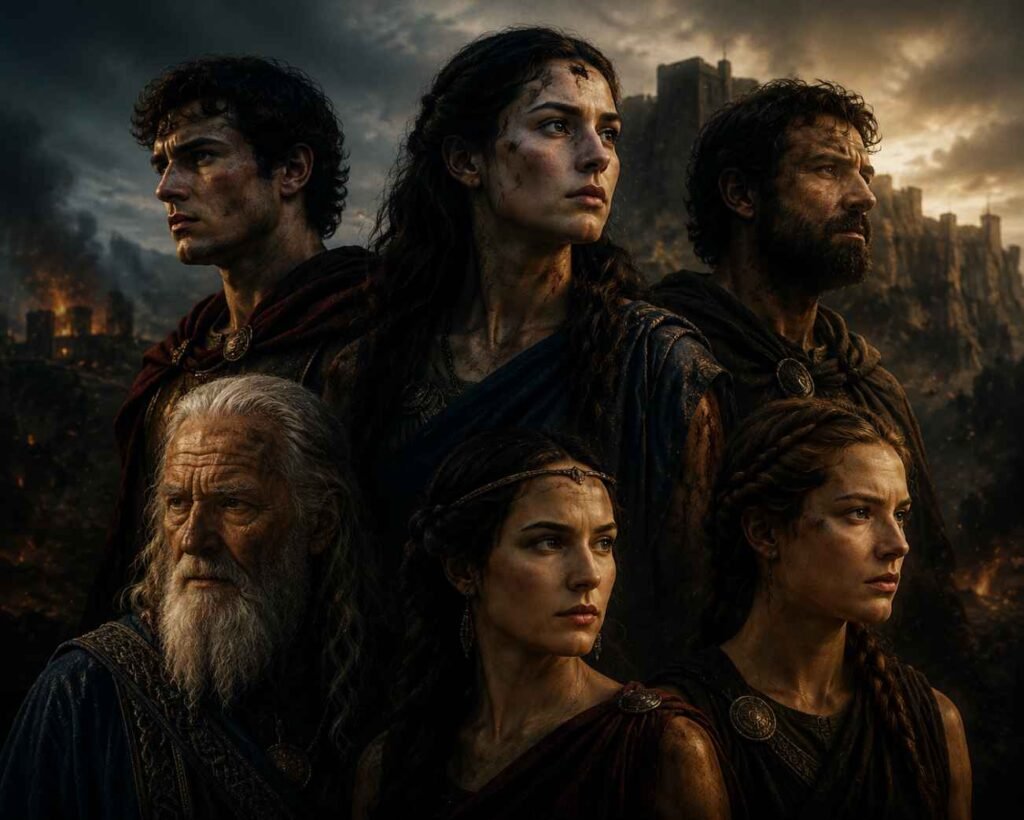
The we who will die characters are the engine of everything, and Marsh writes them with the kind of specificity that makes them feel like people you’ve been avoiding at parties because they make you feel too much.
Seren
The character most readers bond with first. She’s meticulous, emotionally guarded, and genuinely believes in the Covenant at the novel’s opening. Her arc is the most classical of the three: a believer’s loss of faith. What makes her interesting is that Marsh refuses to make her conversion triumphant. Seren doesn’t become a revolutionary. She becomes something messier and more honest.
Oryn
oryn is the harder to like and is probably the more important character for it. He’s been radicalized by two years in the Wilds, and not in a flattering way. He’s willing to do things Seren wouldn’t. The novel asks whether his methods are justified and then refuses to answer cleanly.
Calla
calla carries the historical weight of the book. She’s the character who holds the knowledge, and the we who will die characters structure essentially positions her as both a mentor figure and a walking indictment of the society around her.
Her chapters are the most stylistically distinct: written in a fragmented, archival voice that reads like a document rather than a narrative.
Marsh’s refusal to give any of the three leads a clean arc is a good example of what separates a memorable character from a functional one, a distinction covered in how to create believable fictional characters that readers remember.
Secondary characters include Seren’s supervisor Hadrin, who Marsh writes with genuine ambiguity. Hadrin is complicit in the system but not cartoonishly cruel, which is the more uncomfortable choice and the right one.
We Who Will Die Themes: What the Book Is Actually About
The we who will die themes operate on several frequencies at once. Readers who stay at the surface level read it as a dystopia about death and state power. That reading is valid. But the we who will die themes go considerably deeper.
The archive as resistance.
Marsh builds the entire plot around the act of recording. Seren’s job is to archive declarations. Calla’s act of resistance is writing an unauthorized history. The novel argues, consistently, that who controls the record controls the meaning of lives. This is not a subtle theme, but Marsh earns it through specificity rather than sloganeering.
Complicity and comfort.
The majority of Valdris’s citizens accept the Covenant not because they’re coerced but because it offers them something: belonging, meaning, a story about sacrifice that makes their society feel noble. Marsh doesn’t let the reader off the hook here. The we who will die themes include a sustained examination of how ordinary people participate in harmful systems without ever committing a single dramatic act of cruelty.
That gap between quiet personal complicity and the larger system it upholds is a clean illustration of internal conflict vs external conflict operating at the same time rather than in sequence.
The body as political territory.
The Covenant is, at its core, a claim that society has a legitimate right to your body at a certain age. Marsh is in conversation with a long tradition of feminist and disability scholarship on bodily autonomy, which JSTOR’s archive of feminist theory journals documents extensively. You don’t need to have read that scholarship to feel what the novel is doing, but having read it makes certain scenes land harder.
Exile as truth-telling.
Oryn’s chapters from the Wilds function as a kind of parallel text. The people living outside the Covenant’s boundaries have built something different, not better in every way, but different. The novel uses exile as a lens for seeing what gets defined as civilized and why.
We Who Will Die Age Rating: Who Should Read This?
The we who will die age rating question comes up often in small-press literary communities because the book deals with medically assisted dying as a state mandate, coercion, and some scenes of physical confrontation. None of it is gratuitous.
Marsh writes violence the way Le Guin did: present but not dwelt upon, consequences foregrounded over spectacle.
My honest we who will die age rating assessment is 16 and up for confident readers, 18 and up as a general recommendation for readers who need some context or emotional scaffolding around the themes.
The book isn’t graphic in a conventional sense. But the emotional weight of certain scenes, particularly Calla’s backstory and the Covenant Ceremony sequences, is genuinely heavy. A parent reading alongside a teenager would have a lot to talk about.
The we who will die age rating isn’t the kind of thing Cairn Gate Press has officially set, which is typical of small-press literary fiction. The conventions of YA rating systems don’t really apply to books aimed at adult literary audiences.
We Who Will Die Plot: The Three-Act Architecture
The we who will die plot breaks into three roughly equal parts, though Marsh doesn’t label them that way.
The first section, spanning roughly the first 110 pages, establishes the Covenant’s mechanics through Seren’s eyes. You learn the world through her daily work. The prose is restrained, almost clinical, which is a deliberate mirror of Seren’s own emotional state.
Oryn’s first chapter arrives on page 34 and immediately introduces a different temperature: riskier, angrier, louder.
The middle section is where the we who will die plot accelerates. Seren discovers that 17 of the 43 declarations she’s archived in the current cycle contain identical phrasing, word for word, in sections that are supposed to be personal and unscripted.
Someone is writing the declarations for citizens who may not be choosing freely. This discovery is the novel’s inciting complication, late by conventional thriller standards but perfectly timed for the kind of book this actually is.
Oryn finds his sister. She has already completed the Covenant. The grief of that revelation shapes everything he does in the final third.
Calla’s hidden history is discovered by Covenant authorities in the we who will die plot’s climax, which forces all three characters into a single night of decisions that the novel refuses to resolve with a clean resolution. More on that below.
We Who Will Die Ending Explained
The we who will die ending explained is the thing people search for most, so here it is, clearly. This section contains full spoilers.
In the novel’s final 30 pages, Calla’s archive is seized by Covenant authorities. Calla is offered a choice: renounce the archive publicly and live out her remaining years under house supervision, or be treated as an exile and expelled. She chooses expulsion.
This is not framed as heroic in the conventional sense. Marsh writes Calla’s choice with exhaustion and clarity, not triumph. Calla is 58. She knows what the Wilds are. She goes anyway.
Seren, rather than exposing the forged declarations officially, makes copies of the archive before it’s seized and distributes them through the Refuser network. She remains inside the system. She doesn’t defect. The novel ends with her still at her archivist’s desk, recording a new cycle of declarations, but the last declaration she records in the final pages belongs to someone who has clearly written their own words. It’s unsigned. Seren doesn’t report it as anomalous.
Oryn leaves Valdris again, voluntarily this time. His final chapter is the shortest in the book: 4 pages, no dialogue. He walks back into the Wilds. The novel implies he’s going to help build something, though it never specifies what.
The we who will die ending explained in terms of what Marsh is arguing: she does not believe in clean liberation. The we who will die ending explained in terms of what it leaves with the reader: the sense that change is slow, partial, unglamorous, and worth doing anyway. If you came looking for a revolution, the ending will frustrate you. If you came looking for a novel that tells the truth about how resistance actually works, the ending will stay with you.
“Small-press literary fiction is often where the most formally adventurous, politically honest work is being done, precisely because no one has to make it commercially palatable. The books that come out of places like Cairn Gate aren’t trying to be options; they’re trying to be necessary.”
This perspective reflects a broader consensus among small-press advocates at outlets like Publishers Weekly, which has documented the growth of independent literary publishers consistently since 2018.
We Who Will Die Series Order: Is There More?
The we who will die series order question has a short answer: as of now, the we who will die book is a standalone. Marsh has not announced a sequel, and the ending, as described above, doesn’t demand one. The Remnant world feels fully realized rather than artificially truncated, which is the hallmark of a standalone done right.
That said, Cairn Gate Press confirmed in a newsletter that Marsh is working on a second novel set in a different world. The we who will die series order is not being extended for this book. If that changes, Cairn Gate’s mailing list will be the first to know, and small-press book communities on platforms like Goodreads have active threads tracking it.
If you finished the we who will die book and are hunting for something to fill the gap, the we who will die series order isn’t the answer right now. But the comparable titles table above will keep you busy.
We Who Will Die Book Review: An Honest Assessment
A we who will die book review has to be honest about who this book is for and who it will frustrate, because the split is real.
If your preferred reading involves plot-forward pacing, high action sequences, or a protagonist who wins in a recognizable sense, the we who will die book will test your patience. This is not a criticism of those preferences. It’s just calibration. The book’s first 80 pages move slowly even by literary fiction standards.
If, on the other hand, you’re drawn to fiction that asks structural questions about society through intimate character work, the we who will die book delivers at a level that most debut novels, traditionally published or not, simply don’t reach.
Marsh’s prose is precise without being cold. Her world-building is embedded in behavior rather than explained through exposition, which is harder to do and more satisfying to read.
My we who will die book review would give it a strong 4 out of 5. The single reservation is the middle section, where the Seren chapters occasionally become repetitive in their interiority. Marsh circles certain thoughts in Seren’s mind slightly too many times before moving forward. It’s a minor critique of an otherwise impressive debut.
The we who will die book review conversation online has generally landed in the same place. The book holds a 4.1 average across literary reading communities, which for a debut small-press novel is genuinely strong. The we who will die book review discourse is notably free of the polarization that often follows literary fiction with political undercurrents. That’s either a sign of readership self-selection or a sign that Marsh’s even-handedness earned broad respect. Probably both.
We Who Will Die Book Explained: The Original Framework
The we who will die book explained through a single critical lens won’t capture it. What I’d offer instead is what I’m calling the Archive-Exile-Return Pattern, which is the structural logic Marsh uses throughout.
Every significant moment in the we who will die book explained through this pattern involves one of three movements: something is recorded (archive), something or someone is pushed outside the official story (exile), or something returns to disrupt the record (return).
Seren archives. Oryn is exiled and returns. Calla was erased from official history and has spent decades returning herself to the record through her writing. Even the unsigned declaration at the novel’s end follows the pattern: someone whose authentic voice was exiled from the official declaration format manages to return it to the page.
Once you see the Archive-Exile-Return Pattern, the we who will die book explained with that framework becomes remarkably coherent. It also clarifies why the we who will die ending explained the way it does feels right rather than incomplete. The ending doesn’t resolve the Covenant. It performs a return: one authentic voice, one unforged declaration, quietly let through by an archivist who has changed her relationship to the record.
How to Read the We Who Will Die Book: A Practical Checklist
These are the things that will genuinely improve your reading experience:
- Read the first 40 pages without stopping to assess whether you “like” it. The book earns its setup, but only in retrospect.
- Pay attention to the formatting shifts in Calla’s chapters. They look like archival documents. That’s intentional and matters for the ending.
- Track the specific language used in Covenant declarations. The forged ones have a pattern. Spotting it before Seren does is its own reward.
- Don’t skip Oryn’s chapters even if his early arc seems separate from the main story. His timeline converges in the second half and his perspective reframes everything you thought you understood about Seren’s world.
- Sit with the final page for a minute before closing the book. Marsh puts something specific into Seren’s final action that a fast reader will miss.
We Who Will Die Summary and Final Thoughts
The we who will die book is a precise, patient, morally honest debut that earns its ambition without announcing it.
Marsh builds a world designed to ask what counts as a life worth recording, who gets to decide, and what quiet acts of resistance are available to people who aren’t built for revolution.
The we who will die summary, as compressed as any summary must be, can’t fully account for how the book feels to live inside for its 290 pages.
The we who will die plot is slower than the genre packaging might suggest and more rewarding for it. The we who will die characters are drawn with enough contradiction to feel real. The we who will die themes hold up under scrutiny.
The we who will die ending explained isn’t a cheat or a cop-out: it’s a choice by a writer who respects how change actually works. The we who will die age rating skews toward adult readers, though mature 16-year-olds would get something powerful from it. The we who will die series order is currently one book, standing alone, which is the right call.
If you read small-press literary fiction and you haven’t picked this one up yet, the question worth sitting with is: what story are you willing to let into your record?