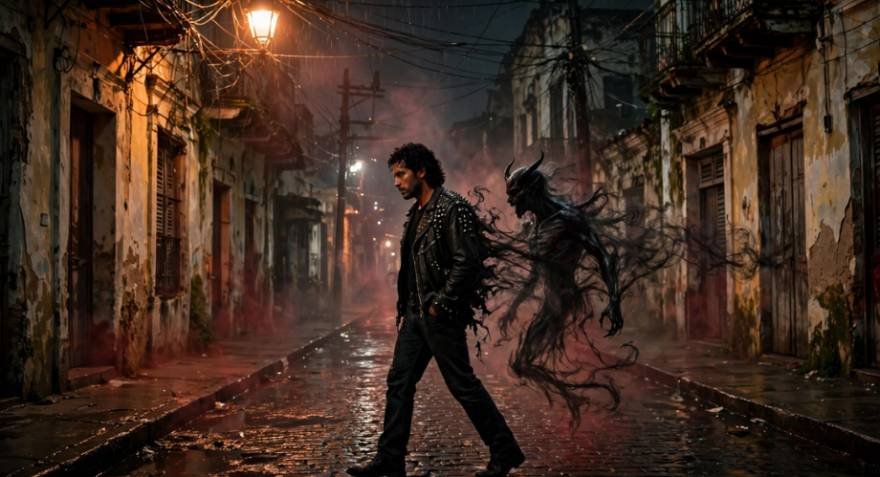
A fading demon, an aging Dominican metal star, black magic, dictatorship scars, and a week of stolen bodies should not fit neatly inside one novel. Rita Indiana seems uninterested in neatness anyway. My asmodeus rita indiana book review finds its strongest idea in that chaos: possession becomes a way of asking who gets forced to carry history inside their body.
Translated from Spanish by Achy Obejas, Asmodeus is scheduled for U.S. publication by Graywolf Press on September 1, 2026. Graywolf lists the novel at 224 pages and describes it as a supernatural noir set in 1992 Santo Domingo.
That compact length matters. Indiana appears to be building something closer to a distorted concept album than a sprawling historical novel.
What Is Asmodeus by Rita Indiana About?
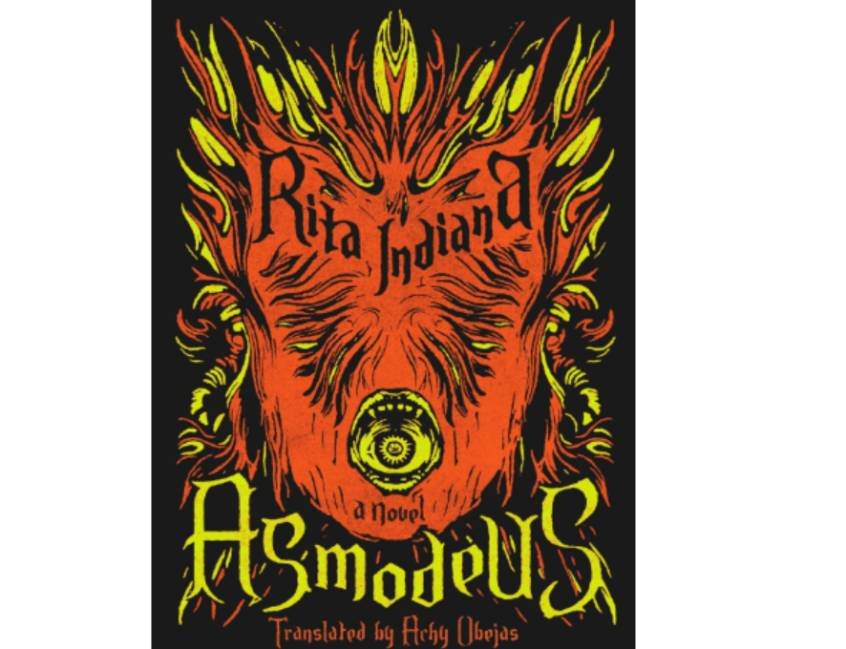
Image Credit: Amazon
At the center of the story is Asmodeus, a demon who has existed for thousands of years. For decades, he has inhabited Rudy Caraquita, a once-famous Dominican heavy-metal musician.
Then his powers begin to fail.
When Rudy is incapacitated by a severe post-cocaine migraine, the demon leaves his familiar host. What follows is a frantic week across Santo Domingo. Asmodeus passes through different bodies while searching for stability.
Among those lives are Guinea, a young metalhead plotting a warehouse robbery, and Mireya, whose family history connects directly with political violence. Graywolf describes each possession as another opening into a city still living with the consequences of the Balaguer dictatorship.
That makes the plot of this asmodeus rita indiana book review far more interesting than a conventional possession story. The demon does not merely invade characters. He exposes the histories already occupying them.
A Demon Is the Perfect Guide to This Santo Domingo

The cleverest choice here may be Indiana’s refusal to anchor the story inside one respectable narrator.
Asmodeus moves through musicians, criminals, survivors, descendants, and people positioned around Santo Domingo’s margins. The result is a city seen through unstable identities.
Body-Hopping Turns Plot Into Political X-Ray
Most body-swapping stories use possession to create suspense or confusion. Indiana appears to use it almost diagnostically.
Every new body carries different memories, vulnerabilities, loyalties, and relationships to political violence. The supernatural mechanism therefore lets the novel cross social boundaries without pretending those boundaries do not exist.
That gives my asmodeus rita indiana book review its central interpretation: the demon is less frightening than the history waiting inside each host.
The technique also prevents dictatorship from becoming distant background information. Political history surfaces through damaged bodies, family relationships, neighborhoods, music, and memory.
Why Asmodeus Becoming Tender Matters
There is another twist that makes the premise stranger.
The demon develops tenderness toward the humans he occupies.
That reversal interests me more than straightforward demonic evil. Asmodeus begins as the invader, yet contact with human lives seems to make him more emotionally vulnerable.
Possession usually erases humanity. Here, possession may teach humanity.
That irony gives Indiana room to ask an uncomfortable question: what if an ancient demon can learn compassion more easily than political systems can?
Heavy Metal, Décimas, and Rita Indiana’s Style

Music is not decoration in this novel.
Indiana is also a musician, and Graywolf describes the prose as urgent and punctuated by original décimas. These are ten-line rhyming poems connected to Latin American musical and oral traditions.
The combination initially sounds contradictory. Heavy metal favors amplified aggression. The décima carries a much older poetic and oral inheritance.
Put them together, however, and they create an intriguing formal argument.
Metal represents rebellion, distortion, volume, and youthful counterculture. The décima represents memory moving through established cultural forms. One looks toward rupture; the other preserves continuity.
For me, that tension is a major reason this asmodeus rita indiana book review stands apart from a basic supernatural-thriller assessment. Indiana seems to make form perform the novel’s historical conflict.
Readers exploring other stylistically ambitious Graywolf fiction from 2026 may also want whyteface a igoni barrett book revi, which approaches identity and social perception through a very different comic and political lens.
Political Trauma Beneath the Supernatural Noir
The novel’s 1992 setting places Santo Domingo after some of Joaquín Balaguer’s most oppressive years in power, but not beyond their consequences.
Publishers Weekly specifically highlights the book’s engagement with Balaguer’s legacy and notes that Rudy carries physical evidence of political violence. The review describes the novel as vivid, though sometimes uneven in its formal movement.
That historical dimension prevents the supernatural material from functioning as escapism.
A demon moving between bodies becomes almost literal political symbolism. Dictatorships end on calendars long before they disappear from families, institutions, neighborhoods, and bodies.
This is where the asmodeus rita indiana book review becomes less about deciding whether the demon is convincing and more about asking what he reveals.
Asmodeus is ancient, but dictatorship creates its own kind of haunting.
Achy Obejas and the Translation
Translation deserves attention because rhythm appears central to the book.
Achy Obejas translates Asmodeus from Spanish. Graywolf identifies Obejas as a poet, novelist, and translator whose honors include support from United States Artists, the National Endowment for the Arts, and the CINTAS Foundation.
A novel combining slang, metal culture, oral traditions, poetry, black magic, and Dominican political references creates unusual translation demands.
The task is not simply carrying information from Spanish into English. Tone, speed, humor, rhythm, and cultural texture must survive too.
That makes Obejas’s role particularly significant in any English-language asmodeus rita indiana book review. The translation must preserve the novel’s noise without flattening its history.
What Works—and What May Divide Readers
The strongest feature appears to be Indiana’s willingness to make structure part of meaning.
Multiple bodies create multiple angles. Poetry interrupts conventional prose. Metal collides with traditional forms. Political memory coexists with occult absurdity.
Readers attracted to similarly unconventional contemporary fiction may also want to explore the Earth 7 Deb Olin Unferth book review, which examines another 2026 Graywolf release that uses speculative elements and an unusual narrative framework to approach larger questions about humanity and the world it inhabits.
That combination should reward readers who enjoy fiction that refuses a single genre.
The same quality could frustrate readers seeking a clean thriller.
Publishers Weekly calls the novel vivid but uneven and notes that its formal shifts can feel jarring. I can understand that response. Constant changes in perspective, poetic interruptions, and compressed pacing may create deliberate instability without always creating smooth reading.
Yet complete smoothness would arguably weaken this particular novel.
A story about possession, trauma, fractured memory, and political afterlives probably should feel slightly possessed itself.
Who Should Read Asmodeus?
I would put this book in the hands of readers who enjoy literary fiction with genre machinery underneath it.
Fans of supernatural noir, Caribbean literature, translated fiction, political allegory, experimental narration, or music-driven prose have obvious entry points.
Readers who enjoy seeing how geography and local culture shape distinctive literary voices can also explore Pacific Northwest writers to read, where speculative fiction, environmental themes, Indigenous storytelling, working-class life, and regional identity take the conversation in a very different American direction.
Readers expecting conventional horror may find the political material more prominent than expected. Readers seeking conventional historical fiction may find the demons and black magic equally disruptive.
That genre instability is precisely why this asmodeus rita indiana book review lands positively for me.
The book seems most exciting when it refuses to choose between literary seriousness and pulp energy.
The Devil Gets the Last Riff
A demon losing his powers could have produced a clever supernatural adventure and nothing more. Indiana appears to use that premise for something sharper.
The bodies Asmodeus enters become archives. Heavy metal becomes political noise. Traditional poetry carries memory. Even tenderness becomes strange when it arrives through a creature built to possess others.
My final take in this asmodeus rita indiana book review is simple: the novel looks designed for readers who like their political fiction loud, strange, formally restless, and unwilling to behave.
If you prefer perfectly orderly narratives, approach with caution. If you enjoy books that make disorder meaningful, put the September 1, 2026 release on your reading list.
Frequently Asked Questions
1. What is Asmodeus by Rita Indiana about?
It follows a weakening ancient demon moving between bodies in 1992 Santo Domingo while confronting political memory and human vulnerability.
2. Is Asmodeus a horror novel?
My asmodeus rita indiana book review places it closer to supernatural noir and literary political fiction than conventional horror.
3. Who translated Asmodeus into English?
Achy Obejas translated Rita Indiana’s novel from Spanish for Graywolf Press.
4. When is Asmodeus by Rita Indiana released?
Graywolf Press lists the U.S. publication date as September 1, 2026.