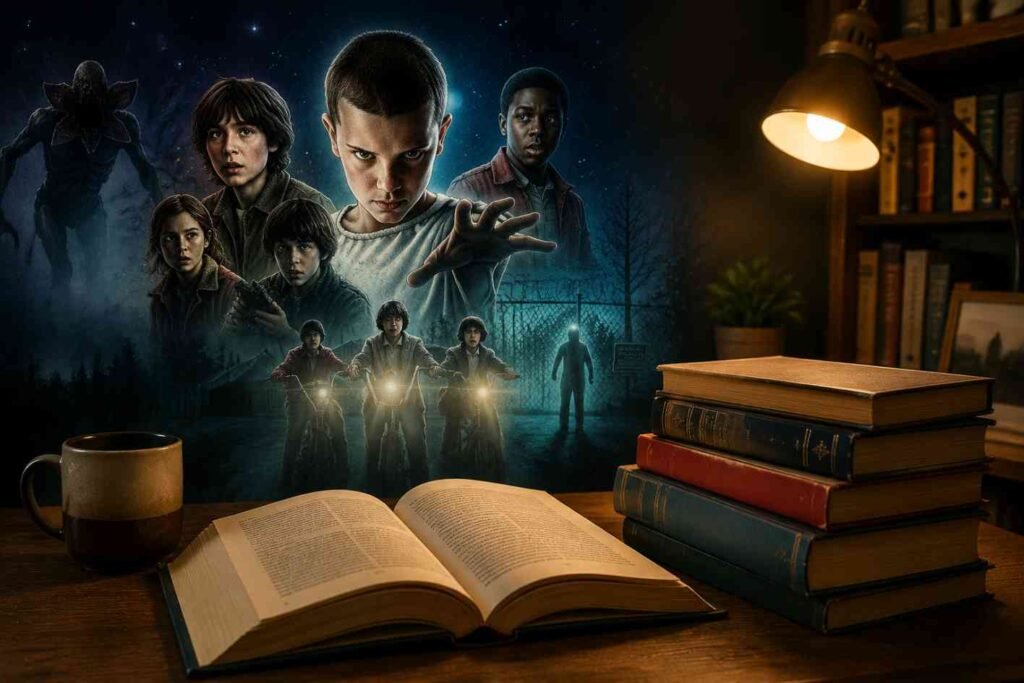
No, Stranger Things was not a book first. The Duffer Brothers wrote it as an original screenplay, which surprises a lot of people who assume every major Netflix phenomenon must have been adapted from a novel sitting on a library shelf somewhere.
But the full picture is way more interesting than a simple yes or no. The show pulls heavily from specific novels, films, and documented government programs, and an entire ecosystem of official stranger things books, comics, and tie-in fiction has grown around it since 2016. If you care about small press fiction, literary origins, or what to read after you finish a binge, this is where the real story lives.
Is Stranger Things Based on a Book? The Origins Explained
The Duffer Brothers, Matt and Ross, developed Stranger Things as a wholly original concept. So the answer to was stranger things a book first is a clean no. They pitched it as a limited series, not as an adaptation. The stranger things original story emerged from a creative brief that blended 1980s genre fiction, Cold War paranoia, and experimental government research into a single Midwest horror-adventure.
That said, calling it purely original would be misleading. The show is one of the most heavily referential pieces of pop culture produced in the past decade, and the Duffer Brothers have been completely open about their influences. Stephen King’s novels, particularly It and Firestarter, shaped the tone and the child-protagonist structure almost directly. D.H. Lawrence’s energy is nowhere near this show, but the spirit of King’s suburban American dread absolutely is.
So when people ask what is stranger things based on, the honest answer involves a long reading list rather than one source text. That reading list is what makes the show so rich, and it’s also what gives small press and literary readers a genuine entry point into the conversation.
Is Stranger Things Based on a True Story?

Here’s where it gets genuinely eerie. The Hawkins National Laboratory and the MKUltra-style experiments on children that drive the show’s plot are not pure fantasy. Is stranger things based on a true story in a literal sense? No. But the show draws directly from the CIA’s real Project MKUltra, a documented series of mind control experiments that ran from the early 1950s through the late 1960s. Declassified CIA documents confirm that experiments involved hallucinogenic drugs, sensory deprivation, and in some cases, children and unwitting civilians.
The sensory deprivation tank that Eleven uses to access the Upside Down maps almost directly onto the isolation tank research conducted by John C. Lilly in the 1950s and later popularized in academic and countercultural circles.
The Duffer Brothers have cited this research in interviews. So the stranger things source material is partly historical record, partly literary canon, and partly original invention. That’s a rarer combination than it sounds.
A thread on the Stranger Things subreddit maps out dozens of specific MKUltra parallels in the show’s plot, and the level of detail users have catalogued there is striking.
“The show is basically a Stephen King novel, a Spielberg film, and a congressional MKUltra hearing report thrown into a blender. The Duffer Brothers understood that the 1980s child was a specific cultural creature, and they wrote to that creature with real precision.”
— Angelica Jade Bastien, film and television critic, writing for Vulture
The Stranger Things Book Adaptation Question
Since there was no source novel, there is no traditional stranger things book adaptation in the way you’d get with, say, The Handmaid’s Tale or Gone Girl. The traffic flows the other direction. The show became so massive that an entire category of official prose and comics has been built outward from its world. This is increasingly common with prestige television, and it raises genuinely interesting questions for small press readers about what counts as primary text and what counts as ancillary merchandise.
The official fiction that exists is not throwaway content. Some of it is legitimately well-crafted, and understanding is stranger things a book series now requires knowing what actually exists in print form.
Stranger Things Novels in Order

The official stranger things tie-in books are published through Del Rey Books and are positioned as canon-adjacent prose expansions. Here’s a clear breakdown of the main novels and their release sequence.
| Title | Author | Year | Setting / Focus
|
|---|---|---|---|
| Suspicious Minds | Gwenda Bond | 2019 | Terry Ives / Eleven’s origin story |
| Darkness on the Edge of Town | Adam Christopher | 2019 | Hopper’s past in New York City |
| The Other Side | Jody Houser | 2019 | Will’s perspective inside the Upside Down (graphic novel) |
| Runaway Max | Brenna Yovanoff | 2019 | Max’s backstory before Hawkins |
| Tomb of Ybwen | Greg Pak | 2022 | Post-Season 4 adventure (graphic novel) |
If you’re approaching these as stranger things novels in order of internal chronology rather than publication date, start with Suspicious Minds since it’s the earliest story by timeline, set in 1969. Then move to Darkness on the Edge of Town, which covers Hopper’s 1984 New York period. Runaway Max runs parallel to Season 2, and the graphic novels sit in and around specific season events.
My honest read: Suspicious Minds is the only one I’d recommend to someone who reads literary fiction seriously. Gwenda Bond actually writes Terry Ives as a fully realized person rather than a plot device, and the MKUltra sequences have a chilling procedural quality the show never quite matched.
That distinction, a fully realized person instead of a device, is the exact line separating memorable characters from functional ones, covered in how to create believable fictional characters that readers remember.
Stranger Things Comics in Order
Dark Horse Comics holds the official comics license and has produced several miniseries. The stranger things comics in order of publication run like this:
- Stranger Things (2018, 4-issue miniseries) by Jody Houser and Stefano Martino, retelling Season 1 from Will’s point of view inside the Upside Down.
- Stranger Things: SIX (2019, 4-issue miniseries) exploring the backstory of Francine, another Hawkins Lab test subject.
- Stranger Things: The Tomb of Ybwen (2021, 4-issue miniseries) by Greg Pak, a standalone Upside Down adventure.
- Stranger Things and Dungeons & Dragons (2020, 4-issue miniseries) co-published with Wizards of the Coast, set during Season 1.
- Stranger Things: Season 1 graphic novel adaptation (2021), collecting the original miniseries into a single volume.
The SIX series is the most interesting from a small press and literary standpoint because it creates a genuinely new character and expands the mythology rather than retelling existing story beats. If you’re selective about which of these you spend time with, that’s the one.
Chart data sourced from Goodreads community ratings as of mid-2024. View the full Stranger Things series page on Goodreads.
What Is Stranger Things Based On? The Literary DNA
The stranger things source material conversation gets genuinely fascinating when you trace the specific novels that shaped the Duffer Brothers’ vision. They’ve named their influences in enough interviews that you can build a real reading list.
These are not vague thematic nods. Some scenes in the show read almost as direct homages to specific passages.
The most direct literary ancestors include Stephen King’s Firestarter (1980), which features a girl with psychokinetic powers produced by government experimentation on her parents, It (1986) for the group of misfit kids fighting a supernatural evil, and The Body (1982) for the elegiac coming-of-age tone. Richard Matheson’s I Am Legend contributes the “entire town as horror setting” architecture.
Then there’s Anne McCaffrey’s Dragonriders of Pern and Ursula K. Le Guin’s work, which the Duffer Brothers have cited as formative in terms of world-building with emotional stakes at the center.
Le Guin’s influence shows up directly in small press fiction too We Who Will Die cites her as a primary touchstone for building a fully realized speculative world around character rather than spectacle.
On the film side, the debts to John Carpenter’s The Thing, Steven Spielberg’s E.T., and Wes Craven’s early work are equally direct. This is a show made by people who read and watched obsessively, and that specificity of reference is exactly what gives it texture that more generic genre television lacks.
Is Stranger Things a Book Series Now?
Technically, yes. Between the Del Rey novels and the Dark Horse comics, there are enough volumes that is stranger things a book series has a genuine answer. It’s not a book series in the traditional sense, where the printed fiction came first and drove the adaptation. It’s a television property with a substantial print extension.
That distinction matters for small press readers. The novels and comics are licensed products, which means they went through a very different editorial and creative pipeline than a novel written from a personal artistic vision. That’s not a condemnation. Suspicious Minds is a real novel by a real novelist with real craft behind it. But you should go in knowing what you’re reading.
The distinction being drawn here, licensed tie-in prose versus a novel written from personal vision, maps closely onto what makes a book a novel in the first place, which separates the form from the object producing it.
The more interesting is stranger things a book series question might be whether future creative extensions will push the prose further toward literary territory. Given that Netflix has invested in literary adaptations more broadly, there’s a reasonable case that the Stranger Things universe has room for more ambitious standalone fiction tied to its world.
Books Like Stranger Things: A Reading Guide
If the show’s blend of supernatural horror, 1980s nostalgia, and government conspiracy is what you’re chasing, these novels scratch that itch in ways the official tie-ins don’t always reach. This is where small press readers and literary fiction people can find genuinely rewarding entry points.
- Firestarter by Stephen King (1980) — The most direct literary ancestor of Eleven’s story. Government experiments, a girl with pyrokinesis, a father on the run. Read it and you’ll see exactly where the Duffer Brothers were working from.
- The Institute by Stephen King (2019) — King practically wrote this in direct conversation with Stranger Things: children kidnapped for their psychic abilities, a shadowy institutional setting, and a kid who escapes and fights back. It was published three years into the show’s run.
- Mexican Gothic by Silvia Moreno-Garcia (2020) — Atmospheric horror with a strong period setting and a protagonist uncovering something genuinely sinister behind a respectable facade. The tone matches.
- The Naturals series by Jennifer Lynn Barnes — Government-adjacent teens with unusual abilities solving crimes. Younger on the age range but structurally very close to what Stranger Things does with its ensemble.
- A Head Full of Ghosts by Paul Tremblay (2015) — Skeptical, literary horror with an unreliable narrator and a reality that may or may not contain the supernatural. More demanding than most books like stranger things recommendations, and worth it.
My personal pick from this list for a small press and literary fiction readership is Tremblay’s novel. It does what the best horror fiction does: uses the genre to pressure-test questions about perception, family, and media that straight realist fiction would handle more timidly.
How to Navigate the Stranger Things Extended Universe: A Reader’s Checklist
If you want to work through the full range of official Stranger Things print material without wasting time on weaker entries, here’s a practical sequence.
Start here if you want prose fiction:
- Read Suspicious Minds by Gwenda Bond. It’s the strongest novel and the most self-contained.
- Follow with Runaway Max by Brenna Yovanoff if you want more character-focused YA-adjacent prose. It’s genuinely readable.
- Skip Darkness on the Edge of Town unless you’re a serious Hopper fan. It’s competent but the slowest of the three novels.
Start here if you want comics:
- The original 2018 miniseries (collected as Stranger Things Vol. 1) is the logical starting point since it retells Season 1 visually and efficiently.
- Move to SIX for original mythology. This is the most creatively independent of the comics.
- The D&D crossover is fun but firmly optional. It’s fan service, and it knows it.
If you just want the real literary influences behind the show:
- King’s Firestarter, then It, then The Body.
- Matheson’s I Am Legend.
- Tremblay’s A Head Full of Ghosts as a modern companion text.
Is Stranger Things Based on a Book? Final Verdict for Literary Readers
The show is not a stranger things book adaptation in any conventional sense. It is an original work so deeply embedded in literary and genre fiction that it sometimes reads like one. The stranger things original story is genuinely original, and that is arguably what makes the surrounding print material more interesting rather than less.
You’re not reading authorized novelizations of a pre-existing book. You’re reading authors given permission to expand a world that itself expanded from decades of fiction and documented history.
For readers who care about small press culture and literary fiction, the most productive move is probably to use Stranger Things as a doorway back into the texts it draws from. King’s 1980s catalog, Matheson’s Cold War horror, the MKUltra historical record, Ursula K. Le Guin’s emotionally anchored world-building. That’s the real library behind Hawkins, Indiana, and it’s deeper and stranger than any of the tie-in volumes.
The question is stranger things based on a true story has a partial yes hiding inside the mostly-no answer. And the question of whether the print extensions constitute genuine literature is one worth sitting with rather than dismissing quickly. Some of them do.
That should matter to anyone who takes fiction seriously.
What’s the novel that influenced your favorite piece of prestige television? The lineage is almost always more interesting than people expect.