
Most people use the word “novel” the same way they use “book,” which is a mistake that trips up writers, readers, and even some booksellers. A novel is not just any long book. It earns that label through a specific combination of length, form, fiction, and intent, and understanding exactly where that line sits matters more than you’d think.
This guide breaks down the novel definition in plain terms, walks through every major type of novel, clears up the confusion around novel vs paperback and novel vs hardcover, and gives you a practical framework for identifying one in the wild. By the end, you’ll know exactly what makes a book a novel, and you’ll never mix it up again.
What Is a Novel, Really? The Core Definition

The novel meaning, stripped to its bones, is this: a novel is a long work of narrative fiction written in prose. That sentence contains four non-negotiable ingredients. Long. Narrative. Fiction. Prose. Pull out any one of those and you may have something great, but you don’t have a novel.
Long means at least 40,000 words, though most published novels land between 70,000 and 100,000. Narrative means it tells a story with forward movement, cause and effect, characters who change or fail to change. Fiction means the events are invented, even if they’re rooted in real settings or history. Prose separates the novel from the epic poem, which can also be long, narrative, and fictional, but is written in verse.
The formal novel definition accepted by most publishers and literary critics reads something like: an extended work of prose fiction presenting characters and a plot. That phrasing comes out of centuries of literary history, and Britannica traces the term’s evolution from the Italian “novella” (a short tale) through the 18th-century English novel as we now know it. The word itself carried a small-press spirit from the start: short, new, circulated among readers hungry for something different from religious texts and classical epics.
So when someone asks “what is a novel,” the honest answer is: it’s the dominant literary form of the last 300 years, and it got there by being the best container humans have invented for sustained, imaginative storytelling.
Novel Size and Word Count: The Numbers That Actually Matter
Word count is the most objective piece of the novel explained puzzle, and it’s also the most misunderstood. Here’s how the industry actually categorizes prose fiction by length:
| Category | Word Count Range | Notes
|
|---|---|---|
| Flash Fiction | Under 1,000 | Scene or vignette, not a novel |
| Short Story | 1,000 to 7,500 | Single arc, compact cast |
| Novelette | 7,500 to 17,500 | Genre fiction home base |
| Novella | 17,500 to 40,000 | Novel’s smaller sibling |
| Novel | 40,000 to 110,000+ | Industry standard minimum: 50,000 |
| Epic Novel | 110,000+ | Fantasy and historical fiction common here |
Novel size varies by genre, too. A literary fiction debut typically runs 70,000 to 90,000 words. A fantasy novel can push 120,000 without raising eyebrows. A category romance often caps at 60,000. These aren’t arbitrary rules; they reflect how much space a given genre’s conventions actually need. According to Writer’s Digest’s genre-by-genre breakdown, hitting the right novel size for your category is one of the clearest signals to an editor that you understand the market.
My take: if your manuscript sits at 38,000 words and you’re calling it a novel, round it up with actual scenes, not filler. Stretching a naturally compact story past its limits hurts the book. Sometimes a 35,000-word novella is exactly what the story wants to be.
Novel Format: Print, Digital, and What It Has Nothing to Do With
Here’s the confusion that refuses to die: novel vs paperback and novel vs hardcover are not the same question. Novel format describes what kind of literary work you’re reading. Paperback and hardcover describe how it’s physically bound and sold. Those are two completely separate axes.
A novel can be published as a hardcover, a paperback, an ebook, an audiobook, or a serialized digital release. The format of the object holding the text does not change what the text is. Cormac McCarthy’s The Road is a novel whether you read it as a hardcover first edition, a mass-market paperback, or a Kindle file. The story, structure, and length are what define it as a novel.
So when you’re comparing novel vs paperback, understand that you’re comparing a content category against a physical production format. They don’t sit on the same spectrum. Novel vs hardcover is the same deal. Hardcover just means a stiff board cover and usually a higher retail price. It says nothing about genre, length, or whether the book is fiction at all.
Novel format, in the literary sense, refers to structural choices: first person or third person narration, linear or non-linear timeline, single protagonist or ensemble cast, chapter-based or section-based organization. Those choices shape the reading experience far more than whether you’re holding cloth boards or a soft spine.
What Makes a Book a Novel: The 5-Part Test
I’ve put together a simple framework I call the FLIPS Test. Run any manuscript or published book through it and you’ll know within two minutes whether it qualifies.
- F: Fiction. The events are imagined, not reported. Historical novels use real settings and sometimes real figures, but the core story is invented. Memoir, biography, and journalism are out.
- L: Length. The work clears 40,000 words, with the industry sweet spot closer to 70,000. Below that line, you’re in novella or short story territory.
- I: Invented characters. The narrative centers on characters with inner lives, motivations, and arcs. An essay collection or a collection of unconnected vignettes doesn’t qualify even if it’s long and fictional.
Getting this criterion right is harder than it sounds how to create believable fictional characters that readers remember covers what actually gives invented characters the interiority this test is checking for.
- P: Prose. The work is written in sentences and paragraphs, not verse. Epic poems can be astonishing, but they aren’t novels.
- S: Sustained narrative arc. There’s a beginning, a middle, and an end. The story builds through conflict and moves toward some form of resolution or reckoning. A loose anthology of related stories might clear every other bar but fail here.
Five out of five? You’ve got a novel. Four out of five? You’ve got something interesting but probably not a novel. And that’s fine. Some of the best books in small-press publishing resist clean categorization. But knowing where the line is helps you talk about your work accurately.
Types of Novel: A Map of the Territory
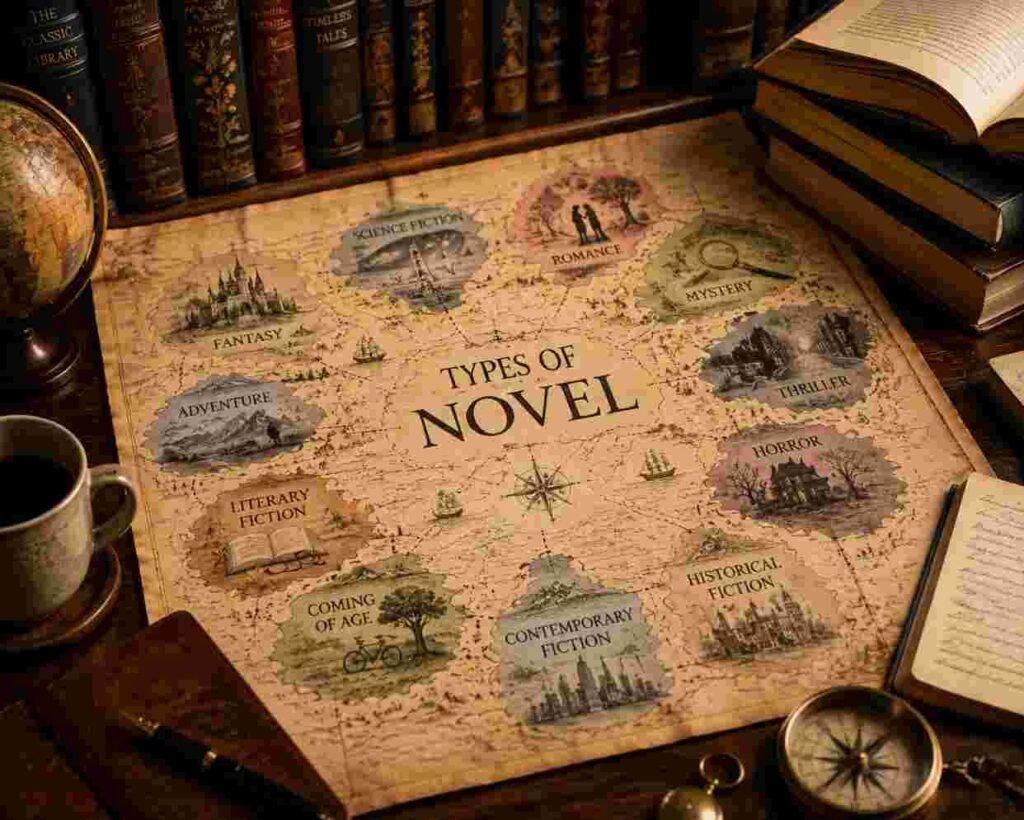
The types of novel are genuinely numerous, and different classification systems carve the territory differently. I find it most useful to separate by genre on one axis and by structure on another.
By genre:
literary fiction, commercial fiction, science fiction, fantasy, horror, mystery, thriller, romance, historical fiction, and speculative fiction each represent a distinct tradition with its own conventions, readership, and word-count expectations. Small presses often work in the genre-bending space between two or more of these.
By structure:
the epistolary novel (told through letters or documents, like Dracula), the bildungsroman (a coming-of-age story, like Jane Eyre), the picaresque (a roguish hero’s loose episodic adventures), the stream-of-consciousness novel (interior monologue as primary mode, like Woolf’s Mrs. Dalloway), the frame narrative (a story within a story), and the multiplot novel (several protagonists whose stories weave together).
The types of novel overlap constantly. Never Let Me Go by Kazuo Ishiguro is literary fiction, speculative fiction, a bildungsroman, and a frame narrative all at once. That layering is part of what makes it last.
If you’re trying to place a specific manuscript within this genre map, popular fiction genres right now breaks down what’s actually selling in each category today.
“The novel is the one bright book of life. Books are not life. They are only tremulations on the ether. But the novel as a tremulation can make the whole man alive tremble.”
D.H. Lawrence, “Why the Novel Matters,” 1936
Lawrence was making a point about novel purpose that still holds: the novel, more than any other form, has the capacity to engage the complete reader. Not just the intellect, not just the emotions, but both simultaneously, over sustained time. That’s the argument for why the form has survived every prediction of its death.
Novel Examples That Illustrate the Definition Perfectly
The fastest way to understand a definition is through concrete novel examples. Here are five that each illuminate a different dimension of what makes a book a novel.
Pride and Prejudice by Jane Austen (1813) is the classic sustained narrative example: 122,000 words, prose, fiction, invented characters, and a clear arc from misunderstanding to recognition. It hits all five FLIPS criteria cleanly.
Slaughterhouse-Five by Kurt Vonnegut (1969) shows that a novel can fracture chronology and break the fourth wall without losing its claim to the form. At 49,000 words, it sits near the low end of novel size, proving that the form doesn’t require length to justify itself.
The Secret History by Donna Tartt (1992) is a great novel example choice for small-press readers because it represents a literary commercial hybrid: smart, plotted, and long at around 200,000 words. It shows how the types of novel blur in practice.
Normal People by Sally Rooney (2018) at 66,000 words is a modern literary novel stripped of quotation marks and conventional chapter titles, yet it absolutely qualifies. Form experiments don’t disqualify a work from the novel definition if the five core criteria are met.
Piranesi by Susanna Clarke (2020) is an epistolary, fantasy, literary novel at under 90,000 words. It won the Women’s Prize for Fiction and is one of the most formally inventive novel examples of the past decade.
For a longer list of novels that hold up against this same definition, Best American Novels of All Time rounds up 15 classics worth reading with the same criteria in mind.
The Guardian’s review captures exactly why Clarke’s structural choices serve rather than obscure the story.
Novel Purpose: Why This Form Exists and Why It Still Matters
Novel purpose is a question that gets asked cynically, usually by people who’ve spent too much time with screens. But it’s worth taking seriously, especially if you’re writing or publishing one.
The novel does things no other form can. It sustains a reader’s immersion inside another consciousness for hours or days. It builds empathy through granular access to interiority, something film can gesture toward but can’t fully deliver. It creates a private experience that millions of readers share individually, which is philosophically strange and socially powerful.
For small-press publishers, novel purpose has an additional dimension: the novel is often the form where risks that commercial publishing won’t take find their home. Experimental structure, difficult subjects, unconventional narrators, niche readerships. The novel’s capacity to hold complexity without resolving it neatly is precisely what makes it the right container for serious literary work.
Novel purpose is also practical. A novelist is building a complete world with its own internal logic, and that world must sustain reader trust for tens of thousands of words. That discipline produces a different kind of artistic and intellectual rigor than any shorter form.
Novel for Beginners: How to Recognize and Read One With Intention
If you’re new to serious fiction reading, picking up a novel for beginners doesn’t mean grabbing the thinnest book on the shelf. It means choosing one that matches your current tolerance for sustained immersion and builds from there.
Here’s a practical checklist for approaching a novel for beginners with intention:
- Check the word count before you start. Most editions list page count, and prose fiction averages roughly 250 words per page. A 280-page novel is about 70,000 words. That tells you what kind of commitment you’re making.
- Read the first chapter twice. The first time you’re orienting. The second time you’re absorbing the author’s voice and the novel’s rhythm. Most readers who quit a novel do so because they never got past orientation.
- Notice whose interiority you’re inside. Whose thoughts and feelings does the narrative prioritize? That character is your guide. Understanding them is how you understand everything else.
- Track one recurring image or motif. Great novels repeat symbols, objects, or phrases with variation. Following one thread gives you an anchor when the plot gets complex.
- Don’t rush the ending. The last 50 pages of a novel are where the full weight of what came before lands. Reading them fast is like leaving a concert before the last movement.
For a first serious novel, I’d suggest starting with something around 200 to 250 pages (roughly 60,000 words) in a genre that already interests you. The novel format should serve your curiosity, not fight it. Once you’ve read two or three novels in a genre you love, the novel for beginners label falls away on its own.
What Makes a Book a Novel: Common Edge Cases and How to Call Them
The novel definition holds in most cases, but a handful of forms sit right at the boundary and deserve a clear call.
A story collection:
not a novel, even if it runs 90,000 words and all the stories share characters and a setting. Winesburg, Ohio by Sherwood Anderson is often called a novel but is more accurately a story cycle. The difference matters because story cycles don’t maintain a continuous narrative arc.
Autofiction:
this one is genuinely contested. Works like Karl Ove Knausgard’s “My Struggle” series use real names, real events, and real people, but shaped and invented enough to be called novels by their publishers. The line between autofiction and memoir is where novel meaning gets philosophically interesting. Most of the literary world calls autofiction a novel and moves on.
Graphic novels:
The name includes “novel” but the form is categorically different. A graphic novel tells a story through sequential art and text combined. It can be brilliant, serious literature. But it’s not a prose novel in the traditional sense. Treating them as equivalent flattens both forms.
Novellas:
A novella runs 17,500 to 40,000 words and typically handles one arc with a small cast. Of Mice and Men is a novella. The Old Man and the Sea is a novella. Calling them novels isn’t wrong on the street, but in publishing and criticism the distinction matters for classification, awards eligibility, and market positioning.
Where Small Press Publishing and the Novel Intersect
Small presses have always had a particular relationship with the novel. Commercial publishing optimizes for novels that fit clean genre categories and proven market sizes. Small presses often do the opposite. They publish novels that don’t fit the grid.
The novel format freedoms that small presses embrace include unconventional structures, non-linear timelines, hybrid genre works, and books that require an engaged reader rather than a passive one. That’s not a niche. According to Publishers Weekly’s coverage of independent publishing trends, independent and small presses have grown their market share consistently over the past decade precisely because readers are actively seeking out voices and forms that larger houses pass on.
Understanding what makes a book a novel matters to small-press readers and writers because the form is your primary vehicle. The novel is where the small press does its most serious work. Knowing its dimensions and definitions means you can talk about that work with precision and argue for it when someone asks why a 280-page, formally strange, genre-resistant book deserves the name novel and the serious attention that label carries.
The Practical Takeaway: A Quick-Reference Decision Guide
Use this sequence the next time you’re trying to determine whether a work is a novel or something else.
- Is it prose fiction? If no, stop here. It’s not a novel.
- Is it over 40,000 words? If no, you’re looking at a novella or shorter. Confirm before calling it a novel.
- Does it sustain a single continuous narrative, not a collection of disconnected pieces? If no, it may be a story cycle or anthology.
- Does it center on invented characters with interiority and arc? If no, check whether it’s creative nonfiction or memoir.
- Is the binding style (hardcover or paperback) influencing your answer? If yes, set that aside. Novel vs hardcover and novel vs paperback are format questions, not content questions.
Five steps, two minutes, clean answer. The novel definition isn’t complicated once you separate what the text is from how the object is produced.
What Makes a Book a Novel: The Final Word
A novel is a long work of prose fiction built around invented characters moving through a sustained narrative arc. That definition has held for 300 years because it describes something real and durable: the most capacious, flexible, and humane literary form ever invented.
Novel size matters but isn’t everything. Novel format in the literary sense shapes reader experience in ways that binding and paper stock don’t. The types of novel are varied enough to contain nearly every kind of story a human might want to tell. Novel purpose runs deeper than entertainment: it’s empathy at scale, sustained over time, experienced privately but shared across communities of readers.
For everyone writing, publishing, or reading in the small-press world, getting the vocabulary right is a form of respect for the work. So the next time someone hands you a manuscript or a finished book and asks what kind of thing it is, you’ll know exactly which questions to ask and exactly what the answers mean.
What kind of novel are you working on or reading right now, and does it fit the definition cleanly or push against it somewhere interesting?