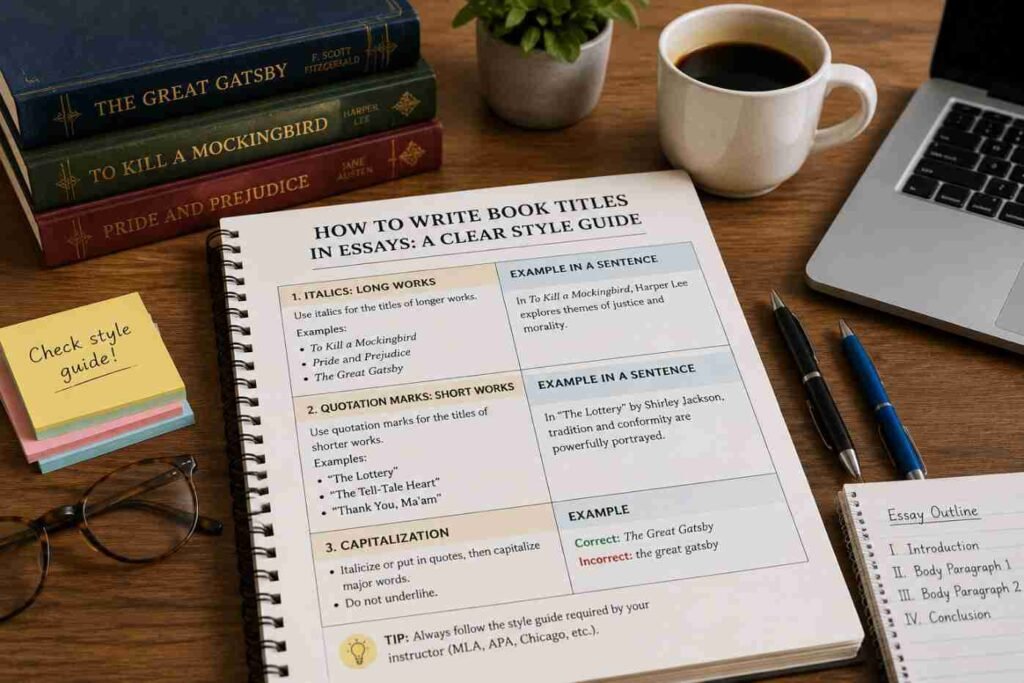
Most writers have paused mid-sentence, cursor blinking, asking themselves: do I italicize this or put it in quotes? Knowing how to write book titles in essays is one of those small things that teachers, editors, and literary journals notice immediately.
Get it wrong and your writing looks careless, even if your argument is brilliant. Get it right and it signals that you know the game. This guide covers MLA, APA, and Chicago rules, explains when italics apply versus quotation marks, and gives you a quick-reference table so you never second-guess yourself again.
Why Book Title Formatting Actually Matters in Literary Writing
Small press publishing and literary essay writing share one fundamental audience: readers who care deeply about craft. A reviewer submitting a piece to a journal like The Rumpus or Literary Hub who misformats a title signals to an editor that they haven’t absorbed professional standards. That’s a fast track to rejection, and it’s entirely avoidable.
Beyond first impressions, correct book title punctuation removes ambiguity. If you write “I loved War and Peace,” a reader might not immediately register that as a novel title rather than a description of your feelings. Formatting creates visual separation between your words and the works you’re discussing, which matters especially in criticism and essay writing where you’re constantly moving between your voice and a text’s.
The Purdue OWL MLA General Format guide remains one of the most-consulted free resources on this topic, and for good reason. It’s thorough, updated regularly, and trusted by professors and editors alike. Bookmark it now if you haven’t already.
The Core Rule: Are Book Titles Italicized?
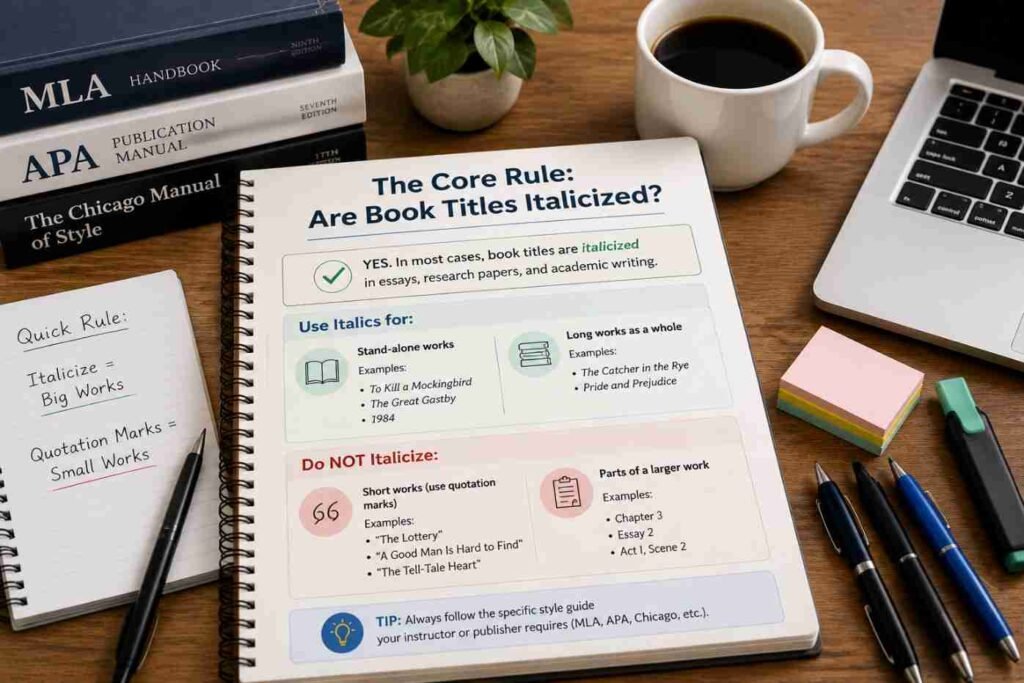
Yes. In virtually every major citation style used today, do you italicize book titles is answered the same way: absolutely. Full-length, standalone works get italics. This includes novels, memoirs, poetry collections, anthologies, and plays.
Shorter works that live inside a larger container, like individual poems, short stories, or chapters, get quotation marks instead.
So The Great Gatsby is italicized because it’s a standalone novel. “The Love Song of J. Alfred Prufrock” gets quotes because it’s a poem published inside a collection. That container-versus-component logic is the single most reliable mental model for deciding between book titles in quotation marks or italics.
Here’s where people slip up: they apply this rule inconsistently. They’ll italicize the novel in one paragraph and forget the formatting three paragraphs later.
Consistency is the actual skill. If you’re writing a long-form essay or a chapbook review, do a final pass just searching for every title to confirm each one is formatted the same way throughout.
How to Write Book Titles in an Essay by Style Guide
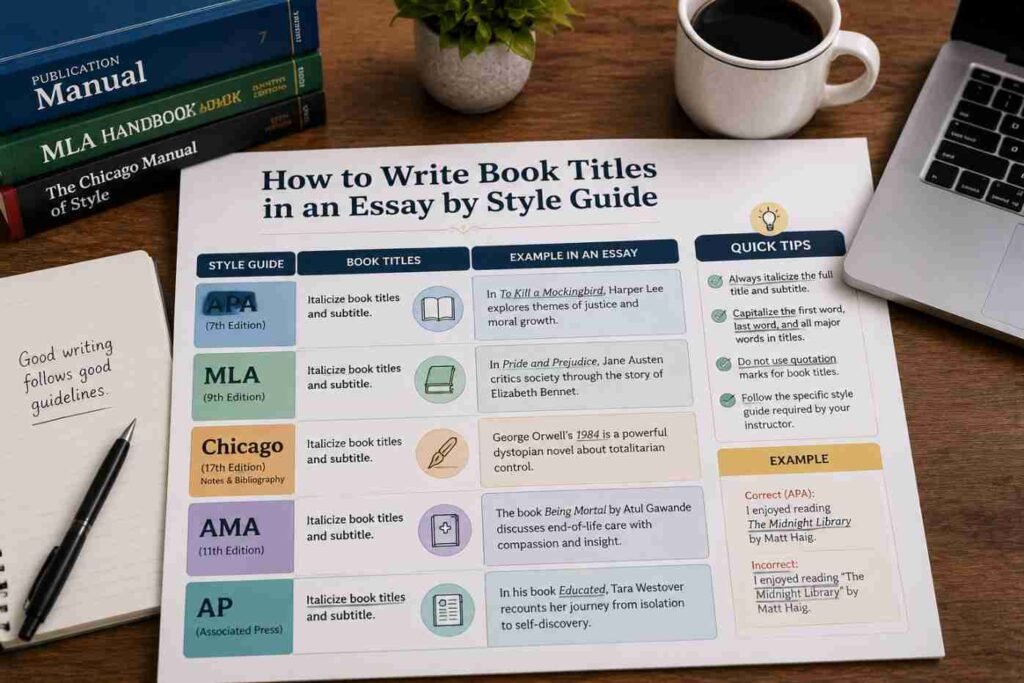
The style you use depends entirely on context. Academic essays in the humanities default to MLA. Social science and psychology writing typically follows APA. University press and trade publishing often defaults to Chicago. Here’s how each one handles titles.
Book Title MLA Format
In book title MLA format, standalone works are italicized. The title is also capitalized using title case, meaning you capitalize the first and last words plus all major words. Articles like “a,” “an,” and “the” are lowercase unless they open the title. Prepositions under five letters are also typically lowercased. So you’d write Of Mice and Men, not Of Mice And Men.
MLA does not use underlining anymore. That convention died with typewriters. If you see a style guide that tells you to underline book titles, it’s outdated. Italics are the standard, full stop.
When you’re asking how to cite a book title in an essay under MLA, the in-text citation pairs the author’s last name with a page number in parentheses: (Fitzgerald 45). The full title appears on your Works Cited page, still italicized.
Book Title APA Format
Book title APA format also italicizes standalone book titles, but the capitalization rule is different and it trips people up constantly.
APA uses sentence case for titles in your reference list, meaning only the first word, the first word after a colon, and proper nouns are capitalized. So The grapes of wrath is correct in an APA reference entry, even though it looks wrong to eyes trained on MLA.
However, and this is a detail that gets overlooked, when you mention a title in the body text of an APA paper, most style guides and the APA Style official italics guidelines indicate you still italicize it. The sentence-case rule applies specifically to your reference list entries, not necessarily to how you write a title mid-paragraph.
Chicago Style
Chicago, used widely in humanities publishing and by many small press journals, also italicizes book-length works. Its capitalization rules align more closely with MLA’s title case.
Chicago’s footnote and bibliography system means you’ll write the full title in your note the first time a source appears, then a shortened form afterward. The title stays italicized in both cases.
Are Book Chapters Italicized? The Container Rule Explained
Are book chapters italicized? No, and this distinction matters a lot in literary criticism. Chapter titles, essay titles within a collection, short story titles, individual poems, and article titles all go in quotation marks. The parent work that contains them gets italics. Think of it as the big thing gets italics, the small thing inside it gets quotes.
A practical example: you’re writing a review of a short story collection. The collection is Interpreter of Maladies by Jhumpa Lahiri. An individual story from it is “A Temporary Matter.” You’d write: In “A Temporary Matter,” collected in Interpreter of Maladies, Lahiri explores grief through quiet domestic rituals.
That structure is elegant and correct. It signals to the reader, at a glance, what’s a container and what’s a component.
This same container versus component logic is what separates a novel from a novella or short story in the first place what makes a book a novel walks through where that line actually sits. In literary essay writing, that clarity isn’t fussy, it’s considerate.
How to Capitalize Book Titles Correctly
Knowing how to capitalize book titles is genuinely style-dependent, but here’s the rule that covers 90% of cases in literary essays and criticism.
Under MLA and Chicago title case, capitalize:
- The first and last word of the title, always
- All nouns, verbs, adjectives, and adverbs
- Subordinating conjunctions like “although,” “because,” and “while”
- Prepositions of five letters or more (so “about,” “between,” “through” are capitalized)
Leave lowercase: articles (a, an, the), coordinating conjunctions (and, but, or, nor, for, so, yet), and short prepositions (of, in, on, at, by, to, up).
Under APA sentence case for reference lists, capitalize only the first word, the first word after a colon or em dash in the subtitle, and proper nouns. Everything else is lowercase. If you’re writing about how to capitalize book titles in an APA body paragraph rather than a reference entry, use title case there too since that’s what readers expect when they see a title mid-sentence.
“Students consistently confuse title case with sentence case because they look visually similar in short titles. The difference emerges in longer titles, and that’s precisely when correct capitalization matters most for readability and credibility.”
This reflects the consensus expressed by style experts across discussions on the WordReference linguistic forums,where the topic generates substantial recurring debate among professional writers and translators.
How to Punctuate Book Titles: A Quick-Reference Table
The table below summarizes how to punctuate book titles and related works across the three main style guides. All figures and conventions are drawn from current style manual editions.
| Work Type | MLA | APA | Chicago
|
|---|---|---|---|
| Novel or book | Italics | Italics | Italics |
| Book chapter | Quotation marks | Quotation marks | Quotation marks |
| Short story | Quotation marks | Quotation marks | Quotation marks |
| Poetry collection | Italics | Italics | Italics |
| Individual poem | Quotation marks | Quotation marks | Quotation marks |
| Anthology or essay collection | Italics | Italics | Italics |
| Essay within a collection | Quotation marks | Quotation marks | Quotation marks |
| Play (published as a standalone) | Italics | Italics | Italics |
| Capitalization in titles (body text) | Title case | Title case | Title case |
| Capitalization in reference list | Title case | Sentence case | Title case |
How to Format a Book Title Mid-Sentence
Knowing how to format a book title in isolation is one thing. Knowing how to handle it when it’s tucked inside a sentence is where the real work happens.
One practical question: what if the title ends your sentence? The period goes outside the closing italics. You write: She finally finished reading Beloved. Not Beloved. The period is yours, not the title’s.
What if the title is possessive? This comes up in criticism constantly. You write: Beloved‘s opening chapter establishes dread immediately. The apostrophe and “s” sit outside the italics. It looks odd the first time you see it. It’s correct.
What if a title contains another title? Rare, but it happens. If a standalone work’s title contains another standalone title, the interior title goes in quotation marks to signal the distinction. For a title that would normally use quotation marks appearing inside a larger quoted title, reverse it to single quotes. This is an edge case in literary essays but not uncommon in criticism and close reading.
Honestly, how to format a book title in tricky grammatical positions is the kind of thing you figure out once and never forget. Write it correctly twice and muscle memory takes over.
How to Write Book Titles in Essays: A Practical Checklist
Use this before submitting any literary essay, criticism piece, or academic paper.
- Confirm your style guide (MLA, APA, or Chicago) before you start formatting anything
- Italicize all standalone, full-length works: novels, memoirs, poetry collections, anthologies, full-length plays
- Put quotation marks around component works: chapters, individual poems, short stories, essays inside collections
- Apply title case capitalization in all body text mentions, regardless of style guide
- Switch to sentence case only in APA reference list entries
- Never underline a title in modern writing, this convention is defunct
- Run a search for every title in your document on a final pass and confirm consistent formatting throughout
- Check that periods and commas land outside italicized titles, not inside them
- Verify that possessives are formatted correctly (‘s outside the italics)
How to Cite a Book Title in an Essay vs. Mentioning It
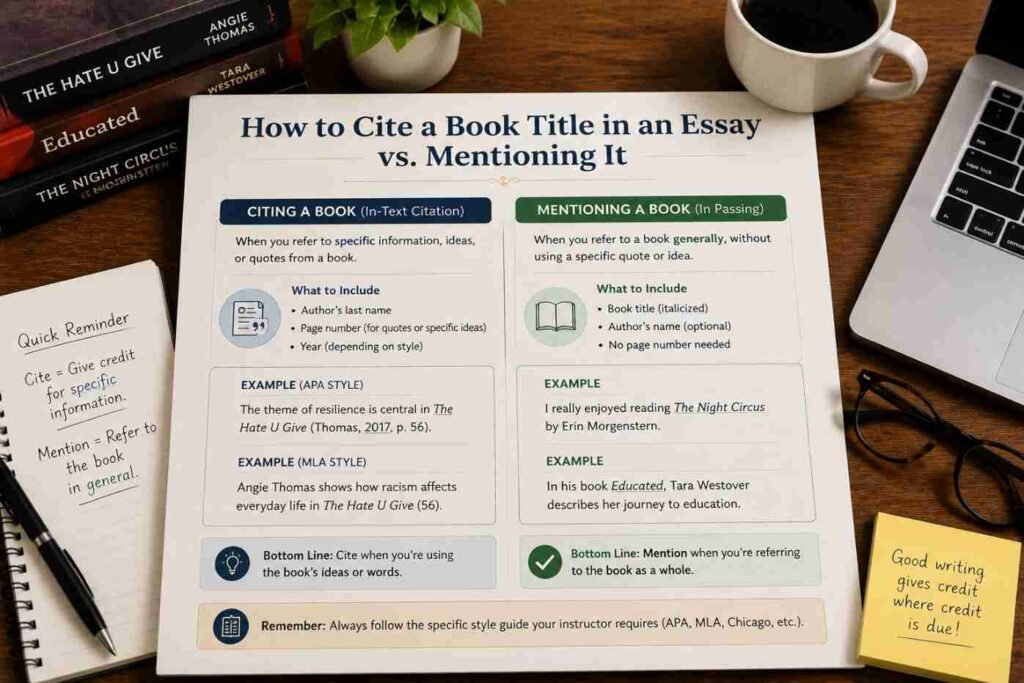
There’s a meaningful difference between mentioning a title and citing a source. Understanding how to cite a book title in an essay means understanding that citation includes both the in-text reference and the full entry in your bibliography or works cited page.
When you mention a title mid-paragraph, you’re just naming the work, formatting it correctly, and moving on. That’s not a citation yet. A citation kicks in when you quote from the text or paraphrase a specific idea from a specific page. At that point, you need the parenthetical (author, page) in MLA, or (author, year) in APA, and you need the full source entry at the end of your piece.
In literary criticism and book reviewing, which is the bread and butter of small press culture, you’ll often mention titles without formally citing them. A review doesn’t have a works cited page. An academic essay does. Know which document type you’re writing and adjust accordingly.
Writers submitting original criticism or essays to small press journals should also know their rights over that work before it’s published how to copyright a book in the U.S. covers the adjacent question of protecting your own writing once it’s out.
If you’re writing for a small press journal and they don’t specify a style guide, my honest recommendation is to default to Chicago. It’s the standard in trade publishing, literary criticism, and humanities scholarship. MLA is fine for academic essays, but Chicago reads more naturally in long-form criticism and reviews.
Common Mistakes and How to Avoid Them
The most frequent error I see in submitted essays and criticism pieces is mixing formats inside the same document. A writer will correctly italicize a novel in their introduction and then put it in quotes by page three. That inconsistency reads as carelessness more than ignorance, and it’s just as damaging to your credibility.
The second most common mistake is applying the wrong rule to book chapters. Are book chapters italicized? No. Beginners assume that because the book is italicized, the chapter must be too. It doesn’t work that way. The chapter goes in quotes. Full stop.
Third: writers often forget to format titles altogether when writing quickly. They’ll mention a book as if it’s just a noun in a sentence. In casual blog writing, maybe that slides. In a literary essay, a chapbook review, or anything going through editorial review, unformatted titles are a red flag.
And if you’re ever genuinely unsure about an edge case, the Chicago Manual of Style Q&A page on titles of works is genuinely one of the most useful free resources in editorial writing. The editors answer real questions from real writers, often with the exact edge cases that trip people up.
How to Write Book Titles in Essays When the Title Is Unusual
Some titles break the normal rules deliberately. e.e. cummings famously wrote his name in all lowercase. When a book title defies conventional capitalization by authorial intent, a genuine editorial debate exists about whether to honor the author’s choice or follow house style.
My stance: honor the author’s intention for their own name and title when writing literary criticism or reviews. If you’re writing an academic paper and your institution’s style guide mandates capitalization, then you follow the style guide and add a note if it feels necessary.
The author’s intent matters most in literary contexts. A rigid style guide matters most in academic submission contexts. Those are two different audiences with two different priorities.
Titles that are questions, titles that include numerals, titles with subtitles separated by colons, titles in other languages: all of these get the same treatment. Italics for the full work, quotation marks for components, title case for body text. The unusual surface form doesn’t change the underlying logic.
The Broader Craft Connection: Why Small Press Writers Should Master This
Understanding how to write book titles in essays correctly is, underneath all the style guide mechanics, about signal and trust. When an editor at a small press reads a submission and sees consistent, correct title formatting, they relax slightly. It tells them you’ve done this before.
You know the conventions. Your ideas can be trusted to survive editing because the writer behind them is paying attention.
That trust compounds over time. Writers who sweat the small stuff on formatting, citation, and punctuation send a message that they care about the reader’s experience even in the mechanical dimensions of their prose.
And in a world where small literary journals receive hundreds of submissions for every slot they publish, that signal is not a small thing.
According to a 2023 survey covered by the independent publishing advocacy group Poets and Writers, small press editors consistently rank “attention to craft and submission guidelines” among the top three factors influencing acceptance decisions, alongside voice and originality. Formatting is craft. It’s not separate from it.
Formatting consistency is one signal editors read for; a distinct, confident authorial voice is the other how to find your unique writing voice covers the half of craft this guide doesn’t touch.
So yes, learn the italics rule. Learn when chapters get quotes. Figure out title case versus sentence case once, commit it to memory, and move on to the work that actually keeps you up at night: the writing itself.
Final Thoughts on Book Title Formatting
Every time you write about a book, you’re making a dozen small decisions about how to write book titles in an essay, and most of them have clear, settled answers. Standalone works get italics. Component works get quotation marks.
Capitalization follows your style guide. Formatting stays consistent from page one to the last paragraph. Knowing how to punctuate book titles and understanding when are book titles italicized versus when they go in quotes are skills that transfer to every piece of literary writing you’ll ever do.
The next essay you submit, the next review you pitch, the next academic paper you draft: run through the checklist above before you hit send. Two minutes of formatting review has saved more than a few writers from an unnecessary rejection.
What’s the one title formatting rule you’ve been getting wrong this whole time? Own it, fix it, and watch how different your submissions feel after that.