Most business books age badly. Simon Sinek’s Start With Why sold over a million copies before its first decade was out, and people are still citing it in pitch decks, leadership workshops, and small press publishing strategy sessions right now.
That kind of staying power demands a serious look. This guide gives you the full start with why book summary, digs into the real themes, explains the ending, profiles the author, breaks down the characters and case studies, and tells you honestly whether the book is worth your time. No fluff, no padding.
Start With Why Author: Who Is Simon Sinek?
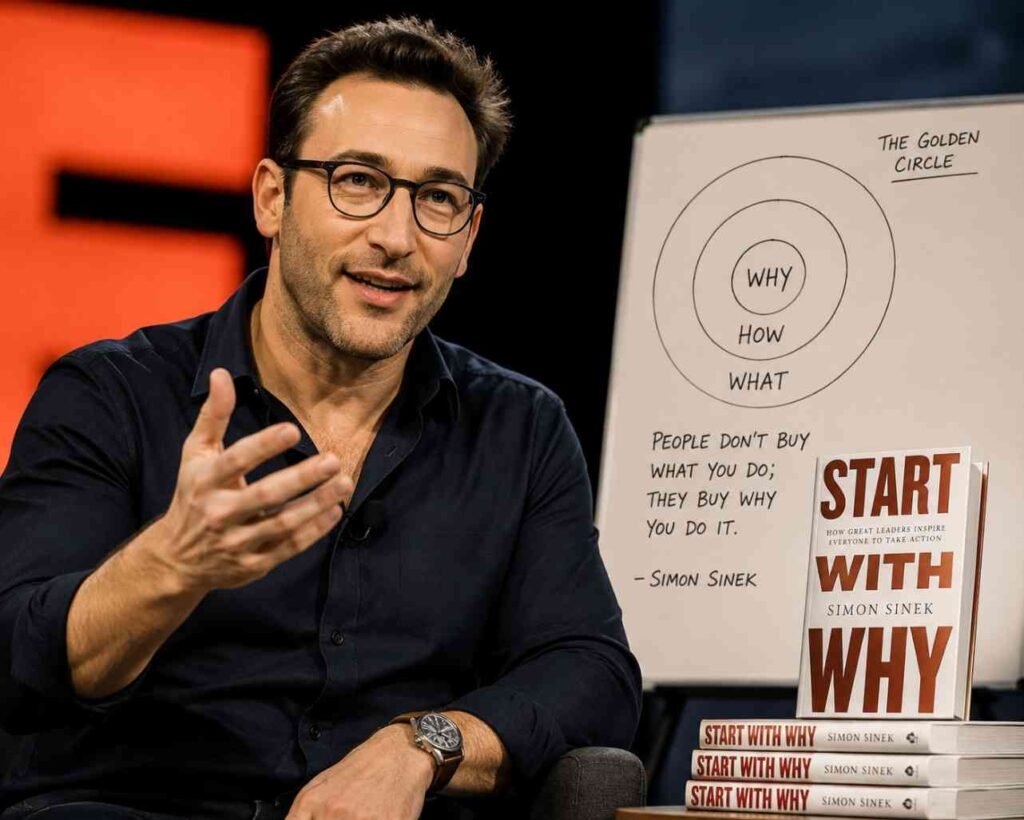
The start with why author is Simon Sinek, a British-American author and organizational consultant born in 1973 in Wimbledon, England. He studied cultural anthropology at Brandeis University before shifting to law, then dropping out to pursue advertising. He worked at the agencies Euro RSCG and Ogilvy before founding his own consulting practice.
Sinek’s real public moment came in 2009 when he delivered what became one of the most-watched TED Talks in history. That talk, How Great Leaders Inspire Action, presented the core idea of the Golden Circle and functioned as the conceptual skeleton of the book he published that same year. By 2025, the talk has over 60 million views on TED.com alone.
He’s also written Leaders Eat Last (2014), Together Is Better (2016), Find Your Why (2017), and The Infinite Game (2019). But the start with why book is the one that launched everything. If you read nothing else by Sinek, this is the one that carries the most original thinking.
Start With Why Genre and Age Rating
The start with why genre sits at the intersection of business non-fiction, leadership development, and popular psychology. Bookstores shelve it under Business and Management. Libraries catalog it under organizational behavior. Academic syllabi treating it as a leadership text classify it under management studies.
For the start with why age rating: there is no official content rating for non-fiction business books the way there is for films or games, but the general consensus across reader communities and educational institutions places it at an appropriate reading level for ages 16 and up.
The language is accessible, the concepts are not abstract in a way that demands graduate-level background, and there is zero content that would flag as mature.
High school entrepreneurship programs regularly assign it. University business courses treat it as core reading. Adult professionals find it directly applicable. The start with why age rating is effectively general audience.
Start With Why Plot: The Book’s Central Argument
The start with why plot is not a narrative in the traditional sense. This is non-fiction, so there are no chapters that build toward a scene. But there is a very clear argument arc, and it functions the way a plot does: it sets up a problem, complicates it, and resolves it with a framework.
Sinek opens by observing that some leaders and organizations command extraordinary loyalty, inspire action, and sustain success across decades, while others with equal resources and talent flame out or plateau. He wants to know why. His answer is the Golden Circle, a three-layer model that works from the outside in:
- What: Every organization knows what it does. These are the products or services it sells.
- How: Some organizations know how they do it. These are the processes, differentiators, and values that distinguish them.
- Why: Very few organizations know why they do what they do. Not profit. Why do you exist? What is your cause?
The start with why plot proceeds to illustrate this model through case studies, biological reasoning, and historical examples. The argument builds steadily from the abstract concept to specific applications in marketing, leadership, and culture. That three-layer structure is what makes the start with why book feel like a coherent intellectual journey rather than a loose collection of business anecdotes.
Start With Why Summary: Chapter by Chapter Breakdown
Here is the start with why summary broken into the book’s main sections. The start with why book summary that follows covers every major argument without cutting corners.
Part One: A World That Does Not Start With Why
Sinek introduces the gap between organizations that manipulate behavior (through price, promotions, fear, or aspirational marketing) and those that genuinely inspire. Manipulation works short-term. Inspiration builds loyalty. He argues most companies are stuck in manipulation because they lead with What, not Why.
Part Two: An Alternative Perspective
This is where the Golden Circle appears. Sinek ties the model to neuroscience, explaining that the outer two rings (What and How) correspond to the neocortex, the part of the brain responsible for rational thought and language. The Why corresponds to the limbic system, which governs feelings, loyalty, and decision-making but has no capacity for language. That mismatch explains why purely rational marketing often fails to move people.
Part Three: Leaders Need a Following
Sinek explores how the Why must diffuse through an organization by way of people who act as amplifiers. He introduces the concept of the Law of Diffusion of Innovation, adapted from Everett Rogers, to explain how ideas spread.
He argues that innovators and early adopters make up roughly 15 to 18 percent of any market, and tipping a mainstream movement requires reaching that threshold by inspiring those early believers first.
Part Four: How to Rally Those Who Believe
This section covers authenticity. Sinek argues that the Why must be genuine and consistently demonstrated through How and What. When the symbols and words of a company align with its actual behavior, trust forms. When they diverge, the brand corrodes faster than any competitor could destroy it from outside.
Part Five: The Biggest Challenge Is Success
Sinek addresses the classic problem of founder-led companies losing their Why after scaling. When the founder, who carries the Why in their own identity, exits or loses influence, the organization can drift toward pure What-driven management. He uses specific case studies to show how this happens and what organizations can do to institutionalize the Why before it’s too late.
Part Six: Discover Why
The closing section pivots to individuals. Sinek argues the Golden Circle applies as much to personal leadership as to corporate strategy.
Anyone can articulate their Why if they look backward at the moments and mentors that shaped their values. The start with why book summary ends here on a personal call to action: figure out your Why before you build your What.
Start With Why Characters: The Real People Sinek Profiles
Because this is a non-fiction business book, the start with why characters are real historical and contemporary figures rather than fictional protagonists. Sinek uses them as case studies, and some appear repeatedly throughout the text.
| Person or Organization | Role in the Book | Why Sinek Uses Them
|
|---|---|---|
| Steve Jobs / Apple | Primary recurring example | Demonstrates the Golden Circle in action; Apple’s Why (“challenge the status quo”) drives every product and campaign |
| Martin Luther King Jr. | Leadership and inspiration model | Shows how a clear Why builds mass movements; famous “I Have a Dream” speech as a Why statement, not a plan |
| The Wright Brothers | Contrasted against Samuel Langley | Illustrates that resources and talent lose to passion and belief; the Wright brothers had neither government funding nor formal training |
| Samuel Langley | Cautionary counterexample | Had Smithsonian backing and government contracts, failed because he wanted fame (What) not flight itself (Why) |
| Harley-Davidson | Community and identity example | Shows how a strong Why builds customer communities that tattoo a brand’s logo on their bodies |
| Herb Kelleher / Southwest Airlines | Culture and employee loyalty example | Demonstrates that a clearly communicated Why attracts employees who fit, reducing hiring and culture problems |
Understanding the start with why characters is key to understanding the argument. Sinek is not writing biography. He is using these figures as evidence, and each appearance is deliberately chosen to isolate one variable of the Golden Circle model.
Start With Why Themes: What the Book Is Really About
The start with why themes go deeper than leadership advice. Here is what the book is genuinely wrestling with beneath the surface of the business case studies.
Authenticity versus performance
This is the dominant thread across the start with why themes. Sinek is making a moral argument, not just a strategic one. Organizations that manipulate customers through fear or novelty can win in the short run, but they breed a transactional culture that collapses the moment a competitor undercuts the price or the novelty wears off.
Authenticity, expressed through consistent alignment between Why, How, and What, produces durable trust.
The limits of rational decision-making
Sinek draws on biological evidence to argue that human beings do not primarily make decisions through logical analysis.
The limbic brain drives loyalty before the neocortex can articulate a reason. This theme runs directly counter to most traditional marketing theory, which assumes that better information produces better consumer decisions.
Sinek says that is wrong, and the neuroscience backs him up. A Harvard Business Review study on organizational trust supports the core claim that emotional alignment precedes rational commitment.
Institutional memory and the problem of scale
One of the underappreciated start with why themes is Sinek’s extended argument about what happens to companies after the founder leaves. The Why lives in a person before it lives in a system.
When Dell, Starbucks, or Walmart began to drift, the pattern was always the same: the founder had moved on, and the organization defaulted to what it measured, which was always What, never Why.
The individual in the organization
Sinek insists that the Golden Circle applies to individual careers, not just corporations. This is a deeply personal theme inside an ostensibly corporate book, and it gives the text a resonance that pure business strategy rarely achieves.
Start With Why Ending Explained
The start with why ending explained is less dramatic than a novel’s finale but no less pointed. Sinek closes with a direct challenge. He has spent the entire book proving that the most influential leaders and organizations operate from a clear Why. The ending lands the implication: if you have read this far and still cannot articulate your Why, that is the work you need to do next.
The final pages draw together the Wright Brothers story, the Martin Luther King Jr. story, and the Apple story to make a unified point: the Why does not guarantee outcome, but it determines who follows you and why they stay.
The start with why ending explained is fundamentally a reframing of what leadership is for. It is not about commanding behavior. It is about attracting people who believe what you believe and sustaining their commitment over time.
Sinek ends with a question rather than a declaration. He asks readers to imagine a world where people wake up inspired to go to work. The optimism is intentional. He is not wrapping up an argument so much as opening a door. That rhetorical choice is deliberate, and it is part of why the book generates ongoing conversation rather than a single read-and-shelve experience.
Start With Why Series Order: Does This Book Have Sequels?
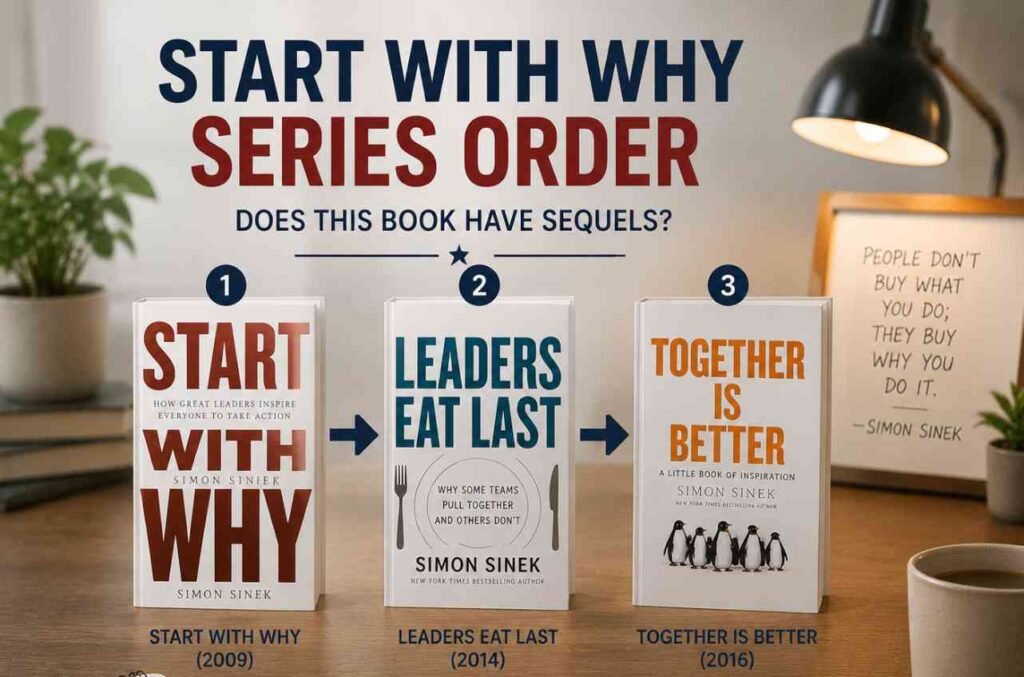
The start with why series order is a common question. Strictly speaking, Sinek did not write the book as part of a planned series, but there is a natural reading order based on how each subsequent book extends the core idea.
| Reading Order | Book Title | Year Published | What It Adds
|
|---|---|---|---|
| 1 | Start With Why | 2009 | Introduces the Golden Circle and the core Why concept |
| 2 | Leaders Eat Last | 2014 | Extends the argument into team culture and organizational trust, drawing on military examples |
| 3 | Find Your Why | 2017 | A practical workbook for individuals and teams trying to articulate their Why; co-authored with David Mead and Peter Docker |
| 4 | The Infinite Game | 2019 | Reframes business competition as infinite rather than finite, extending the Why concept to long-term strategy |
In the start with why series order, reading Find Your Why directly after the original is the most practical combination. The first book convinces you the framework matters; the second gives you exercises to actually implement it. Leaders Eat Last and The Infinite Game are more valuable once you have used the Golden Circle long enough to run into its friction points.
Start With Why Book Review: An Honest Assessment
The start with why book review community is enormous and divided in specific, instructive ways. On Goodreads, the book holds a 4.1 rating across more than 150,000 ratings as of early 2025. Academic reviewers are more cautious. Understanding both sides makes you a smarter reader.
“The Golden Circle is a powerful heuristic, but Sinek uses it as a universal law. The strongest chapters are where he admits the model’s limits. The weakest are where he doesn’t.”
This represents a consensus view among business school critics who reviewed the book’s case study methodology. The critique appears repeatedly in critical appraisals published by Business Insider and in academic discussions of leadership literature.
Here is the honest start with why book review breakdown:
What works well
The Golden Circle is genuinely clarifying. Sinek’s core insight, that why precedes what in the minds of loyal customers, is both counterintuitive and defensible.
The Wright Brothers versus Langley comparison is one of the most effective rhetorical constructions in modern business writing. The neuroscience framing, while simplified, points at real cognitive research.
For anyone new to thinking about purpose-driven leadership, the start with why book is a productive two-day read.
Where it strains
Sinek cherry-picks his examples. Every company he profiles as a Why-driven success had other advantages he does not fully account for: capital, timing, regulatory environment, and network effects. The book occasionally proves too much, implying that any company with a clear Why will succeed, which is not what the data shows.
The organizational behavior literature is more nuanced on what actually drives sustained performance.
My take: read this book once, take the Golden Circle seriously as a diagnostic tool, and resist treating it as a complete theory of business success. It is a better lens than most, not a law of nature.
The Start With Why Book Explained: How to Apply the Golden Circle
The start with why book explained section is where most summaries drop the ball. They describe the Golden Circle but skip the how. Here is a practical sequence for actually using what the book teaches, whether you are running a small press, a freelance practice, or any creative enterprise.
The start with why book explained in operational terms comes down to four movements:
- Map your current outside-in messaging. Pull your website homepage, your bio, and your last five social posts. Count how many sentences start with What (product, service, title) versus Why (belief, purpose, cause). Most people find 90 percent of their communication is What-first. That is your baseline.
- Write your Why in one sentence. Sinek’s formula: “To [contribution] so that [impact].” The contribution should express what you do for others. The impact should express what changes in the world as a result. Iterate until it passes the gut-check test: does this feel true, or does it feel like a mission statement someone generated in a workshop?
- Audit your How for consistency. Your processes, partnerships, and day-to-day decisions are either evidence of your Why or contradictions of it. Pick three decisions you made last month and ask whether each one would make sense to someone who only knew your Why statement. If they do not, you have found a friction point worth examining.
- Rebuild your What around your Why. The products or services you offer should be the most tangible expression of your Why available. If they are not, either the offerings need to change or the Why statement is off. This is the hardest audit because it can point at genuinely expensive decisions.
This sequence is not in the book as a checklist. Sinek writes in big strokes. But the four movements above are a direct translation of his argument into operational language, and they are the ones that consistently produce insight when working through the framework with real organizations.
What the Start With Why Book Gets Right That Most Leadership Books Miss
Most leadership books assume the reader already knows who they are and just need better tactics. The start with why book does the opposite. It starts with identity and works outward. That reversal is genuinely unusual in the genre.
The book also refuses to stay at the CEO level. Sinek spends serious time on movement-building, on how a belief system travels from one person to a team to a market. That sociological awareness separates the start with why book from the majority of leadership texts, which treat organizations as machines to be tuned rather than communities to be grown.
For small press publishers, independent writers, and creative professionals specifically, the Golden Circle maps surprisingly well onto the challenge of building a readership. The question of why your publication or writing practice exists is exactly the question most small press founders cannot answer without defaulting to describing what they publish. Sinek’s framework surfaces that gap quickly and, once you see it, you cannot unsee it.
The start with why summary for creative practitioners reads like this: your readers do not buy your books because of what is in them. They buy because of what your Why says about who they are. The What has to be good, obviously. But the Why is what builds a community around a press or a writing practice over years rather than titles.
Common Criticisms of the Start With Why Book Answered
Two objections come up in nearly every start with why book review discussion, and both deserve a straight answer.
Objection 1: The examples are biased toward winners.
This is true. Sinek writes about Apple, Southwest, and Harley-Davidson partly because they succeeded in ways that fit his model. He does not systematically examine companies with clear Whys that still failed. This survivorship bias is a real methodological problem. The fair response: the book is making a conceptual argument, not a statistical one. The Golden Circle is a thinking tool, not a prediction engine. Use it that way.
Objection 2: The neuroscience is oversimplified.
Also true. Sinek maps the Golden Circle onto the triune brain model, which most neuroscientists consider an outdated simplification of how the brain actually works. The limbic system does not “not understand words” in the clean way the book implies. But the underlying point, that emotional resonance drives decisions more than rational argument – has solid empirical support in behavioral economics. The map is not the territory, but it points at real terrain.
Neither objection kills the book’s usefulness. They do set the appropriate confidence level: treat the start with why book as a powerful heuristic, not a physics law.
How the Start With Why Book Applies to Small Press Publishing
The contemporary small press exists in a market where the What is brutally crowded. There are more books published each year than any reader can process. Distribution advantages have narrowed. Digital storefronts have lowered barriers to entry for everyone. In that environment, the only durable differentiator is Why.
Small presses that survive long enough to matter are almost always animated by a clear Why. Coffee House Press publishes to amplify voices that challenge mainstream culture. Graywolf Press exists to support literary writing that “makes a difference.” Drawn and Quarterly built an identity around a specific aesthetic philosophy. None of those missions are stated in terms of product categories. They are Why statements, whether or not the founders ever read the start with why book.
The practical implication for small press editors and publishers is this: before you design a catalog, commission a cover, or write a submission guidelines page, you need a Why that is honest enough to say no with. If your Why does not help you reject manuscripts that are good but wrong for you, it is not specific enough. That discriminating specificity is what the start with why book explained ultimately leads toward, even if Sinek never quite puts it in those terms.
This kind of mission-first thinking eventually runs into practical questions too, including how a small press is actually structured as a business, which do authors need an LLC covers from the operational side.
Should You Read the Start With Why Book?
Here is the decision guidance. Read the start with why book if you run, lead, or are trying to build anything where other people’s belief in your mission matters. That includes small presses, independent publishing projects, creative agencies, nonprofits, and any entrepreneurial venture where loyalty from customers or collaborators makes the difference between sustainability and collapse.
For small presses specifically, that clarity of purpose tends to show up first in production choices, the same intentionality covered in what is a coffee table book, where format itself becomes part of what a press is actually saying.
Skip it if you are looking for operational tactics, financial frameworks, or research-heavy analysis of organizational performance. The book does not offer those things. It offers a reframe, and a reframe is only useful if your current frame is producing problems.
Read Find Your Why immediately after if you finish the original and want to do something with the insight rather than just carry it as a concept. The start with why series order matters here: the workbook is far less valuable if you have not already internalized why the Why matters.
A Quick Reference Checklist Before Reading
- Can you state your organization’s Why in one sentence without using the words “quality,” “value,” or “service”?
- Do your employees or collaborators know why your organization exists, or do they only know what it produces?
- Is your marketing primarily about features and price, or about belief and identity?
- Has your organization lost something hard to name since its early days of momentum?
- Do you hire for skills first or for alignment with a mission first?
If most of those questions produce uncomfortable pauses, the start with why book will be worth four or five hours of your reading time. That is a good return on friction.
Start With Why Book: Final Thoughts
Fifteen years after publication, the start with why book still earns its place on the desk of anyone building something that needs other people to care.
The Golden Circle is not a complete theory of success. It is a diagnostic tool with a specific, well-defined job: it helps you find where your communication and your identity have diverged, and it gives you a direction for closing that gap.
The start with why book summary reduces to one sentence that Sinek himself would approve: people do not buy what you do, they buy why you do it.
Everything else in the book is evidence and elaboration. The start with why themes of authenticity, emotional resonance, and institutional identity are as relevant to a two-person literary journal as to a Fortune 500 company.
The start with why author wrote a book that outlasted its moment, and that kind of longevity is usually the clearest evidence that something real was said.
The question worth sitting with after closing the last page: what would your readers, collaborators, or customers say your Why is, based purely on your behavior? If that answer matches what you believe your Why to be, you are already operating with unusual clarity. If it does not, you now have a framework for understanding why, and a direction for changing it.