Most small press creators have heard the term thrown around at zine fests, Risograph studios, and micro-publishing forums. But the burn book meaning gets muddy fast, partly because the format sits at a weird crossroads between zine culture, artists’ books, and lo-fi publishing traditions that don’t always talk to each other.
So here’s the short answer: a burn book is a self-published, typically limited-run booklet or bound collection that prioritizes raw, unfiltered content over polished production, and it carries a long history inside underground and independent press communities. This guide covers the burn book definition in full, walks through real format choices, compares it to standard binding types, and gives you a practical path forward if you’re ready to make one yourself.
What Is a Burn Book, Really? The Full Definition
The burn book definition has two layers. On the surface, it refers to a physical book, usually small-format and short-run, that contains content the maker considers too honest, too raw, or too niche for conventional publishing channels.
That content might be personal essays, confessional poetry, satirical commentary, collage work, or documentation of a subculture that mainstream publishers would never touch. The burn book meaning gets its name from the idea that the content is “hot enough to burn,” a nod to both the emotional intensity of the writing and the cultural tradition of destroying records that could cause trouble.
On a deeper level, the burn book definition is a production philosophy. It’s the commitment to making something real, distributing it in small circles, and caring more about the truth of the content than the cleanliness of the margins.
Plenty of zine scholars and small press historians have tracked this lineage back through punk fanzines of the 1970s and 1980s, riot grrrl publications of the 1990s, and the broader tradition of samizdat, the Soviet-era underground self-publishing practice where citizens literally typed and passed around uncensored manuscripts. MoMA’s 2006 exhibition on zine culture documented exactly this lineage, tracing how lo-fi self-publishing became a formal artistic and political act.
So when someone asks “what is a burn explained” in a small press context, the honest answer is this: it’s equal parts format, attitude, and community signal. Making one says something about who you are as a publisher.
Burn Book Meaning Across Different Creative Communities

The burn book meaning shifts depending on where you encounter it. In literary zine circles, the term usually describes a saddle-stitched or staple-bound booklet running between 8 and 32 pages, printed on a home printer or a copy shop machine, and distributed at cost or free.
In artists’ book communities, it might refer to a more carefully constructed hand-bound volume that still carries the raw, unedited spirit of the burn book tradition, even if the craft is high. In queer and radical feminist publishing spaces, burn books have functioned as survival tools, literally documentation of experiences that the mainstream press refused to acknowledge.
The Zine Wiki community archive catalogs thousands of burn-style publications across these communities, and the pattern is consistent: low print run, high emotional stakes, direct distribution. That combination is what most people mean when they use the term today, and it’s what you should be thinking about when you decide whether this format fits your project.
Here’s my take: the burn book meaning that matters most for contemporary small press work is the one that centers the maker’s intention. If you’re producing something because you genuinely couldn’t find a publisher willing to run it, and you believe it needs to exist in the world, you’re working in the burn book tradition whether you use that label or not.
Burn Book Format: Paper, Binding, and Production Choices
The burn book format is one of the most flexible in independent publishing, which is actually one of its biggest draws. You’re not locked into a standard trim size or a specific binding method. But flexibility without some structure creates confusion, so here’s how the format typically breaks down.
Most burn book format decisions start with the binding. Saddle-stitch (two or three staples through the spine fold) is the most common because it’s cheap, fast, and honest-looking. A single-fold signature with no binding at all is another choice, often used for very short pieces of 4 to 8 pages.
Some makers use a Japanese stab-binding technique, sewing through pre-punched holes along one edge, which adds a tactile quality that photocopied interiors don’t usually get. Perfect binding, the same flat spine you’d see on a trade paperback, shows up occasionally in longer burn books, but it starts to push the production cost in directions that can compromise the DIY spirit of the format.
Paper stock matters more than most beginners realize. Uncoated 60lb or 70lb text paper runs cleanly through most digital printers and holds toner without shine. Some makers deliberately use newsprint or bright-colored copy paper to reinforce the lo-fi visual identity. Cover stock typically runs 65lb to 100lb cardstock if the maker wants a defined cover, though plenty of burn books use the same interior stock folded over as a wrap-around cover. That choice is part of the aesthetic signal.
Burn Book Size: The Most Common Dimensions and Why They Exist
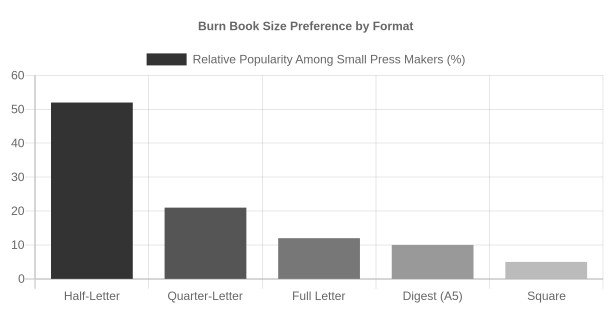
The burn book size question comes up constantly at zine fests and small press fairs because size affects how a book feels in your hand, how much it costs to mail, and whether it fits into a standard display rack. Just as writers learn to use active voice without losing style, independent publishers must balance practical choices with creative expression. Here are the sizes you’ll actually encounter in the wild:
| Burn Book Size | Dimensions | Common Use Case | Typical Page Count
|
|---|---|---|---|
| Half-letter (most common) | 5.5 x 8.5 inches | Personal essays, poetry, fiction chapbooks | 8 to 32 pages |
| Quarter-letter (micro) | 4.25 x 5.5 inches | Minicomics, event handouts, protest literature | 8 to 16 pages |
| Full letter | 8.5 x 11 inches | Visual art documentation, collage-heavy issues | 12 to 48 pages |
| Digest (A5 equivalent) | 5.83 x 8.27 inches | International makers, bookshop distribution | 16 to 48 pages |
| Square format | 6 x 6 or 8 x 8 inches | Photography-led or image-forward burn books | 12 to 36 pages |
The half-letter format is the one I’d recommend for most first-time makers. A single sheet of letter-size paper folded in half gives you a four-page signature, and multiples of that fold stack cleanly. You can print a 24-page burn book on 6 sheets of paper, and the folded result fits in a standard envelope for mailing. That practicality is part of why the half-letter burn book size has dominated the format for decades.
Burn Book vs Paperback and Burn Book vs Hardcover: What Actually Differs
The burn book vs paperback comparison is the one that comes up most often from people who’ve been publishing with print-on-demand platforms like Ingram Spark or Amazon KDP and are wondering what makes a burn book different from a standard trade paperback. The answer is meaningful.
A trade paperback is designed for retail distribution. It has an ISBN, a spine wide enough to display in a bookstore, and trim sizes standardized around what the supply chain can handle (typically 5 x 8 or 6 x 9 inches). The burn book vs paperback distinction isn’t about quality, it’s about distribution logic. A paperback is made to move through a system. A burn book is made to move between people.
Print runs tell the story most clearly. A standard paperback print run through a commercial printer starts at a minimum of 250 to 500 copies for offset printing, though print-on-demand has compressed that floor. A burn book typically runs between 10 and 150 copies, often printed one sheet at a time on a Risograph, a photocopier, or a home laser printer. That small print run isn’t a limitation, it’s the point. Scarcity and directness are part of the burn book definition.
The burn book vs. hardcover comparison is a little more unusual because hardcovers rarely show up in burn book territory at all. Even a compact creative project designed to help beginners draw a open book in 7 days would typically favor a simpler format. Hardcover binding requires case-binding equipment or outsourced production, immediately pushing the cost per unit beyond what most small-press makers can absorb at low quantities.
That said, some artists’ book makers do produce hand-bound hardcover burn books in editions of 10 to 25, and these function more as art objects than distributable publications. When you see a burn book vs hardcover discussion in a small press context, the hardcover is usually either a very high-end artists’ book or a production error in someone’s cost planning.
Burn Book Purpose: Why People Actually Make These
The burn book purpose varies more than most format guides acknowledge. Here are the four real reasons people make them, based on what actually shows up in small press communities:
- To publish content that no existing outlet would run, because it’s too personal, too political, too experimental, or too specific to a niche community that mainstream gatekeepers don’t serve.
- To build a physical object that documents a moment, a feeling, or a community, because digital posts disappear and print persists in ways that matter to the maker.
- To participate in the culture of exchange at zine fests, distros, and small press fairs, where trading publications is a social act as much as a commercial one.
- To practice making, because producing a 24-page burn book from scratch teaches layout, editing, and production skills that no workshop replicates as efficiently.
The burn book purpose that gets underemphasized the most is that last one. Making a burn book is one of the fastest ways to develop real publishing competence. You make decisions, you produce a physical object, you see what works and what doesn’t, and you do it again. Most experienced small press editors I’ve encountered made burn books long before they moved into longer-form projects.
Types of Burn Book: A Practical Taxonomy

The types of burn book aren’t formally codified anywhere, but the small press community has developed distinct subcategories through practice. Understanding these types helps you make cleaner decisions about your own project.
The confessional burn book is the oldest type in the tradition. It centers one person’s unfiltered perspective, usually in essay or poetry form, and makes no pretense of balanced reporting or editorial distance. This type maps most directly to the cultural origin of the burn book definition.
The community burn book collects voices from a specific group, scene, or moment. Riot grrrl publications like Bikini Kill zine and Gunk operated in this mode, as do many contemporary BIPOC-led small press publications that document experiences and aesthetics specific to their communities. This is different from an anthology because there’s no formal editorial selection process, the community self-selects who contributes and what gets in.
The visual burn book leads with image: collage, photography, illustration, or sequential art. Text is secondary or absent entirely. These types of burn book often push toward larger formats (full letter or square) to give visual work room to breathe.
The protest or ephemeral burn book is made for distribution at a specific event, action, or moment and is designed to be consumed and discarded rather than collected. Although creators may still need to fix short story pacing to deliver an immediate impact, these books usually have the shortest page counts and simplest production methods.
Each of these falls under the broader types of burn book umbrella, and most real-world examples blend two or more of these modes. My own preference is the confessional-community hybrid, where one editor’s voice shapes a collection of contributors’ work, because that tension between individual curation and collective expression produces the most interesting results.
Burn Book Examples From the Contemporary Small Press World
Concrete burn book examples matter more than abstract descriptions, so here’s a look at what the format actually produces in practice.
The Persistent Pest, a quarterly half-letter saddle-stitched publication run by a collective of Midwestern writers, is one of the cleaner burn book examples of the confessional-community type. Each issue runs 24 pages, prints in an edition of 75, and is distributed entirely through trades at Small Press Expo and through a personal mailing list. No ISBN, no retailer, no discount structure. That’s burn book logic operating at its purest.
On the visual side, Risograph-printed burn book examples have proliferated since the mid-2010s as affordable Riso access through print shops like Perfectly Acceptable in Cleveland and Print Club Ltd in the UK gave small press makers a way to produce two-color printed work that looked unmistakably hand-made. Print Club London’s Risograph services are a good reference point for what production-ready Riso burn books look like in terms of cost and output quality.
The burn book examples that tend to resonate longest in the community are the ones that document something that wouldn’t have been documented otherwise. That’s the test worth applying to your own project: if this book didn’t exist, would anyone else make it? If the answer is no, you have a burn book worth making.
“The zine exists because mainstream publishing doesn’t want it. That’s not a failure condition. That’s the whole point. The refusal is the origin story.”
This framing, articulated repeatedly in interviews with zine librarians and small press curators compiled by the Antiquarian Booksellers’ Association of America in their documentation of artists’ book traditions, captures exactly what the burn book purpose has always been about.
What Is a Burn Explained: The Production Vocabulary You Need
If you’re new to this, the jargon gets thick fast. Here’s what is a burn explained in plain production terms, so you’re not lost in a conversation at a zine fest or a print shop.
Imposition is the process of arranging your pages so they print in the right order when the paper is folded. A 16-page half-letter burn book is actually 4 sheets of letter paper, each printed on both sides, with 4 pages per sheet. Getting this wrong produces books that read out of order, and it happens to every maker at least once. Software like Scribus (free) or Adobe InDesign handles imposition automatically, or you can use a web tool like Bookleteer for very simple layouts.
Bleed is the area of your design that extends past the trim edge, typically 0.125 inches on each side, so that if the cut is slightly off, you don’t get a white border on a design intended to go edge to edge. Most burn books skip bleed entirely because their designs are text-based or they don’t use a guillotine cutter, but if you’re doing full-page image work, build in bleed from the start.
Signature is one folded section of a book. A single letter sheet folded in half is a 4-page signature. Multiple signatures stacked and bound together form a longer book. Understanding signatures is central to what is a burn explained properly, because your page count must always be a multiple of 4 for a fold-and-staple burn book.
Edition size is how many copies you print. Numbering your burn book (e.g., “Copy 23 of 50” handwritten inside the cover) is a convention that signals limited-run intent and adds a collectibility factor that some readers genuinely value.
Burn Book for Beginners: A Practical 8-Step Production Path

This section is built specifically as a burn book for beginners guide. If you’ve never made one, follow these steps in order.
Step 1: Decide on your content and page count. Start with 16 pages. It’s the most forgiving burn book for beginners format because 4 sheets of letter paper fold and staple easily with a long-reach stapler. Aim for content that fills the space without padding.
Step 2: Choose your size. Half-letter (5.5 x 8.5 inches) is the default. Set your document to that trim size in whatever software you’re using, whether that’s Canva, InDesign, Affinity Publisher, or Google Slides.
Step 3: Write and edit your content before you design. Designing around unfinished text wastes time and produces awkward layouts. Lock the words first.
Step 4: Set your margins.** 0.5 inches on all sides for interior pages is the minimum for readability. The gutter (inner margin, closest to the spine) should be slightly wider at 0.625 to 0.75 inches because saddle-stitched books pull the inner margin toward the spine.
Step 5: Handle imposition. Use Scribus’s built-in booklet print feature, or export your pages as a PDF and use a free imposition tool like Cheap Impostor or PDF Booklet to rearrange them for printing.
Step 6: Print a proof copy first. Always. Print one copy on your target paper, fold it, staple it, and read it from cover to cover before printing the full run.
Step 7: Assemble and finish. Fold each signature, nest them in order, and staple through the spine fold. A long-reach stapler handles up to about 20 pages. Beyond that, use a saddle-stitch stapler or take the job to a print shop.
Step 8: Decide on distribution. Table at a zine fest, mail to a list, trade with other makers, leave copies at independent bookshops, or all four. Distribution is where the burn book for beginners experience becomes a community experience rather than a solo project.
Burn Book Explained: Common Mistakes and How to Avoid Them
Getting the burn book explained in theory is one thing. The mistakes that actually derail first-time makers are specific and avoidable.
The most common error is wrong imposition. Your pages print out of order because you didn’t account for how a folded booklet rearranges page sequence. The fix is always to print a single test copy before the full run.
Second most common: page count that isn’t a multiple of 4. A 22-page burn book sounds reasonable until you realize you’ll have two blank pages you didn’t plan for. Either cut to 20 or add content to reach 24.
Third: using an inkjet printer on uncoated paper for a print run over 20 copies. Inkjet ink smears when handled repeatedly and fades faster than toner. A laser printer or a copy shop digital press is the right tool for any run you intend to distribute. This is part of the burn book explained conversation that most beginner guides skip, and it costs people real money when they have to reprint.
Fourth: pricing too high at the table. The community expectation for a half-letter, 16-to-24-page saddle-stitched burn book is roughly $3 to $6. Price above that and you’ll move very few copies. Price at $5 with a “or trade” option and you’ll move everything.
What Is a Burn Book in the Broader Publishing Ecosystem?
Understanding what is a burn book in relation to the wider publishing landscape helps you position your own work accurately. Burn books sit in a specific zone between ephemeral handouts (too short, no binding) and chapbooks (more formally edited, often ISBN-registered, frequently produced through a press rather than self-published).
The distinction from a chapbook is partly production (chapbooks often use a print-on-demand service or an offset printer) and partly intent (chapbooks aim for a longer shelf life and sometimes seek wider distribution through literary channels).
What is a burn book when compared to a zine? Almost interchangeably for most makers, though the zine label is older and carries a slightly broader connotation that includes serialized publications and publications focused on a specific interest area (music, sports, cooking) rather than literary or artistic content. A burn book tends to imply a one-off or limited series rather than an ongoing publication. That’s the most useful distinction in practice.
The contemporary small press ecosystem has room for all of these formats, and the smartest makers treat them as different tools for different jobs rather than competing categories. A burn book for a specific project might lead to a chapbook submission for a longer version of the same work, which might eventually inform a full-length manuscript. The burn book is often where the most honest version of an idea lives, before editing and audience consideration soften it into something more palatable.
Final Thoughts on the Burn Book Format
The burn book has survived decades of technological change, from mimeograph machines to photocopiers to Risographs to digital print-on-demand, because the format serves a need that no technology can make obsolete: the need to make something real and put it directly into someone’s hands. The burn book meaning has always been about that directness. It bypasses gatekeepers not because it has to, but because bypassing them is the point.
If you’ve been sitting on a project that feels too personal, too niche, or too unfinished for a “real” publisher, that feeling is exactly where the burn book format lives. Print 25 copies. Staple them. Give them away. See what happens. The worst outcome is a stack of paper in your closet. The more likely outcome is that you’ll have made something that a specific group of people needed and couldn’t find anywhere else.
What would you put in a burn book that you’ve never been able to say anywhere else?