
A self-published romance novel about a figure skater and a hockey player managed to outperform traditional literary heavyweights on the New York Times bestseller list for over 70 weeks. When Hannah Grace released Icebreaker in late 2022, she did not just publish a book; she executed a masterclass in market-targeted commercial fiction.
Understanding what is the book icebreaker about requires looking past the surface-level tropes of college athletics and forced proximity. At its core, the novel serves as a case study in modern commercial pacing, emotional conflict design, and character dynamics tailored for the contemporary publishing landscape.
For authors, literature students, and publishers, analyzing this text offers valuable insights into why certain romance tropes dominate the modern market and how character arcs can drive commercial success.
Deconstructing the Icebreaker Plot and Narrative Architecture
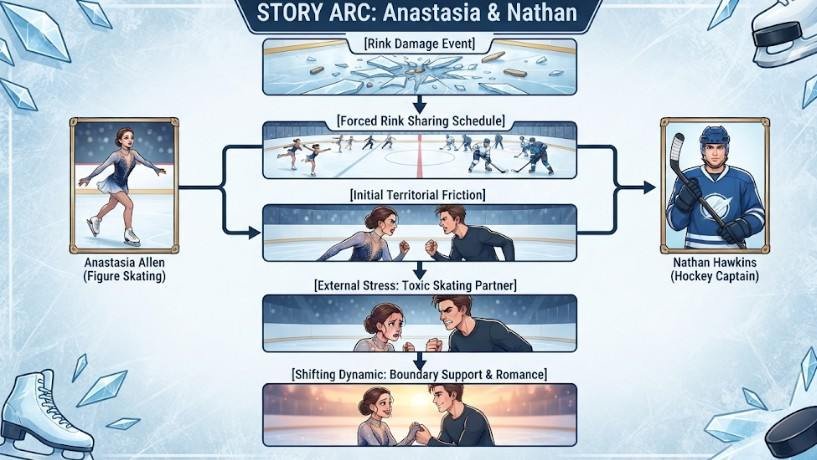
The plot hinges on a classic romance premise: forced proximity. Set at the fictional Maple Hills University, the story pairs Anastasia “Stassie” Allen, a hyper-focused competitive figure skater aiming for Team USA, with Nathan “Nate” Hawkins, the easygoing captain of the university’s hockey team.
When a deliberate prank by the hockey team damages their main arena, the athletic department forces both teams to share a single ice rink. This scheduling conflict sets off the immediate tension required to drive the first act forward.
The friction shifts when Anastasia’s figure skating partner, Aaron Carlisle, becomes increasingly manipulative and toxic. As Aaron’s behavior threatens their Olympic prospects, Nate steps in—not as a savior, but as a stable counterweight. The narrative shifts from territorial rivalry to a deeper exploration of agency, trust, and psychological safety within competitive sports.
For a broader look at how narrative structures vary across indie and traditional works, learning how to study author writing styles can help you unpack pacing choices like those used by Hannah Grace.
Character Dynamics: A Structural Analysis
The character dynamics in the novel rely on contrasting behavioral profiles to create emotional regulation.

| Character | Primary Trait / Role | Narrative Function |
| Anastasia Allen | Driven, anxious, hyper-organized | Internal conflict driver |
| Nathan Hawkins | Adaptable, protective, empathetic | Catalyst for character growth |
| Aaron Carlisle | Controlling, manipulative, rigid | Primary antagonist / Obstacle |
Anastasia Allen
Anastasia represents a classic high-functioning, perfectionist protagonist. Her internal conflict centers on control, managing severe anxiety, strict scheduling, and an eating disorder tied to the pressures of elite figure skating. Her journey is about learning to uncouple her personal self-worth from athletic performance.
Nathan Hawkins
Nate acts as the stabilizing force. Unlike traditional “alpha” romance leads who assert dominance, Nate’s appeal lies in his emotional intelligence and respect for boundaries. He provides a safe harbor for Anastasia, offering a sharp contrast to the controlling figures in her professional life.
Aaron Carlisle
Aaron serves as the primary obstacle. He illustrates how toxic co-dependency can mask itself as professional dedication in pair sports. His manipulative behavior highlights the dark side of elite athletics, giving the romance a realistic, high-stakes backdrop.
Core Themes and Commercial Pacing
While market dynamics often class it purely as a sports romance, a closer icebreaker book summary reveals several distinct thematic pillars:
- Autonomy vs. Control: The narrative continually contrasts healthily established boundaries with emotional coercion.
- Mental Health and Therapy: The story actively incorporates therapy, anxiety management, and recovery as normal aspects of an athlete’s routine, normalizing mental health care in commercial fiction.
- Found Family: The supporting cast—specifically the hockey team—creates an inviting environment that cushions the lead characters’ emotional growth.
For writers, the novel’s commercial success lies in its pacing. Hannah Grace alternates high-intensity athletic scenes with intimate, dialogue-driven emotional beats. According to readership research published by the Publishers Association, character-driven romances with clear boundary-focused arcs have seen massive growth among young adult readers.
Evaluating the Tropes: A Writer’s Checklist
If you are developing a romance novel or analyzing one for editorial review, use this decision framework to evaluate how tropes function within the text.
[Analyze Tropes in Story]
│
┌──────────────┴──────────────┐
▼ ▼
Does Forced Proximity Does Character Growth
Drive Action Naturally? Happen Independently?
│ │
├─► YES: Good tension ├─► YES: Healthy arc
└─► NO: Structural flaw └─► NO: Passive plot
Tropes Evaluation Checklist
- Forced Proximity: Is the shared space logical within the setting? (In this case: Shared rink due to facility damage).
- Rivals-to-Lovers: Does the antagonism stem from misaligned goals rather than petty malice? (In this case: Limited ice time threatening career goals).
- Emotional Safety: Does the love interest encourage the protagonist’s independence rather than replacing one controlling figure with another?
The Icebreaker Series Order and Market Impact

Understanding the broader context of Hannah Grace’s work helps explain its commercial longevity. The novel serves as the entry point to the Maple Hills series, followed by subsequent companion novels focusing on different members of the athletic group. You can find more details on the author’s website.
[Icebreaker (Book 1)] ──► [Wildfire (Book 2)] ──► [Daydream (Book 3)]
By structuring the series around an interconnected cast rather than a direct continuation of one couple’s story, Grace built a repeatable, expandable narrative ecosystem. This model allows publishers and indie authors to build long-term reader retention.
Limitations and Critical Considerations
While highly popular, the novel is not without its editorial critiques. Literature students and editors often highlight a few specific trade-offs in its design:
- Pacing and Length: At over 400 pages, some subplots involving secondary hockey players slow down the central romantic arc.
- Tone Shifts: The narrative shifts rapidly between light, banter-filled comedy and heavy thematic elements like emotional abuse and eating disorders, which can occasionally disrupt the narrative flow.
- Target Audience vs. Marketing: The cartoonish cover art often leads casual readers to assume it is a lighthearted young adult novel, despite its explicit themes and adult rating.
Publishers interested in researching romance trends can look into literary analysis resources available through academic institutions like Stanford University Humanities to study how digital fan spaces influence contemporary publishing.
Frequently Asked Questions
1. Is Icebreaker a spicy book?
Yes. The novel contains frequent, explicit sexual content and adult themes throughout the story. It is classified as an explicit contemporary adult romance novel rather than young adult fiction.
2. Can my 14 year old read Icebreaker?
No. The book features explicit sexual scenes, profanity, mature themes, and depictions of emotional abuse. It is generally recommended for readers aged 18 and older.
3. What is the plot of the book “Icebreaker”?
When a prank forces a college hockey team and figure skating duo to share a single ice rink, competitive skater Anastasia and hockey captain Nathan navigate forced proximity, toxic partnerships, and an unexpected romance.
4. What age is appropriate for the book Icebreaker?
The book is written for mature audiences aged 18 and above due to its explicit content, graphic romantic scenes, complex mental health themes, and strong language.
Analyzing modern bestsellers like Icebreaker shows how deliberate trope execution, emotional safety, and relatable character dynamics drive contemporary fiction trends. Whether you are an author plotting your next novel, a literature student breaking down current pop-culture hits, or a publisher evaluating market demand, dissecting these narrative mechanics reveals exactly what modern readers are looking for on the page.