
When Hunter S. Thompson was a young journalist, he typed out the entire text of F. Scott Fitzgerald’s The Great Gatsby on his manual typewriter. He wasn’t plagiary-minded; he simply wanted to feel what it physically felt like to write a masterwork.
Learning how to study author writing styles isn’t about copying another creator’s voice—it’s about discovering the structural scaffolding behind prose that moves people. Whether you are an aspiring novelist, a literature student, or a editorial professional, breaking down an author’s unique voice reveals the mechanics of literary impact.
The Anatomy of Prose: Micro-Level Elements of Style
To analyze an author’s voice effectively, you must move past emotional reactions like “this scene felt dark” and dissect the underlying linguistic choices.
Diction and Vocabulary Tiering
An author’s choice of words sets the baseline for their world. Consider whether the prose relies on concrete nouns and active verbs or favors Latinate, multi-syllabic vocabulary.
- High-register diction: Utilizes specialized, archaic, or formal phrasing to build distance, authority, or grandeur (e.g., Cormac McCarthy).
- Low-register diction: Employs vernacular, colloquialisms, and simple Anglo-Saxon words to create intimacy or speed (e.g., Raymond Carver).
Syntax and Sentence Architecture
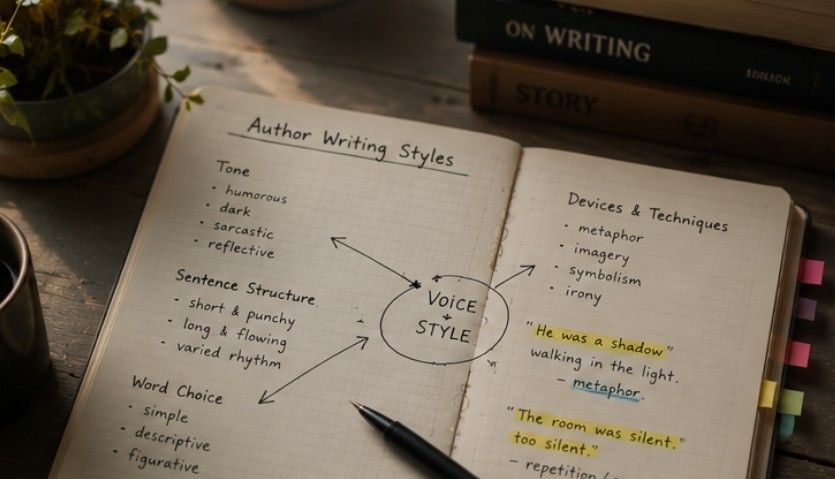
Syntax and grammar are important, it determines the cadence of storytelling. Pay attention to how an author manipulates sentence types to control reader fatigue and emotional tension.
[Short, Staccato Sentences] ──> Speeds up time / Elevates panic
[Long, Complex Clause Chains] ──> Slows down time / Invites introspection
Short, declarative sentences create urgency and realism, while complex, multi-clause sentences suit contemplative, introspective passages. If you are examining historical American texts, understanding major literary movements in American literature will help you see how cultural shifts directly influenced these syntax trends over time.
Deconstructing Voice: Insights from Narrative Mechanics
When studying prose mechanics, literary researchers break down style into four distinct operational pillars:
┌──────────────────────────┐
│ 4 PILLARS OF STYLE │
└────────────┬─────────────┘
│
┌──────────────────┬──────────┴───────────┬──────────────────┐
▼ ▼ ▼ ▼
┌─────────────┐ ┌─────────────┐ ┌─────────────┐ ┌─────────────┐
│ Diction │ │ Syntax │ │ Tone & Mood │ │ Pacing │
│ Word Choice │ │ Structure │ │ Perspective │ │ Modulation │
└─────────────┘ └─────────────┘ └─────────────┘ └─────────────┘
- Diction: Precision versus broad abstraction in vocabulary selection.
- Syntax: The physical length, variance, and grammatical rhythm of clauses.
- Tone and Mood: The author’s subtle perspective toward their characters versus the atmospheric feeling created for the reader.
- Pacing: How punctuation, white space, and paragraph breaks modulate reading speed.
Understanding these mechanics helps writers edit their own drafts more effectively. Knowing which extra words slow down a narrative allows you to trim fluff; applying a clear list of words to cut from manuscript drafts makes prose far sharper.
3 Practical Exercises to Master Any Author’s Style
Analyzing text passively isn’t enough; you need active, hands-on exercises to internalize prose mechanics.
1. Verbatim Copywork
Typing or hand-writing a passage word-for-word forces your brain to process word choice at the author’s original pace, rather than scanning at normal reading speed. Academic studies hosted by the National Center for Biotechnology Information demonstrate that tactile, motor-based practice reinforces pattern recognition and structural recall far better than passive reading alone.
2. Reverse Engineering a Scene

Take a 300-word excerpt and strip away the descriptive adjectives and adverbs. Rebuild the passage from its bare structural skeleton to discover how much work the verbs and nouns are doing on their own.
3. The Structural Template Method
Extract the exact grammatical blueprint of a paragraph without keeping any of its original subjects or actions.
- Original: “The cold rain fell relentlessly against the glass, blurring the city lights into smears of yellow.”
- Template: [Definite article] + [Adjective] + [Noun] + [Action verb] + [Adverb] + [Prepositional phrase], [Participial phrase modifying the verb].
- Your Version: “The sharp wind blew wildly through the alleyway, scattering the old papers into bursts of white.”
Stylistic Comparison: Hemingway vs. Woolf
To see how stylistic choices alter the reader experience, compare how two classic authors approach narrative voice:
| Feature | Ernest Hemingway | Virginia Woolf |
| Primary Diction | Anglo-Saxon, direct, simple | Polysyllabic, lyrical, sensory |
| Sentence Structure | Short, paratactic, sparse clauses | Long, hypotactic, nested clauses |
| Punctuation Focus | Periods, minimal commas | Semicolons, em-dashes, commas |
| Narrative Stance | External observation (Iceberg theory) | Internal stream-of-consciousness |
Choosing the right digital toolkit makes tracking these stylistic mechanics much simpler. Utilizing the best software for writing books allows you to run readability metrics, analyze sentence length distributions, and highlight overused parts of speech across entire manuscripts.
When Style Analysis Fails: Misconceptions and Limits
Studying style is a powerful tool, but it comes with a few traps:

- The Mimicry Trap: Emulating an author too closely can make your own voice sound like a cheap imitation rather than a genuine expression.
- Genre Mismatch: Applying a minimalist noir style to a sweeping high-fantasy epic can leave the worldbuilding feeling thin and bare.
- Over-Analyzing Outliers: Every author tries to write good sentences or unusual passages. Always analyze passages across multiple chapters to identify their true patterns rather than one-off anomalies.
According to research literature preserved by the Library of Congress, enduring literary voices are rarely built on strict rules. Instead, they come from an author’s personal blend of influences, environment, and intentional experimentation.
Frequently Asked Questions
1. What are the 7 types of writing styles?
The seven primary writing styles are expository, descriptive, persuasive, narrative, creative, objective, and subjective. Each style serves a distinct purpose depending on the intended audience and narrative goals.
2. What author was rejected 23 times?
Frank Herbert’s sci-fi masterpiece, Dune, was rejected by 23 publishers before Chilton Book Company—a publisher known for auto repair manuals—finally accepted the manuscript.
3. At what age do writers peak?
Writers do not peak at a specific age. Many debut in their twenties, while others, like Toni Morrison, published their first novels in their late thirties or fifties.
4. What is JK Rowling’s style of writing?
JK Rowling uses an accessible, narrative style characterized by third-person limited perspective, inventive naming conventions, clear pacing, and immersive worldbuilding tailored for wide readability.
Unlocking Your Unique Voice
Learning how to study author writing styles is not about copying someone else’s work; it is about building your own creative toolkit. By breaking down diction, dissecting sentence structures, and trying hands-on copywork, you learn how great prose is built from the ground up.
Use these techniques to analyze the books you love, take what works, and leave the rest behind. The goal was never to become a second Hemingway or Woolf—it is to use their tools to craft an unmistakable voice that is entirely your own.