
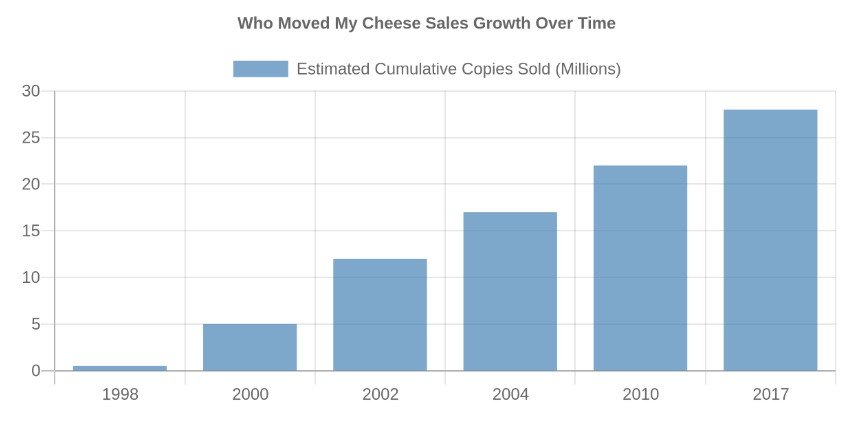
Roughly 28 million copies sold worldwide, and people are still arguing about whether this tiny book changed their life or just annoyed them. That split reaction is what makes the who moved my cheese book one of the most fascinating publishing phenomena in the small press and self-help space. Written by Spencer Johnson and originally published in 1998, it barely qualifies as a book by page count, yet it has outlasted hundreds of longer, more “serious” titles. This guide covers the who moved my cheese summary, the characters, the themes, the ending, and a blunt review, so you can decide for yourself whether it deserves a spot on your shelf.
Who Moved My Cheese Book: What It Is and Why It Still Matters
The who moved my cheese book is a parable. That’s the genre, plain and simple. Spencer Johnson, the who moved my cheese author, wrote it as an allegorical story set inside a maze, where four characters search for cheese as a metaphor for whatever you want most in life, whether that’s a job, a relationship, or a sense of security. The book clocks in at about 94 pages, and a fast reader can finish it in under an hour.
So why does a book this short carry this much cultural weight? Because it arrived at exactly the right moment. Corporate America in the late 1990s was obsessed with downsizing and restructuring, and managers handed this book out by the thousands. According to Publishers Weekly, it was one of the best-selling business books of its decade. That context matters when you’re evaluating the who moved my cheese book review conversation happening in book clubs and online forums today.
The who moved my cheese genre sits at the intersection of business fable, motivational literature, and what the contemporary small press world sometimes calls “parable fiction.” It doesn’t fit neatly into one shelf, and that ambiguity is part of its appeal and its criticism.
Who Moved My Cheese Summary: The Full Plot Breakdown
Before diving deeper, here’s the full who moved my cheese book summary, no spoilers held back.

The who moved my cheese plot opens with a group of old school friends at a reunion. One of them, Michael, shares a story called “Who Moved My Cheese?” to explain how he dealt with a major change in his own life. That framing device sets up the actual parable.
Inside the parable, four characters live in a maze and spend their days searching for cheese. Two of them are mice named Sniff and Scurry. Two are “Littlepeople,” human-sized beings named Hem and Haw. All four find a massive supply of cheese at a location called Cheese Station C, and they settle into comfortable routines around it.
Then one day, the cheese is gone. This is the central crisis of the who moved my cheese plot. The mice, Sniff and Scurry, had noticed the supply dwindling and had already laced up their shoes. They head straight into the maze to find new cheese. Hem and Haw react very differently. Hem gets angry and refuses to accept the situation, demanding that someone explain what happened to his cheese. Haw eventually comes around, puts on his running shoes, and ventures into the maze, writing messages on the walls as he goes.
The who moved my cheese summary of Haw’s journey is really the emotional core of the book. He learns to let go of the past, to laugh at his own fear, and to move toward the unknown rather than waiting for things to return to normal. He finds new cheese at Cheese Station N, where Sniff and Scurry are already feasting.
Hem’s fate is left ambiguous, which is actually one of the more honest storytelling choices Spencer Johnson makes. The book closes with the friends debating which character they most identify with, which is a clever way to extend the reader’s engagement beyond the last page.
Who Moved My Cheese Characters: A Closer Look at All Four
The who moved my cheese characters are deliberately simple, and that simplicity is both the book’s strength and its biggest vulnerability to criticism.
- Sniff is the mouse who detects change early. He represents pure instinct, the part of you that senses something is shifting before your conscious mind catches up.
- Scurry is the mouse who acts immediately without overthinking. He’s pure momentum, no analysis, just movement.
- Hem is the Littleperson who refuses to change. He’s the loudest character in the who moved my cheese summary because his resistance is the most recognizable human trait in the story.
- Haw is the protagonist most readers are supposed to identify with. He feels fear, hesitates, but ultimately chooses to adapt. His wall writings are the closest thing the who moved my cheese book has to a thesis statement.
Spencer Johnson’s choice to use mice alongside human-like figures is intentional. It suggests that sometimes the “simpler” approach, acting on instinct without ego, actually gets better results than human complexity and rationalization. That’s a provocative argument, and it’s one reason the who moved my cheese book review conversation tends to get heated.
Who Moved My Cheese Author: Spencer Johnson’s Background
The who moved my cheese author, Spencer Johnson, was a physician turned writer who built his career on short, parable-style books. He co-authored The One Minute Manager with Ken Blanchard in 1982, another mega-selling business title. Johnson held degrees from the University of Southern California and Royal College of Surgeons in Ireland, but he spent most of his adult life as an author rather than a practicing physician.
Johnson passed away in July 2017, but not before seeing the who moved my cheese book become a global phenomenon. According to The New York Times, he sold over 28 million copies of the title across more than 40 languages. For a book that most publishers initially considered too short to take seriously, those numbers are extraordinary.
His writing philosophy was built around the idea that simple stories carry complex truths more effectively than dense theory. Whether you agree with that philosophy probably determines how you feel about the who moved my cheese book review you’d write after reading it.
Who Moved My Cheese Themes: What the Maze Is Really About
The who moved my cheese themes operate on multiple levels, and the book is smart enough to let you choose your own interpretation.
The primary who moved my cheese themes center on change, fear, and adaptability. But if you read carefully, you’ll find secondary themes around self-awareness, the cost of stubbornness, and the relationship between comfort and stagnation. Haw’s journey is as much about internal change as it is about finding new cheese.
One of the wall writings Haw scrawls in the maze reads: “What would you do if you weren’t afraid?” That single question is probably the most quoted line from the who moved my cheese book explained discussions online, and for good reason. It reframes fear as the real obstacle, not the absence of cheese.
“The more important your cheese is to you, the more you want to hold on to it.” Spencer Johnson wrote this as a paradox: the things we value most are the things that most trap us when they disappear. This observation has been cited repeatedly in organizational behavior research, including discussions of Harvard Business Review’s work on why people resist change.
The who moved my cheese themes also touch on anticipation versus reaction. Sniff and Scurry represent proactive monitoring; Hem represents denial; Haw represents the slow but possible shift from reactive to proactive thinking. In that sense, the who moved my cheese book explained as a piece of organizational psychology makes more sense than when it’s read as a personal development text alone.
Who Moved My Cheese Ending Explained
The who moved my cheese ending explained in plain terms: Haw finds new, better cheese at Cheese Station N. He’s surrounded by abundance and has learned that his fear of change was more painful than the change itself. He hopes Hem will eventually show up but doesn’t wait for him.
The who moved my cheese ending explained in a deeper reading: Hem’s absence at the end is the most honest part of the book. Not everyone adapts. Not everyone chooses to move. Johnson doesn’t give Hem a redemption arc or a punishment. He just leaves the question open. That ambiguity is where the real emotional punch lands, if you’re willing to sit with it.
The outer frame story, where Michael’s friends debate the parable at their reunion, closes with each person identifying which character they’ve been at different points in their lives. That’s a clever structural move. It tells you the book is designed for reflection, not prescription. The who moved my cheese ending explained this way is less about a tidy moral and more about an open question you take home with you.
Who Moved My Cheese Age Rating and Audience Fit

The who moved my cheese age rating is a common question, especially for parents and educators. Educators and librarians generally recommend the book for readers aged 13 and up, although no official body assigns it a traditional age rating. The language is simple enough for middle schoolers, but the emotional concepts, career change, loss, identity tied to routine, are more resonant for adults.
The who moved my cheese age rating conversation gets interesting when you realize that many companies buy it in bulk for adult employees. That corporate context makes it feel patronizing to some readers, as if the employer is calling them “Hem.” That perception issue is one of the most common threads in the who moved my cheese book review discussions you’ll find on Goodreads and Reddit.
For classroom use, the who moved my cheese book explained through discussion questions works well for high school students studying change management, resilience, or personal development. The short length is an asset in that context.
Who Moved My Cheese Series Order: Is There a Sequel?
The who moved my cheese series order is a short list. Spencer Johnson wrote a follow-up called Out of the Maze: An Even Better Way to Deal with Change, published posthumously in 2018. This sequel focuses on Hem, picking up where the original left off and finally giving that character a resolution. It was completed with the help of Johnson’s estate.
The who moved my cheese series order, then, runs as follows:
| Order | Title | Published | Focus
|
|---|---|---|---|
| 1 | Who Moved My Cheese? | 1998 | Haw’s journey through change |
| 2 | Out of the Maze | 2018 | Hem’s eventual adaptation |
Reading the who moved my cheese series order in sequence gives you a more complete picture book of the who moved my cheese characters. Hem’s story in Out of the Maze is actually more nuanced than his portrayal in the original, which makes the duology more interesting than either book on its own.
Who Moved My Cheese Book Review: An Honest Take
My take on the who moved my cheese book review question is simple: corporate culture damaged the reputation of a genuinely clever parable far more than the book’s actual content deserved.
The who moved my cheese book review on Goodreads currently sits at around 3.5 out of 5 stars across tens of thousands of ratings. The negative reviews are almost always the same complaint: “My boss gave this to me during layoffs and it felt like being told to just accept it.” That’s a legitimate grievance, but it’s a grievance about how the book was used, not necessarily about what the book says.
Read on your own terms, the who moved my cheese book explained as a 94-page thought experiment works. It’s not trying to be psychology, economics, or philosophy. It’s a fable. Judge it the way you’d judge Aesop’s fables. As a compressed delivery mechanism for a single idea, and it holds up fine.
Where it genuinely falls short is in its treatment of structural barriers. The who moved my cheese themes assume the reader has the freedom and resources to simply “go find new cheese.” That assumption erases a lot of real-world complexity. For someone facing genuine external constraints, not just internal fear, the book’s message can feel dismissive.
Still, for what it is, it’s well-executed. Spencer Johnson knew how to write a tight parable. The who moved my cheese author never promised a sociological treatise, and holding the book to that standard is unfair criticism.
How to Actually Use This Book: A Practical Framework
If you’re going to read the who moved my cheese book, here’s a way to get real value out of it rather than either dismissing it or taking it too literally.
The “Cheese Inventory” framework I’d suggest runs like this:
- Before reading, write down the three things in your current life that feel most fixed and non-negotiable. These are your “Cheese Stations.”
- Read the who moved my cheese summary section of any chapter and ask: which character am I being right now, in this specific area of life?
- For each fixed thing you listed, ask Haw’s question: what would I do in this area if I weren’t afraid?
- Write one concrete small action you could take this week that moves you even slightly toward new cheese in one of those areas.
- After finishing the who moved my cheese book, read the sequel Out of the Maze and see if Hem’s journey reframes any of the areas where you identified as Hem yourself.
This approach lets the who moved my cheese book explained framework do its actual job, prompting reflection, rather than acting as a prescription handed down from above.
Who Moved My Cheese Book Summary: The Lines That Actually Stuck
Beyond the plot holes, the who moved my cheese book summary experience lives in the wall writings Haw leaves behind. These short phrases are the distillation of the book’s who moved my cheese themes, and they’re worth reading as standalone aphorisms.

A few that carry genuine weight:
- “Movement in a new direction helps you find new cheese.”
- “The quicker you let go of old cheese, the sooner you find new cheese.”
- “Noticing small changes early helps you adapt to the bigger changes that are to come.”
- “Old beliefs do not lead you to new cheese.”
These lines show up in the who moved my cheese book explained discussions precisely because they function independently of the story. You don’t need the full who moved my cheese plot to be affected by the idea that old beliefs don’t lead to new outcomes. That separability is part of why the book has lasted as long as it has.
If you want a broader look at how parable fiction fits into contemporary publishing. The contemporary small press world has been increasingly interested in short-form narrative nonfiction that functions the same way, compressing insight into story rather than argument. The who moved my cheese book was ahead of that trend by about two decades.
Final Thoughts on the Who Moved My Cheese Book
The who moved my cheese book is not the life-changing masterpiece its most enthusiastic fans claim, and it’s not the condescending corporate propaganda its harshest critics insist on. It’s a well-crafted short fable that delivers one idea with genuine clarity: fear of change costs more than change itself.
The who moved my cheese summary holds up. The who moved my cheese characters are intentionally archetypal, and that’s a design choice, not a flaw. Who moved my cheese ending explained honestly leaves the hardest question, whether Hem ever changes, open. And the who moved my cheese themes, adaptability, self-awareness, the relationship between comfort and stagnation, are worth sitting with regardless of how the book landed in your hands.
Read it on your own terms. Apply the who moved my cheese book explained framework only where it actually fits your situation. And if someone hands you a copy during a restructuring, maybe ask them which character they think they are. That question tends to be more interesting than the book itself.
Which character have you been this year?