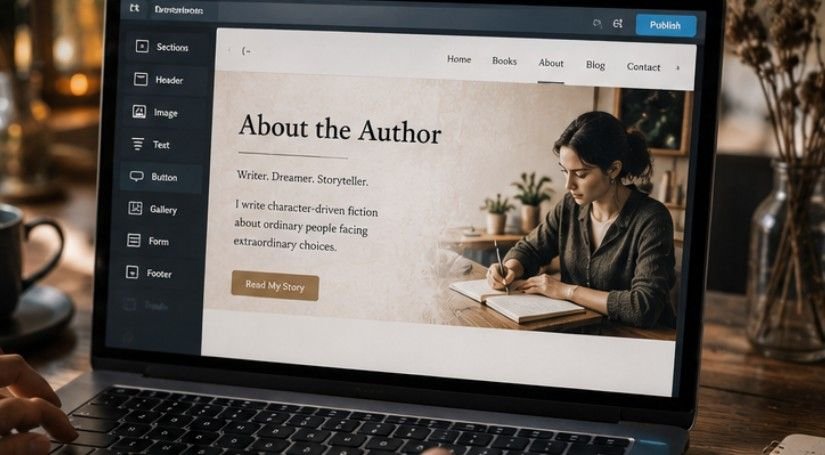
An author website does not need dozens of pages or expensive animation. Its job is simpler: help a stranger understand who you are, what you write, and what they should do next.
If you are learning how to set up an author website, start with ownership rather than appearance. Buy a domain you control, build a few useful pages, and give readers a way to stay in touch. Social platforms can change; your domain remains your home base.
Start With the Part You Own: Your Domain
For most writers, the best domain is your author name or pen name followed by .com. Keep it easy to spell and easy to say aloud.
Register the domain in your own account, even if a designer builds the site. Reedsy recommends authors keep control of their domain and hosting so future changes are not dependent on a third party.
WordPress.com currently lists standard .com registration at $13 per year, while BookBub Author Websites says domains registered through its service renew at $15 per year after the introductory period. Check renewal pricing, not just the first-year offer.
Choose a Platform Based on How You Will Use It

There is no universal “best” website builder for authors. Pick the system you will actually maintain.
WordPress suits writers who want blogging, plugins, and customization. Squarespace works well for polished templates and visual editing. BookBub’s Author Websites includes book displays, mailing-list tools, reader magnets, and author-focused templates.
Reedsy estimates an author website plus newsletter can cost about $60–$500 per year. Its 2025 marketplace data found an average professional author web-design project of about $1,640.
Build the Five Pages Readers Actually Need
IngramSpark recommends keeping author sites organized and giving individual books dedicated pages rather than burying them in one long list.

Homepage
Your homepage should quickly answer who you are, what you write, and what visitors should do next. Feature a current book or project, a brief bio, and one main action such as “Buy the book” or “Join my newsletter.”
Books
Give each published book its own page when possible. Include the cover, description, formats, publication details, reviews, and retailer links. For a series, make the reading order obvious.
Before promoting a new release, make sure the manuscript is ready. This guide on how to edit a novel manuscript offers a useful pre-launch refresher.
About
Readers do not need your whole life story. Give them details that explain your writing: genre, relevant experience, awards, interests, and a little personality.
Writers still revising may also benefit from these developmental editing tips for fiction writers before turning the site into a launch platform.
Contact and Media
Use a contact form instead of publishing a personal email address everywhere. If you have an agent or publicist, make media and rights contacts easy to find.
For interviews or events, add a media page with headshots, bios, book covers, ISBNs, and selected reviews.
Newsletter Signup
A mailing list lets you reach readers without depending on a social feed. Offer a reason to subscribe: a sample chapter, deleted scene, short story, reading guide, or launch updates. BookBub’s author platform supports signup forms and reader magnets built around this purpose.
If you send promotional email in the United States, review the Federal Trade Commission’s CAN-SPAM guidance. It covers accurate sender information, non-deceptive subject lines, a postal address, and a working opt-out process.
Make the Site Searchable Without Writing for Robots
Learning how to set up an author website also means making it understandable to search engines. Use your author name, book titles, genre, series name, and relevant subjects naturally in page titles, headings, image alt text, and descriptions.
Create pages around real reader questions: reading order, book-club questions, events, or behind-the-book essays.
If short-form publishing is part of your platform, this guide on how to submit writing to literary magazines can support that strategy.
Run a Five-Minute Launch Test
Before publishing, check the site on your phone. Can a new visitor identify your genre within five seconds? Find your books in one click? Use every purchase button? Join the mailing list easily? Contact you safely?
Then test accessibility. The U.S. Department of Justice web accessibility guidance recommends considering readable contrast, meaningful headings, keyboard navigation, zoom-friendly text, and other accessibility practices. Add useful alt text to meaningful images.
Finally, proofread the mobile version. A beautiful desktop page can still fail if a cover image pushes the buy button far below the fold.
Common Mistakes That Make Author Sites Weaker

The biggest mistake is designing for the author instead of the visitor. Hidden menus, autoplay video, crowded homepages, and too many calls to action create friction.
Another mistake is waiting until publication day. Even an unpublished writer can use a bio, writing credits, contact page, and newsletter signup while querying agents or building an audience.
The U.S. Copyright Office notes that original writing, artwork, and photographs on websites may be copyright protected, so get permission before using third-party material.
Frequently Asked Questions
1. How much does it cost to set up an author website?
A DIY author site can cost roughly $60–$500 per year depending on the domain, builder, hosting, and email tools. Professional custom design can push the initial cost into four figures.
2. How do I create my own author website?
Buy a domain, choose a builder, create homepage, books, about, contact, and newsletter pages, connect email tools, test the mobile experience, and publish.
3. How much does an author make on a $20 book?
It varies by contract and format. The Authors Guild model contract starts adult hardcover royalties at 10% of list price, equal to about $2 on a $20 book before agent considerations.
4. What is the best website platform for authors?
WordPress is strong for flexibility, Squarespace for visual simplicity, and author-specific builders for quick book and mailing-list setup. The best option is one you can maintain.
Make the Site Earn Its Keep
A good author website is not an online monument; it is a working bridge between your writing and the readers most likely to care about it. Keep the first version small, own the domain, and make every page serve a reader need. Prioritize books, email signup, contact details, speed, accessibility, and mobile usability over decoration.
Expand only when there is a clear reason, such as a new release, media kit, events page, blog, or direct store. The smartest approach to how to set up an author website is to launch something useful, then improve it as your writing career grows.