
I have always been drawn to poems that give me something I can actually see. A line about grief can be moving, but when a poet turns that feeling into a room, a body, a landscape, or some small object I can picture, the emotion tends to stay with me much longer. I have found that the poetry I return to most often is rarely the poetry I understood perfectly on the first read. It is usually the poetry that left behind an image I could not quite shake.
I also noticed that powerful imagery does not have to mean elaborate descriptions. Sometimes the strongest image comes from an ordinary detail placed in an unexpected way. A flower can carry an entire memory. A kitchen can become a place of mourning. A body can represent identity, fear, desire, or survival. That is what makes choosing poetry books with powerful imagery so interesting. The best collections do more than describe something beautifully. They make an abstract feeling feel physical.
What Makes Imagery in Poetry So Powerful?

Imagery gives an idea a shape.
Instead of simply telling you that a speaker feels lonely, a poem might place that loneliness inside an empty house, a cold bed, a fading photograph, or a landscape that suddenly feels unfamiliar. Visual imagery is only part of it, too. Strong poetry can engage sound, touch, taste, smell, temperature, movement, and memory.
Metaphor and symbolism make those details even more layered. A single object can remain literal while quietly taking on another meaning as the collection develops. That gives readers room to bring their own experiences into the poems.
The most effective imagery also tends to be specific. Rather than using broad descriptions of sadness or beauty, a poet gives you something concrete to hold onto. That specificity is often what makes a poem feel personal even when the experience belongs entirely to someone else.
Calling a Wolf a Wolf by Kaveh Akbar
Kaveh Akbar’s Calling a Wolf a Wolf is a strong choice for readers who want imagery that feels intense, intimate, and sometimes unsettling.
The collection explores addiction, recovery, desire, faith, and the struggle to understand the self. Its imagery often moves between the physical and spiritual, creating a world where craving can feel almost tangible. Objects, bodies, religious ideas, and natural imagery become ways of expressing experiences that are difficult to explain directly. The collection was first published in 2017 and became known for its treatment of addiction and recovery.
Time Is a Mother by Ocean Vuong
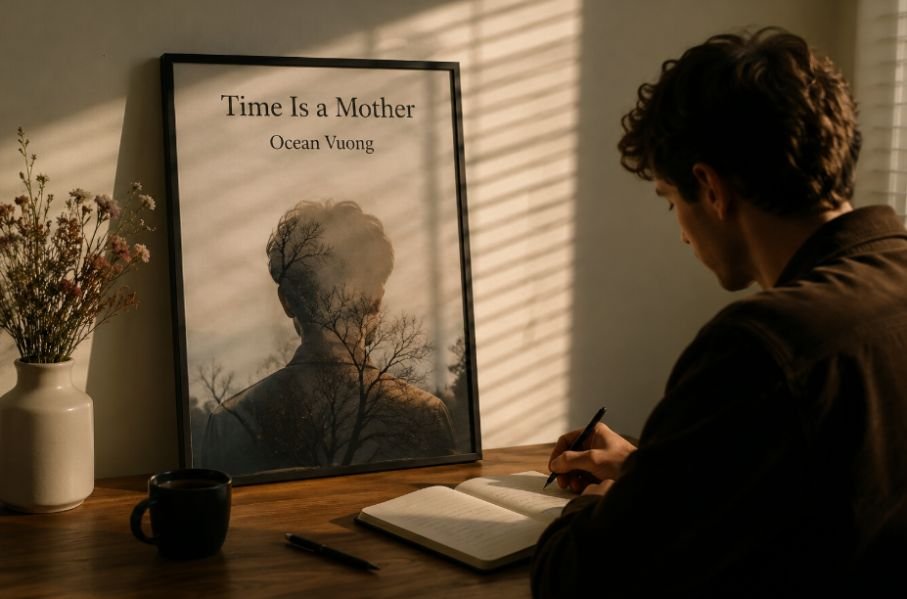
Ocean Vuong’s Time Is a Mother approaches imagery through grief, family, memory, love, and survival. Written after the death of Vuong’s mother, the collection moves through personal and social loss while still making room for tenderness and moments of joy.
The imagery here often feels cinematic. Small details can carry the weight of an entire memory, while familiar parts of everyday life become connected to absence and mourning. That quality makes the collection especially powerful for readers interested in emotional poetry that does not rely on simply naming an emotion.
Instead, grief appears through scenes, objects, memories, and fragments of life. The result is a collection where the images can feel intimate without becoming overly explained.
Deaf Republic by Ilya Kaminsky
Deaf Republic takes imagery in a different direction. Rather than building primarily around personal reflection, Ilya Kaminsky creates an imagined town under occupation and uses that setting to explore violence, resistance, silence, love, and collective action.
The collection begins with the killing of a deaf boy by soldiers. Afterward, the people of the town become deaf and communicate through sign language as their resistance grows. The narrative structure gives the poems a strong visual and theatrical quality, while the silence itself becomes part of the imagery.
That makes this collection especially interesting for readers who enjoy poetry with a larger world around it. The images are not simply decorative. They help build the atmosphere and carry the political and emotional weight of the poems.
Prelude to Bruise by Saeed Jones
Saeed Jones’s Prelude to Bruise is another powerful choice, particularly for readers interested in poetry where the body becomes central to the emotional experience.
The collection examines identity, vulnerability, desire, violence, memory, and the complicated ways people understand themselves through other people’s perceptions. The body becomes a recurring point of connection between the personal and the external world. Coffee House Press describes the collection through questions of reckoning with the past and using people and bodies as expressions of experience.
That focus gives the imagery a physical immediacy. Feelings do not remain abstract for long. They become associated with skin, movement, exposure, wounds, intimacy, and distance.
Choosing Poetry Based on Its Imagery

Not every reader responds to the same kind of imagery. A collection built around nature may feel incredibly vivid to one person while another reader connects more strongly with imagery involving memory or the body.
Before choosing a book, think about the kind of images that naturally stay with you. The way you read can matter as much as what you read, too. Readers interested in analog reading culture in America may find that physical poetry collections encourage slower, more attentive reading, making it easier to notice recurring symbols, visual details, and subtle connections between poems.
- For landscapes and sensory details, look for collections where nature, place, weather, and physical surroundings play an active role.
- For emotional depth, look for poetry that turns grief, love, memory, or identity into concrete scenes and objects.
- For symbolism, choose collections where recurring images develop additional meanings as you read.
- For something more dramatic, look for poetry with narrative settings, unusual structures, or imagery that creates an entire world.
There is no single definition of powerful imagery. What matters is whether the poet gives you something specific enough to picture and meaningful enough to remember.
Why Imagery Can Make Emotional Poetry Hit Harder
Some feelings are difficult to explain because they are too broad. Saying that someone feels heartbroken tells you the emotional state, but it does not necessarily make you experience it.
Imagery closes that distance.
A poet can take a feeling that exists internally and attach it to something physical. Suddenly, the emotion has color, texture, temperature, movement, or weight. That is one reason readers often remember individual poetic images long after they have forgotten the exact wording of a poem.
It is also why emotional poetry books about life can feel so personal. The strongest collections often do not tell readers what to feel. They give them an image and allow the feeling to develop from it.
How to Read Poetry for Its Images

You do not need to understand every poem immediately. In fact, trying to solve every line on the first reading can take some of the pleasure out of poetry.
Instead, notice what catches your attention.
Which image keeps returning? Which object suddenly feels more important than it should? What changes when a poem moves from a physical description into metaphor? Does a particular color, place, body part, animal, or household object appear more than once?
Reading closely can also help aspiring poets understand how imagery develops across an entire collection. Writers who eventually plan to publish their own work may also want to learn how to copyright a book in the U.S. so they understand the basics of protecting an original poetry manuscript.
Reading a collection slowly can reveal connections that are easy to miss when you rush through it. A poem that seems simple at first may become much more complicated once another poem gives the same image a new context.
Frequently Asked Questions
1. What is powerful imagery in poetry?
Powerful imagery uses specific sensory details, metaphors, or symbols to make an idea or emotion feel tangible. It gives readers something concrete to picture and remember.
2. Which poetry book is best for emotional imagery?
Time Is a Mother is a strong choice for readers drawn to grief, family, memory, and intimate emotional experiences expressed through vivid details.
3. Does poetry imagery have to be visual?
No. Imagery can involve sound, touch, taste, smell, movement, temperature, and physical sensation. Strong poems often combine several types.
4. How can I get better at noticing imagery?
Read slowly and pay attention to recurring objects, sensory details, unusual comparisons, and images that create an emotional response. Rereading often reveals connections you missed initially.
The Images That Stay After the Page
The poetry collections that matter most are often the ones that leave something behind after you close the book. You may not remember every poem or be able to explain every metaphor, but one image can remain surprisingly clear. A particular landscape, body, object, silence, or moment can return to you days later because the poet gave an otherwise invisible feeling a physical form.
That is the real pleasure of imagery. The words end on the page, but the picture can keep changing in your mind.