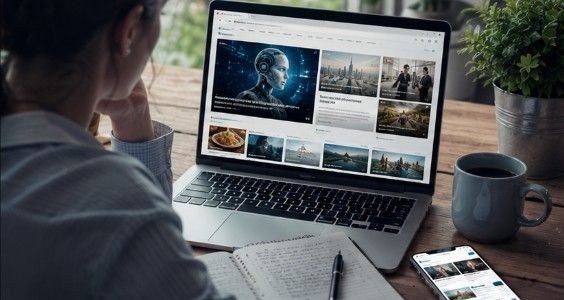
Americans live through screens, yet one of 2026’s most noticeable reading trends is decidedly low-tech: paper. The analog reading culture in America is growing as readers seek relief from digital fatigue, fragmented attention, and constant connectivity. I see it less as nostalgia and more as a deliberate effort to make reading focused, physical, and social again.
Why Are Americans Returning to Physical Books?
Print never disappeared, but its role is changing. Pew Research Center reported in April 2026 that 75% of US adults had read at least part of a book in the previous year. Sixty-four percent had read a print book, compared with 31% who had read an e-book and 26% who had listened to an audiobook.
That matters because physical books now compete with phones, streaming, emails, social feeds, and notifications. Choosing print can become intentional screen-free time, whether readers are revisiting classics or exploring the best contemporary American authors to read.
The broader “analog moment,” sometimes called the “year of analog,” reflects the same desire as Americans return to journals, film cameras, vinyl, and other offline hobbies.
Is Doomscrolling Fueling the Analog Reading Revival?

For many readers, yes. Social platforms encourage endless scrolling, quick rewards, and constant novelty. A printed book has fixed pages, a clear beginning and end, and no notifications waiting between paragraphs.
Ideas such as #ReadMoreScrollLess capture that contrast. Some readers keep a paperback nearby instead of automatically reaching for a phone, connecting reading with digital detox, slow living, and attention management.
Researchers have also examined what is sometimes described as a “shallow screen reading mindset.” The point is not that screens automatically harm comprehension. Rather, repeated skimming, switching, and fragmented online reading can encourage habits less suited to sustained long-form attention. Print removes many of those distractions.
Why Does Reading a Physical Book Feel Different?
Physical books offer sensory and emotional ownership. Readers can feel a hardcover’s weight, watch a bookmark move forward, underline sentences, and write in margins. The smell of paper and visible progress through a book create useful “friction” that makes reading feel slower and more deliberate.
That tactile experience also gives physical books permanence. Unlike a digital file stored behind an account or app, a favorite novel can sit on a shelf, collect annotations, become a gift, or remain part of a personal library for decades.
Why Is Gen Z Leading a Post-Digital Reading Trend?
One of the most interesting parts of the analog reading culture in America is that highly connected younger readers are helping drive it.
American Library Association research found that 54% of surveyed Gen Z and Millennials had visited a physical library during the previous 12 months. Respondents also read and bought roughly twice as many print books per month as e-books or audiobooks, and the research identified print as Gen Z’s preferred format.
This is not an anti-technology movement. It is post-digital behavior: young readers often use technology to discover books and then choose physical copies for the reading experience.
How Do BookTok and Bookstagram Drive Print Sales?

BookTok and Bookstagram turn discovery into a visual, social experience. Readers encounter reviews, shelf tours, reading challenges, discussions about the best American novels of all time, and special editions online, then buy physical books offline.
ALA research found that one in three surveyed Gen Z and Millennials had bought books because of Instagram recommendations or advertising, while 31% reported purchases influenced by TikTok reviews or ads.
Physical books have also become aesthetic objects. Special-edition hardbacks, matching sets, annotated copies, and curated bookshelves make books collectible in ways digital files cannot match. Research from Cambridge University Press also highlights how Gen Z moves fluidly between online book discovery and physical reading.
What Is the “Analog Bag” Trend?
The analog revival has become part of lifestyle culture too. CNBC reported in 2026 on young consumers carrying “analog” items such as paper planners, journals, film cameras, and books so they always have an offline activity available.
A paperback in a tote can replace the reflex to open a social app while commuting or waiting for coffee. Carrying a book also makes reading part of personal identity and style.
Are Bookstores, Libraries, and Silent Book Clubs Growing Too?
Analog reading is also rebuilding physical communities. Public libraries remain important American third spaces, while independent bookstores act as neighborhood hubs through author events, recommendations, cafés, book clubs, and discussions celebrating famous women writers and other influential literary voices.
Silent reading groups add another dimension. People meet in bookstores, cafés, bars, or parks, read their own books quietly, and socialize before or afterward. The format provides companionship without requiring everyone to read the same title.
For readers who feel digitally connected yet physically isolated, these spaces create low-pressure, real-world community.
Are E-Books and Audiobooks Losing to Print?

Not really. American reading habits look increasingly hybrid.
Pew data shows that e-book and audiobook use has grown substantially since 2011 while print remains dominant. Readers choose formats by situation: audiobooks for commuting, e-books for portability, and physical books for screen-free focus, collecting, or annotation.
Publishers Weekly also reported that adult fiction unit volume in 2025 remained nearly 50% above its 2020 level while booksellers paid greater attention to the “analog living” trend. Physical reading can thrive without digital reading disappearing.
Frequently Asked Questions (FAQs)
1. Why Is Analog Reading Becoming Popular Again in the US?
Screen fatigue, doomscrolling, fragmented attention, tactile experiences, BookTok, libraries, bookstores, and reading communities are all contributing to renewed interest in physical books.
2. Why Does Gen Z Prefer Printed Books?
Many younger readers value print for its tactile feel, visual appeal, collectibility, and screen-free nature while still relying on TikTok, Instagram, and other digital communities to discover titles.
3. What Counts as Analog Reading?
It includes paper books, print magazines, handwritten annotation, reading journals, library browsing, bookstore visits, and other screen-free reading habits.
Why the Future of Reading Will Be Both Digital and Physical
I do not think America is returning to a pre-smartphone world. Digital formats offer convenience and accessibility that print cannot match. What is changing is the value readers place on experiences that do not demand another screen.
That is why analog reading culture in America feels less like rejecting technology and more like correcting digital overload. A reader can discover a novel on TikTok, discuss it online, and still spend Saturday afternoon reading the paperback in a neighborhood café. In an always-connected country, turning a page has become a surprisingly modern way to slow down.