I know how confusing professional editing can feel when every editor seems to describe their services differently. One website recommends line editing, another combines it with copy editing, and someone else suggests that proofreading will prepare a manuscript for publication. These services may overlap slightly, but they solve very different problems.
In this guide, I’ll make line editing vs proofreading explained in practical terms, using examples rather than vague definitions. You’ll learn what each editor examines, when each service belongs in the publishing process, and how to choose the right one without wasting money.
What Is Line Editing?
Line editing improves writing at the sentence and paragraph level. Its purpose is not simply to find mistakes. A line editor examines how effectively your language communicates the intended meaning, emotion, voice, and atmosphere.
The editor may revise awkward sentences, remove unnecessary words, improve transitions, flag repetition, tips for writing dialogue, and suggest more precise language. They also watch for inconsistent tone, confusing point-of-view shifts, unnatural phrasing, and passages that interrupt the narrative flow.
For example, consider this sentence:
“She walked very slowly into the room because she was nervous about what he might tell her.”
A line editor might change it to:
“She edged into the room, bracing for his answer.”
Both sentences communicate the same basic action. However, the edited version is tighter, more vivid, and emotionally stronger. This kind of intervention goes beyond correcting grammar.
What a Line Editor Commonly Checks
A line editor generally examines:
- Sentence clarity and construction
- Word choice and unnecessary repetition
- Voice, tone, and style
- Dialogue and narrative flow
- Paragraph transitions
- Rhythm and readability
- Point-of-view consistency
- Clichés, vague descriptions, and overwritten passages
The editor should improve the prose without replacing the author’s individual voice.
What Is Proofreading?
Proofreading is the final quality-control stage before publication. It checks an already edited manuscript for errors that remain or were introduced during formatting.
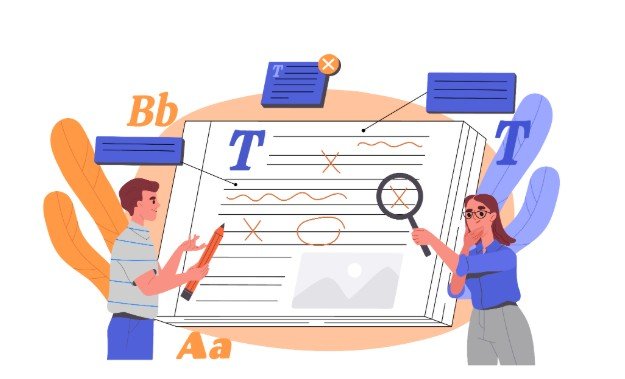
A proofreader searches for typographical errors, misspellings, missing punctuation, incorrect capitalization, inconsistent spacing, and formatting problems. In book publishing, proofreading often takes place after the manuscript has been typeset or converted into its final layout.
Suppose the line-edited sentence appears as:
“She edged into the room bracing for his answer.”
A proofreader may add the missing comma:
“She edged into the room, bracing for his answer.”
The proofreader corrects the error but does not normally rewrite the sentence to make it more dramatic. That difference in scope is crucial.
What a Proofreader Commonly Checks
Proofreading normally covers:
- Spelling and typographical errors
- Missing or repeated words
- Grammar and punctuation mistakes
- Incorrect page numbers
- Inconsistent headings and fonts
- Awkward line or page breaks
- Spacing and indentation problems
- Formatting inconsistencies
- Errors in captions, contents pages, and running headers
A proofreader may alert the author to a serious problem, but extensive rewriting is usually outside the agreed service.
The Main Difference Between the Two Services
Line editing asks, “Is this the most effective way to express the idea?”
Proofreading asks, “Is the final version accurate, consistent, and ready to publish?”
Line editing can substantially change sentences, while proofreading should involve only limited corrections. A line editor works with prose that still requires refinement, whereas a proofreader handles content that should already be polished and structurally complete. Understanding developmental editing vs copy editing also helps authors distinguish these sentence-level and final-stage services from broader structural editing.
Line editing is therefore a creative and interpretive process. Proofreading is a controlled final inspection.
Where They Belong in the Editing Process
A professional book may pass through several stages:
- Developmental editing
- Author revisions
- Line editing
- Copy editing
- Typesetting or formatting
- Proofreading
- Publication
Developmental editing addresses the manuscript’s larger structure. For fiction, that can include plot, pacing, character development, scene order, and strategies to build tension in literary fiction. For nonfiction, it may include organisation, argument, missing information, and chapter progression.
Line editing then refines the language. Copy editing checks correctness, consistency, usage, grammar, and adherence to a chosen style guide. Proofreading catches the final errors after the text and layout are almost complete.
Not every publishing project separates these services. Some editors combine line editing and copy editing, while smaller publishers may organise the workflow differently.
Why Editing Terminology Can Be Confusing
There is no universal agreement on every editing label. An editor may advertise “copy editing” while including substantial sentence-level work. Another professional may call the same service “line and copy editing.”
As with design for product labels, the exact scope depends on the provider’s process and stated deliverables. Definitions can also vary between publishing markets. Consequently, authors should compare deliverables instead of choosing a service solely by its name.
Before hiring anyone, ask what will actually be reviewed. Will the editor improve voice and flow? Will changes be tracked? Is a style sheet included? Does the service cover formatting errors? Will the editor provide an editorial letter?
A short sample edit can reveal more than a service label. It shows how extensively the editor will intervene and whether their approach suits your voice.
Can Proofreading Replace Line Editing?
Proofreading cannot replace line editing when the prose is repetitive, unclear, inconsistent, or difficult to read.
A proofreader may produce a grammatically cleaner manuscript, but perfect punctuation will not repair flat dialogue, confusing sentences, weak transitions, or excessive exposition. Hiring a proofreader too early can create additional costs because the manuscript may still require editing and another proofread later.
Proofreading alone may be appropriate when a manuscript has already received careful editing and has reached its final formatted stage. It is not an inexpensive substitute for deeper editorial work.
How to Decide Which Service You Need
Choose line editing if readers understand your story or argument but regularly comment that the writing feels awkward, repetitive, slow, or unclear. It is also appropriate when your structure is stable but individual paragraphs still lack energy or precision. This level of editing can be particularly helpful when learning how to write big articles and not get tired, as it reveals recurring habits that weaken clarity and momentum.
Choose proofreading if the manuscript has already been revised and professionally edited, and you are preparing the final files for publication. At this stage, you should be satisfied with the language and organisation.
If you remain uncertain, send a representative chapter to an experienced editor and request an assessment or sample. Explain the manuscript’s history, your intended audience, and the editing it has already received.
Questions to Ask Before Hiring an Editor
Ask prospective editors:
- How do you define the service?
- What problems are included and excluded?
- Have you edited books in my genre?
- Do you use tracked changes and comments?
- Will I receive a style sheet or editorial letter?
- Can you provide a sample edit?
- Will another proofread be required afterward?
- What happens if you discover larger problems?
Clear answers protect both the author and the editor from mismatched expectations, allowing them to develop a consistent writing routine that accommodates feedback, revisions, and deadlines.
Frequently Asked Questions
1. What is the simplest way to have line editing vs proofreading explained?
Line editing strengthens the language and reading experience, while proofreading catches final mechanical and formatting errors before publication.
2. Does line editing include grammar corrections?
A line editor may correct grammar encountered during the edit, but grammar is not the service’s only purpose. The main focus is clarity, style, voice, rhythm, and flow.
3. Should proofreading happen before formatting?
The final proofread generally works best after formatting because new errors can appear during typesetting. An earlier review may still be useful, but it should not replace the final check.
4. Can I proofread my own book?
You can review your own book, but familiarity makes errors harder to notice. A fresh, trained reader is more likely to catch missing words, inconsistencies, and layout problems.
5. Do I need copy editing as well?
Many manuscripts benefit from copy editing between line editing and proofreading. However, some professionals combine line and copy editing, so confirm exactly what the quoted service includes.
Final Thoughts
I would choose an editor by the work my manuscript needs, not by the label attached to the service. If the prose needs stronger language, better rhythm, or clearer sentences, line editing is the appropriate investment. If the book is already edited, formatted, and almost ready for readers, proofreading provides the final safeguard.
The right sequence prevents duplicated costs and last-minute delays. More importantly, it allows every editorial stage to do its proper job, moving the manuscript from a promising draft to a polished publication.