Most people think you need thousands of books. You don’t. The honest answer to how many books to be considered a library sits closer to 1,000 volumes for a formal institutional collection, but for a personal or home library, the number is far more flexible than any official body will tell you.
This article will give you the actual figures, explain what qualifies as a library under different definitions, and walk you through how to build a home library that earns the name without filling three rooms with shelving units you can’t afford.
How Many Books to Be Considered a Library: The Numbers That Actually Matter
There is no single globally enforced threshold. That’s the first thing to understand. The International Federation of Library Associations and Institutions (IFLA) sets broad professional standards for institutional libraries but stops short of mandating a minimum book count for all library types. What you find instead is a patchwork of professional norms and local regulations.
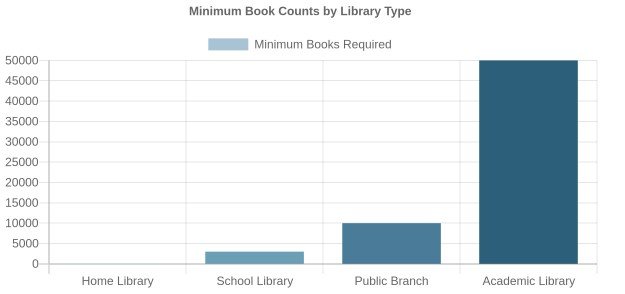
For public libraries in the United States, the American Library Association recommends that a branch collection hold at least 10,000 volumes to serve a small community effectively. Academic libraries often hold hundreds of thousands. School libraries typically aim for a minimum of 10 books per enrolled student, which in a school of 300 kids puts the floor around 3,000 volumes.
But here’s the thing: those numbers describe institutions. The question most readers of a small press site are actually asking is about personal collections. And for a personal library definition, the range most librarians and book culture writers accept is roughly 100 to 500 books. Below 100, you have a respectable reading shelf. Above 500, you’re running what almost anyone would call a proper library without argument.
| Collection Type | Commonly Accepted Minimum | Source / Standard |
|---|---|---|
| Public Library Branch | 10,000 volumes | ALA guidelines |
| School Library | 10 books per student | ALA / AASL standards |
| Academic Library | 50,000+ volumes | ACRL benchmarks |
| Home / Personal Library | 100 to 500 books (widely cited) | Book culture consensus |
| Special / Niche Collection | No universal minimum | IFLA framework |
What Qualifies as a Library Beyond Raw Book Count
Count alone does not settle the question. What makes a collection a library has always been about organization and access, not just volume. A pile of 2,000 books in a garage is a hoard. A carefully catalogued set of 150 books on a single subject, organized so that anyone can find what they need, is functionally a library.
Librarians generally point to three elements that separate a library from a pile of books:
- Organization by a consistent system (alphabetical by author, subject categories, Dewey Decimal, or even your own personal schema).
- Intentional curation, meaning the collection was assembled around a purpose or theme, not just accumulated by accident.
- Accessibility, meaning someone other than you could navigate it, or at least that you yourself can retrieve any item quickly.
The personal library definition most commonly cited by book historians and archivists leans into this idea of intentionality. A home library size of 200 books that covers a specific subject deeply and is organized logically earns the label faster than a random scatter of 800 paperbacks nobody can locate.
A 2021 study published through the Pew Research Center found that about 27% of American adults reported not reading a single book in the previous year. The people who do read tend to own more books than anyone estimates, and the homes with the largest collections are generally the homes where reading habits started earliest. That context matters when you’re asking what makes a collection a library: it’s as much about relationship with the objects as it is about raw count.
What Makes a Collection a Library: The Curation Argument
Jorge Luis Borges called his library a “garden of forking paths.” Umberto Eco famously maintained a private collection of over 30,000 books in his Turin apartment, though he was quick to point out that the books he hadn’t read were more valuable to him than the ones he had, because they represented what he still didn’t know. Eco’s idea became known as the “antilibrary” concept, later popularized by Nassim Nicholas Taleb.
“Read books are far less valuable than unread ones. The library should contain as much of what you do not know as your financial means, mortgage rates, and the currently tight real-estate market allows you to put there.” Nassim Nicholas Taleb, The Black Swan, 2007.
That philosophy won’t land the same way for everyone, but it reframes the whole question of how many books make a library. If you’re building a collection as a research tool and intellectual companion, the number that qualifies will always be higher than what you’ve already absorbed. That’s actually a motivating idea rather than a discouraging one.
Average Number of Books in a Library and What That Tells You

The average number of books in a library varies wildly by type. The American Library Association’s library fact sheet reports that the average public library in the United States holds approximately 57,000 print volumes. Academic libraries at major research universities often exceed 1 million volumes. Those numbers can feel paralyzing if you’re sizing your personal collection against them.
Don’t. A home library is not competing with a university archive.
For a home context, how many books in a home library typically ranges from 50 to 2,000 depending on the household. Surveys of book-loving households suggest that serious readers often land between 200 and 800 volumes. The sweet spot where a home collection stops feeling like a shelf and starts feeling like a room with a purpose sits around 300 to 400 books, by most accounts from people who write about book culture regularly.
How Many Books Do You Need for a Library at Home
Here’s my honest take: 200 books, organized and curated, is enough to call it a library without anyone laughing at you. If you’re building a specialty collection around small press fiction, poetry chapbooks, or independent publishing (which fits perfectly with what this site is about), 150 titles on a defined theme carries more weight than 600 randomly acquired bestsellers.
How many books do you need for a library depends on the purpose you define before you start buying. A reference library for a writer needs different depth than a lending library shared with a book club. A collection of first editions has different requirements than a reading library you cycle through actively. Set the purpose first, then reverse-engineer the minimum number of books for a library that fulfills that purpose.
For most home situations, here’s the framework I’d use (and I’m calling it the Purpose-First Library Scale):
- Reading Library (personal use, active rotation): 100 to 300 books, organized by genre or mood.
- Subject Library (deep focus on one area, like small press poetry): 75 to 200 titles, organized by author or press.
- Reference Library (writer’s or researcher’s tool): 200 to 500 books, organized by topic with heavy annotation and notes.
- Showcase Library (curated, aesthetic, social): 150 to 400 books, organized for visual coherence and thematic resonance.
How Many Books Should a Home Library Have: Small Press Perspective
For readers and writers in the small press world, how many books should a home library have takes on a specific texture. Small press titles, chapbooks, and limited-edition collections don’t always take up the same shelf space as trade paperbacks. A home library built around independent and small press publishing might include 400 to 600 items and still fit on two standard-length shelving units if the titles run slim.
Home library size in this context is also about depth. A single shelf of 40 chapbooks from independent poetry presses represents more curation than 200 airport thrillers picked up at random. The minimum number of books for a library in the small press niche can reasonably sit at 75 to 100 carefully chosen titles if the collection is organized and purposeful.
How many books make a library matters less than whether the collection reflects genuine engagement with a subject. A focused collection that includes the second Harry Potter book, for example, can hold more personal value than shelves filled without intention. That’s my position, and I’d hold it against any argument that defaults to a raw number.
Small Home Library Ideas That Work in Real Spaces

Most people don’t have a dedicated library room. That’s fine. Small home library ideas don’t require an estate. They require vertical space and a decision about what stays.
A built-in floor-to-ceiling unit along one wall of a living room can hold 400 to 600 paperbacks. A pair of BILLY bookcases from IKEA (each running about $60 as of 2024) with added height extensions gives you roughly 200 to 250 volumes per unit depending on book size. That’s a workable library for under $150 in shelving.
For genuinely small spaces, corner shelving, over-door racks, and under-stair builds are legitimate routes. Some of the most thoughtful home libraries I’ve seen photographed online occupy a single dedicated corner of a bedroom. Even a collection shaped by a specific question, such as when was Book of Enoch written, can become a purposeful library. The physical arrangement signals intent, which is half of what makes a collection a library in the first place.
How many books in a home library can fit in a 10-foot wall unit? Realistically, 300 to 400 standard paperbacks or 200 to 250 hardcovers. That’s a solid working library in one stretch of wall.
How to Build a Home Library Without Starting Over Every Year
Building is different from accumulating. How to build a home library the right way means making decisions up front that save you from a chaotic, unmanageable pile two years from now. Here’s a practical checklist you can actually use:
- Define your collection’s purpose in one sentence before you buy anything new.
- Choose an organization system (author alphabetical, subject grouping, or press-based for small press collections) and commit to it before the first book goes on the shelf.
- Set a physical limit based on your actual space, not aspirational future space. If you have room for 200 books, plan for 200 books and buy a second unit only when that’s genuinely full.
- Run a weeding pass every 12 months. Remove anything that no longer fits the collection’s stated purpose. Donate to a local library or a Little Free Library rather than selling, if you can.
- Log your collection in a free tool like LibraryThing (librarything.com) or Goodreads so you can track what you own, what you’ve read, and gaps in coverage.
- Prioritize depth over breadth. Five books by the same small press author tell a better story on a shelf than five books from five entirely unrelated genres.
How to build a home library is ultimately a question of identity as much as logistics. You’re deciding what kind of reader and thinker you want to be, whether your curiosity leads you to ask what is book Icebreaker about or to explore an entirely different genre. The collection reflects that identity over time.
How Many Books to Be Considered a Library: A Practical Decision Guide
If you need a definitive answer to take away and use, here it is. For a personal library definition that most book people would accept without argument:
- Under 50 books: a shelf, not a library.
- 50 to 99 books: a strong personal collection, starting to feel intentional.
- 100 to 299 books: a home library by most informal definitions, especially if organized.
- 300 to 999 books: a proper personal library, no qualification needed.
- 1,000 or more books: a private library by historical and institutional definitions.
The minimum number of books for a library in a home context is 100, with organization. Below that, you’re building toward a library. Above that, you already have one. That’s the practical answer. Everything else is context.
How many books make a library will always depend somewhat on who’s asking and why. For formal institutions, the bars are much higher. For someone building a focused collection of small press fiction or independent poetry, 100 curated, organized titles is more than enough to earn the name.
Final Thought
The question of how many books to be considered a library has a bureaucratic answer and a real answer, and they rarely match. Your home library size doesn’t need validation from an accrediting body. It needs a purpose, an organizing principle, and enough depth to be genuinely useful to you as a reader and thinker.
Start with the 100-book threshold. Build with intention. Weed regularly. And consider what small press titles belong in your collection, because independent publishing is exactly the kind of thing a personal library should be preserving and celebrating. What does your collection say about what you think is worth keeping?