Scholars date the earliest sections of the Book of Enoch to roughly 300 BCE, with the bulk of the text compiled between 200 BCE and 100 BCE. That puts it squarely in the Second Temple period of Jewish history, centuries before Christianity existed and long before the biblical canon hardened into the form you recognize today. If you’ve been told this is some fringe document dug up by conspiracy theorists, the archaeological record disagrees.
Fragments of 1 Enoch were found among the Dead Sea Scrolls, which means Jewish scribes were copying and preserving this text at least two thousand years ago. This article covers who wrote it, when the different sections were composed, what the Book of Enoch says, why it was pulled from the Bible, and what it actually means for readers who care about ancient literature and early religious thought.
When Was the Book of Enoch Written: A Timeline of Composition
The Book of Enoch is not a single book written in one sitting by one author. That’s the first thing you need to understand. Scholars generally refer to the complete work as 1 Enoch, a composite text made up of at least five distinct sections, each with its own approximate date of origin. Here’s how the timeline breaks down based on the most widely accepted textual scholarship:
| Section | Chapters | Estimated Date | Primary Themes
|
|---|---|---|---|
| Book of the Watchers | 1 to 36 | 300 to 200 BCE | Fallen angels, Nephilim, cosmic tour |
| Book of Parables | 37 to 71 | 100 BCE to 70 CE | Son of Man, final judgment |
| Book of Luminaries | 72 to 82 | 300 to 200 BCE | Astronomy, calendars, solar/lunar cycles |
| Book of Dream Visions | 83 to 90 | 165 to 161 BCE | History of Israel in symbolic form |
| Epistle of Enoch | 91 to 108 | 200 to 100 BCE | Ethics, apocalyptic woes, final age |
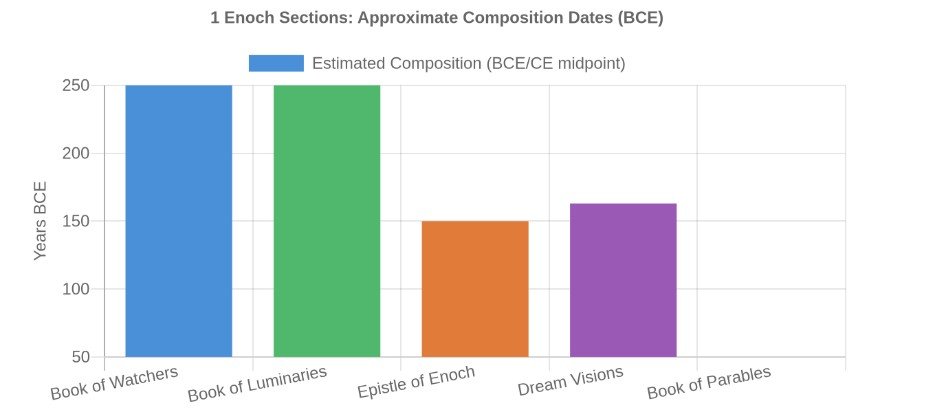
The question of when was the book of enoch written doesn’t have one clean answer. The Book of the Watchers and the Book of Luminaries are the oldest, likely predating the Maccabean revolt. The Book of Dream Visions, by contrast, appears to have been written during the Maccabean revolt itself, sometime around 165 BCE, because its symbolic history abruptly ends right at that moment, which is exactly the tell-tale sign of a text composed in real time rather than looking back on events from a distance.
Who Wrote the Book of Enoch?
Nobody named Enoch wrote it. The biblical Enoch, described in Genesis 5 as the great-great-great-great-grandson of Adam who “walked with God” and never died, lived thousands of years before writing was even invented, at least according to the internal chronology of the Hebrew Bible. So who wrote the book of enoch in practice?
Scholars are confident the text was written pseudepigraphically, meaning anonymous Jewish authors wrote under the name of Enoch to give their work ancient authority. This was a common literary strategy in the Second Temple period. You wanted your ideas to carry weight, so you attached them to a legendary figure. The actual authors were almost certainly Jewish scribal circles, possibly associated with Levitical priestly traditions or proto-apocalyptic movements that were wrestling with real political crises: Hellenistic cultural pressure, foreign domination, and questions about why the righteous suffered while the wicked prospered.
George W. E. Nickelsburg, one of the foremost Enoch scholars of the modern era, spent decades studying the text and concluded that multiple authors across multiple generations contributed to what we now call 1 Enoch. His two-volume commentary published by Fortress Press remains the standard academic reference. The community that produced and circulated the text almost certainly overlapped with the community that later produced some of the Dead Sea Scrolls, though the exact organizational link is still debated.
Book of Enoch Summary: What the Text Actually Contains
A book of enoch summary can’t fit in one paragraph, but here’s the honest shape of it. The text opens with a vision of the end of the world, then pivots to what became the most famous section: the story of the Watchers.
The Watchers are divine beings, angels assigned to watch over humanity, who looked down at human women, found them beautiful, and decided to abandon their heavenly station to come to earth and take wives. This is the book of enoch fallen angels narrative that has captured imaginations for centuries. Two hundred of these beings descended on Mount Hermon.
Their leader, Semyaza, organized the whole rebellion. Another figure, Azazel, taught humans forbidden knowledge: how to make weapons of war, how to use cosmetics and seduction, how to practice sorcery. The union of these fallen angels with human women produced offspring known as the book of enoch giants, often identified with the book of enoch nephilim of Genesis 6.
These giants, according to the text, were enormous beings who devoured the earth’s resources and then turned on humans, animals, and eventually each other. God saw the chaos, sent the archangels Uriel, Raphael, Michael, and Gabriel to deal with it, and eventually unleashed the flood of Noah. Azazel was bound under rocks in the desert. Semyaza and the other Watchers were imprisoned in darkness until final judgment. The giants’ spirits, after the giants died in the flood, became what the text calls evil spirits that wander the earth, afflicting humanity.
The Rest of 1 Enoch
That’s just the opening section. The rest of 1 Enoch includes Enoch’s guided cosmic tour through heaven and the places where the dead wait for judgment, the astronomical treatise in the Book of Luminaries, the symbolic history of Israel rendered as animals (the Dream Visions), and the Epistle of Enoch which reads like apocalyptic social criticism aimed at the corrupt wealthy class.
“1 Enoch is a crucial document for understanding the religious environment in which both Judaism and Christianity developed. Without it, much of what we read in the New Testament is simply not fully comprehensible.”
James VanderKam, Professor Emeritus of Hebrew Scriptures at the University of Notre Dame and co-author of The Meaning of the Dead Sea Scrolls, in his introductory study of the Enoch tradition.
VanderKam’s point is not a fringe opinion. It reflects a near-consensus in Second Temple scholarship. The book of enoch bible connection runs deeper than most casual readers expect.
The Book of Enoch Explained: Its Relationship to the Bible
Is the book of enoch biblical? The short answer is: it depends where you live and what tradition you follow. For most Protestant Christians and Catholic Christians, no, 1 Enoch is not part of the biblical canon. But for the Ethiopian Orthodox Tewahedo Church, the book of enoch bible status is fully canonical. Ethiopian Christians have treated 1 Enoch as scripture for well over a thousand years, and the Ge’ez language version is actually the most complete manuscript tradition we have for the entire text.
The book of enoch bible connection in Protestant and Catholic traditions is indirect but undeniable. The New Testament book of Jude explicitly quotes 1 Enoch. Jude 14-15 reads: “Enoch, the seventh from Adam, prophesied about these men: ‘See, the Lord is coming with thousands upon thousands of his holy ones to judge everyone.'” That is a direct quote from 1 Enoch 1:9. The author of Jude didn’t flag it as apocrypha. He cited it as authoritative prophecy.
Peter’s letters, parts of Revelation, and several Gospel passages show clear thematic dependence on Enoch’s framework of fallen angels, cosmic judgment, and the Son of Man figure. So when people ask is the book of enoch biblical, a more precise answer is: the biblical authors knew it, used it, and did not flag it as heresy. That came later.
Why Was the Book of Enoch Removed from the Bible?
Why was the book of enoch removed from the bible is the question that gets the most online traffic, and the honest answer is more mundane than the conspiracist version. The book was never formally “removed” from a unified canon, because that unified canon didn’t exist in the way people imagine during the early centuries CE.
Here’s what actually happened. Jewish rabbinical leadership at the Council of Jamnia (around 90 CE) was in the process of defining which texts were authoritative after the destruction of the Temple. 1 Enoch didn’t make the cut for what became the Hebrew Bible, likely because its angelology was considered too speculative, its cosmology was at odds with emerging rabbinic interpretations, and it wasn’t written in Hebrew (the surviving copies were in Aramaic and Greek). The rabbis prioritized texts they could trace to prophetic authority within Israel’s recognized history.
Early Christian communities were messier. Some church fathers, like Tertullian in the late second century CE, accepted Enoch as authentic scripture. Others, like Origen and Jerome, were skeptical. By the time the major councils of the fourth century consolidated Christian canon lists, 1 Enoch had been sidelined except in the Ethiopian church. The reason was partly theological, partly political, and partly that the text’s detailed angel mythology had started to feel theologically inconvenient for orthodoxies that wanted tighter control over cosmological claims. That’s why was the book of enoch removed from the bible in practical terms: not a single decision, but a drift toward exclusion over several centuries.
When Was the Book of Enoch Written: Evidence from the Dead Sea Scrolls
The most definitive physical evidence for when was the book of enoch written comes from the Dead Sea Scrolls discovered at Qumran in 1947. Scholars working with the Israel Antiquities Authority identified fragments of 1 Enoch written in Aramaic across multiple Qumran caves. Carbon dating and paleographic analysis place the oldest of these fragments somewhere between 200 BCE and 150 BCE, which means the text was already being copied and treated as important literature at that date. The original composition must be earlier still.
What the Qumran evidence also shows is that the community there had extensive Enoch literature, possibly more than has survived. They had copies of multiple Enoch sections, astronomical tables that match the Book of Luminaries, and texts that elaborated on the Watcher mythology. The scrolls suggest that 1 Enoch wasn’t a marginal text in Second Temple Judaism. It was mainstream in at least some Jewish communities.
The book of enoch explained through the Dead Sea Scrolls lens is a text that held serious religious authority for Jewish communities before and during the time of Jesus. That context matters enormously for how you read the New Testament’s use of Enoch material.
Book of Enoch Giants and Nephilim: The Most Controversial Section
The book of enoch giants narrative is the part that has generated the most cultural fascination, from ancient Jewish readers to modern internet researchers. The text says the Watchers produced offspring that were 450 feet tall, though different manuscript traditions give different numbers. These are the book of enoch nephilim, linked to the “sons of God” and “daughters of men” passage in Genesis 6:1-4, one of the most debated and compressed passages in all of Hebrew scripture.
Genesis gives you two verses. 1 Enoch gives you multiple chapters of backstory, names, and consequences. For many ancient readers, Enoch was filling in a gap that Genesis left deliberately vague. Whether that fill-in is theologically or historically accurate is exactly what makes is the book of enoch true such a persistent question. You’re essentially asking whether an ancient pseudepigraphical apocalyptic text reflects genuine oral tradition about events before Noah’s flood, or whether it’s a literary-theological explanation of why the world is broken, using mythological categories that ancient readers understood.
Most mainstream biblical scholars treat the giant mythology as literary and theological rather than literal history. But they also take seriously that the book of enoch nephilim tradition shaped how first-century Jews and Christians understood cosmic evil, spiritual warfare, and the origin of demons. Those theological ideas have real influence on New Testament passages whether or not giants were literally 450 feet tall.
1 Enoch Summary: The Five Books at a Glance
A 1 enoch summary that’s actually useful needs to treat each section separately. Here’s the condensed version of each major section so you can understand what you’re reading when you pick up the full text:
The Book of the Watchers (chapters 1 to 36)
It is the foundation. Fallen angels, the book of enoch nephilim, Enoch’s intercession before God on behalf of the Watchers (which gets rejected), and a cosmic tour of the ends of the earth. This is the section quoted in Jude and echoed throughout the New Testament.
The Book of Parables (chapters 37 to 71)
It is the most theologically loaded section for Christian readers because it develops the “Son of Man” figure as a pre-existent heavenly being who will judge the wicked. Some scholars argue Jesus’ use of the title “Son of Man” was directly informed by this Enochic tradition. This section was not found at Qumran, which is one reason scholars debate its date most vigorously.
The Book of Luminaries (chapters 72 to 82)
It is an astronomical text, almost a scientific treatise by ancient standards. It describes the movements of the sun and moon, argues for a 364-day solar calendar, and attributes the transmission of this knowledge to the angel Uriel. For those who find the giant mythology too wild, this section is fascinating as a window into ancient Jewish cosmology and timekeeping debates.
The Book of Dream Visions (chapters 83 to 90)
Sometimes called the “Animal Apocalypse,” recasts the entire history of Israel using animals as symbols. Adam is a white bull. The fallen Watchers are stars that fall from heaven. Israel’s enemies are different animals, wolves, ravens, foxes. It culminates in a messianic age. The abrupt halt around the Maccabean period is why scholars date this section so precisely to about 165 BCE.
The Epistle of Enoch (chapters 91 to 108)
Wraps the whole collection with moral exhortation and a famous sequence called the Apocalypse of Weeks, which divides all of human history into ten symbolic periods. The woes against the wealthy and powerful in this section read almost like prophetic social criticism. Some scholars see echoes of it in the book of James in the New Testament.
That’s the 1 enoch summary in its most compressed form. The full text, with good scholarly annotations, runs about 100 to 120 pages. George Nickelsburg and James VanderKam’s translation published by Fortress Press is the one I’d send you to first if you want something rigorous but readable. You can also find accessible introductions through the Society of Biblical Literature, which publishes and promotes scholarship on exactly this kind of text.
What Does the Book of Enoch Say About Judgment and the Afterlife?
What does the book of enoch say beyond the famous fallen angel narrative? Quite a lot, and most of it is about judgment. The text is relentlessly focused on the question of theodicy, why bad things happen to good people and vice versa, and its answer is: patience. The wicked prosper now, but cosmic judgment is coming and the machinery of that judgment is already in motion at the heavenly level.
Enoch’s cosmic tour shows him the places where the dead wait: a hollow mountain divided into four chambers, with separate compartments for the righteous, the moderate, the wicked, and a fourth group described as those who were killed unjustly and cry out for vengeance. This is a far more developed afterlife geography than anything in the Hebrew Bible proper, and it shows Jewish thinkers in the Second Temple period working hard on questions that the older scriptures left unanswered.
The book of enoch explained in terms of its core theological argument: the universe has a moral structure enforced by God through angelic administration, human sin has cosmic consequences, the disorder you see in the world traces back to the primordial rebellion of the Watchers, and that rebellion will be fully adjudicated at the end of history. It’s a framework that early Christianity absorbed almost entirely and built upon.
Is the Book of Enoch True? How to Think About This Question Seriously
Is the book of enoch true is the question that sounds simple but actually requires you to decide what “true” means before you can answer it.
If true means historically factual, meaning that a man named Enoch walked with God before Noah’s flood and wrote down these visions, then the scholarly consensus is a clear no. The text was written pseudepigraphically centuries after the supposed events. The giant mythology doesn’t match archaeological or genetic records of ancient human populations.
If true means theologically significant, meaning that the ideas in the text reflect genuine religious insight that shaped Judaism and Christianity in documented, traceable ways, then the answer is an equally clear yes. The book of enoch fallen angels narrative influenced how New Testament authors understood Satan, demons, and cosmic evil. The Son of Man traditions in the Book of Parables may have directly shaped Jesus’ self-understanding or how his followers understood him. The ethical urgency of the Epistle of Enoch is consonant with Hebrew prophetic tradition. These are not trivial connections.
Is the book of enoch biblical in the sense of being theologically useful for people who take the Bible seriously? Plenty of serious scholars think yes, at least as background literature. You don’t have to treat it as equally authoritative with Genesis to find it genuinely illuminating.
How to Read the Book of Enoch: A Practical Starting Point
If you want to actually engage with this text rather than just read about it, here’s a practical approach that won’t leave you confused or lost:
- Start with chapters 1 to 36, the Book of the Watchers. This is the section that generated the most downstream influence and the most accessible narrative.
- Read a scholarly introduction alongside the text. R.H. Charles’ translation is freely available online and was the standard English translation for most of the 20th century, but it’s dated. Nickelsburg and VanderKam’s 2012 Fortress Press translation is more accurate and includes helpful notes.
- Keep Genesis 6:1-4, Jude 6, Jude 14-15, and 2 Peter 2:4-5 open on the side. Reading those passages while you read 1 Enoch illuminates both texts in ways that are genuinely surprising.
- Don’t skip the Book of Luminaries even though it reads like an astronomy manual. The calendar debates reflected there help explain sectarian Jewish conflicts in the Second Temple period, including some tensions between different Jewish groups of Jesus’ era.
- Check resources from the Early Jewish Writings project, which compiles scholarship and text sources in one place and saves a lot of library hunting.
One caution: a lot of online content about the Book of Enoch leans hard into the sensational angle, treating the book of enoch giants and book of enoch fallen angels material as literal pre-flood history or as keys to decoding current events. That approach tends to miss the actual richness of the text as ancient literature and religious thought. The book rewards readers who bring curiosity and some historical context far more than it rewards readers who bring a pre-formed narrative they want confirmed.
The Book of Enoch’s Lasting Influence on Literature and Culture
Book of enoch explained as a cultural artifact has a reach that goes way beyond religious studies. John Milton knew the Enoch traditions when he wrote Paradise Lost. The Romantic poets who obsessed over fallen angels were drawing on an imagination that 1 Enoch did a lot to shape. Modern fantasy and science fiction, from Tolkien’s fallen Maiar to countless “ancient aliens” narratives, owe a structural debt to the Watcher mythology even when the authors don’t know it.
For readers and writers interested in ancient texts and their literary legacies, the Book of Enoch sits at an unusually productive intersection. It’s an ancient Jewish apocalypse, a foundation document for early Christianity, a piece of Second Temple pseudepigrapha with genuine archaeological attestation, and a narrative that has proven remarkably generative across two thousand years of storytelling. That’s an unusual combination for a text most people have never read.
Understanding when was the book of enoch written, who wrote it, and what it contains gives you a better grip on a huge swath of Western literary and religious history than you’d expect from a book most people first encounter in a YouTube rabbit hole.
Closing Thoughts
The Book of Enoch was written in stages between roughly 300 BCE and 100 BCE. By anonymous Jewish authors in the Second Temple period. It’s not one book but five, each with its own concerns and its own compositional moment. Nobody named Enoch wrote it, but the communities that read and copied it treated it with deep seriousness. And the authors of the New Testament clearly did too. Analog writing culture in America was built eventually. Whether you approach it as religious literature, ancient history, or a key text in the history of ideas. It repays the effort of actually reading it rather than just reading about it.
The real question worth sitting with after you understand all this context is: what does it mean that a text this influential got pushed to the margins of the canon? And what else might be sitting in the margins of the texts you already know that’s doing more work than you’d expect?