
If you searched border territory for place waste dissent, the book you likely want is Place Waste Dissent by Paul Hawkins. The longer phrase is not its exact title. However, it captures the book’s core questions: who controls land, who gives it meaning, and who disappears when a lived community becomes an obstacle?
I approached the work less as a standard poetry collection and more as a contested site. Poems, photographs, notices, memories, and collage recreate the pressure, disorder, humor, and emotional damage surrounding political resistance.
Quick Verdict: Protest History That Refuses to Behave
Border territory place waste dissent provides a useful lens for this difficult, abrasive, and moving book. Hawkins does not polish Claremont Road into a simple heroic legend. He keeps grief, loyalty, surveillance, creativity, vulnerability, and resistance within the same frame.
My verdict is 4.5 out of 5. I recommend it to readers interested in experimental poetry, visual literature, urban history, activist memoir, and political art. Anyone seeking a smooth chronological account may find it challenging.
That challenge feels deliberate. The book refuses to turn disorder into comfortable entertainment.
What Border Territory Place Waste Dissent Really Means
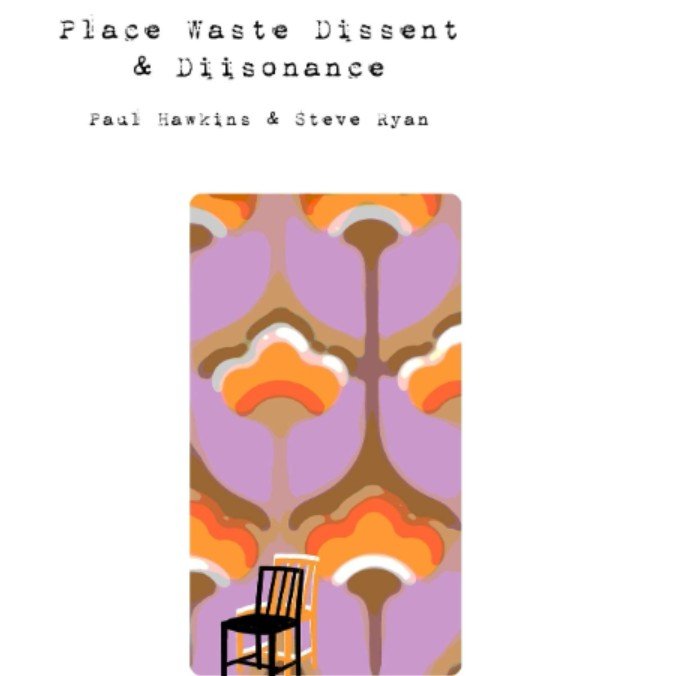
Image source: Amazon
Hawkins spent part of the early 1990s occupying properties and protesting around Claremont Road in East London. The street became a major center of resistance to the proposed M11 Link Road. Influx Press describes the book as mapping that resistance through experimental text, lo-fi collage, and voices including longtime resident Dolly Watson.
The forced clearance of Claremont Road began in November 1994. Parliament recorded a policing cost of £1,014,060 for taking possession of the street. Total M11 protest policing costs had exceeded £2.2 million by then. Those figures sharpen the book’s visual fragments. This was a serious struggle over homes, infrastructure, public money, and political authority.
History Rebuilt Through Collage
The collection records what happens when planning language collides with lived attachment. Houses become assets, liabilities, shelters, memories, evidence, and targets. Residents become human beings and administrative problems at the same time.
The first edition appeared through Influx Press in 2015. An expanded edition titled Place Waste Dissent and Diisonance followed in 2020. Blurb lists it as a 192-page collaboration by Hawkins and artist Steve Ryan. It broadens the original project through themes including surveillance culture and Occupy.
Why the Visual Form Matters
Hawkins uses rough typography, monochrome images, cut-up documents, negative space, and layered voices. The Quietus describes the work as a lo-fi poetry collage rooted in early-1990s squat culture. Its visual construction carries the unrest of the period into the reading experience.
A neat layout would betray the subject. The pages feel interrupted because the community was interrupted. Images and text appear unstable because demolition was never merely a metaphor.
The Five-Word Political Grammar
My central reading is that border territory places waste and dissent forms a political sequence. Each word marks a stage in the transformation of land.
This framework helped me understand why the collection moves between official documents, personal memories, photography, poetry, and visual disruption.
Border and Territory: Power Draws the Line
A border separates what counts from what does not. Territory goes further by attaching control to that boundary.
The planned road transforms ordinary streets into a zone claimed by policy before physical demolition starts. Residents may still live there, but another authority has already imagined the land without them.
The map begins acting like a verdict.
Place and Waste: Language Selects What Survives
A place contains routines, relationships, memory, identity, and emotional ownership. Waste is what those in power may call land when they want its human meaning to disappear.
This is where border territory places waste dissent becomes the book’s moral engine. Claremont Road matters deeply to its inhabitants, yet the transport project treats it as disposable.
Hawkins keeps exposing the distance between those two interpretations. His work suggests that destruction often begins with vocabulary. Once a neighborhood becomes “waste,” removing it becomes easier to defend.
Dissent: The Discarded Place Answers Back
Dissent begins when people marked as removable reject the description imposed on them. Occupation transforms threatened homes into art, community spaces, defensive structures, and public arguments.
The collection preserves autonomous voices that challenge official narratives and allow residents, activists, and marginalized communities to define the meaning of their own experiences.
The resistance did not stop the road from being constructed. However, the book challenges any scorecard based only on that outcome.
Memory matters. Political education matters. Public exposure matters. The influence a protest has on later movements also matters.
How Border Territory Place Waste Dissent Reads
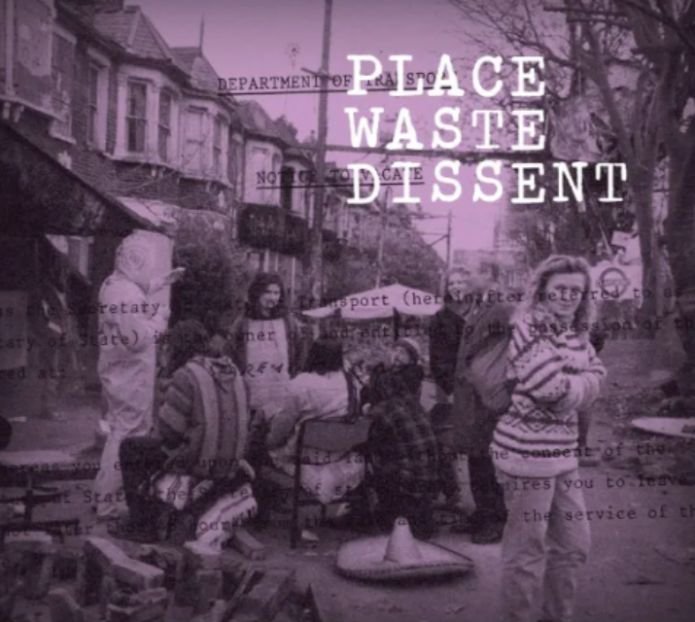
Image source: minorliteratures.com
The format asks readers to slow down and look twice. I found that friction valuable because it prevents a painful history from becoming easy entertainment.
The collection does not guide readers through a clean beginning, middle, and end. Instead, it reproduces the way memory works after political upheaval. Faces, documents, voices, threats, and moments of affection return unevenly.
What Worked for Me
The strongest achievement is the union of form and subject. Legal notices and documentary fragments become part of the poetic voice. Personal memories keep the politics from becoming abstract, while the collage prevents private grief from becoming sentimental.
Dolly Watson’s presence gives the conflict a vital human center. She had lived on Claremont Road for decades and resisted leaving her home. Her relationship with the protesters complicates shallow stereotypes about squatters, activists, and local residents.
The book repeatedly asks what “progress” means when it requires someone else’s removal. That question stayed with me longer than any single visual experiment.
Where It May Lose Readers
The same fragmentation that gives the book power can limit access. Readers unfamiliar with British road protests may want more historical framing. Some sequences remain intentionally opaque, and emotional force often arrives before chronology.
A short timeline would help new readers without weakening the experimental design. It could establish essential dates while allowing the poems and collages to remain unstable.
That limitation does not ruin the work. It simply makes patient reading more rewarding than casual browsing.
Why US Readers Should Care
American readers may recognize the pattern immediately. Federal Highway Administration histories document urban freeway revolts and growing public opposition to highway projects that threatened established communities. The locations differ, but the political question remains familiar: who pays the human cost of infrastructure presented as public progress?
That is why border territory places waste dissent travels beyond East London. It speaks to eminent domain, freeway revolts, neighborhood displacement, environmental protest, and the political power of maps.
It also exposes how official terms such as “blight,” “clearance,” and “improvement” can conceal unequal consequences. Hawkins encourages readers to examine who selects those words and who must live with their results.
Readers drawn to experimental literature about bodies under institutional pressure may also explore from professor Murasaki’s notebooks on the effects of lightning on the human body as a companion internal link.
Who Should Read This Book?
Border territory place waste dissent will work best for readers who enjoy documentary poetry, political collage, radical publishing, urban studies, or first-person protest histories.
It also suits readers interested in typography, archives, photography, and found documents as forms of argument.
The book may not suit readers seeking a linear plot, traditional lyric poetry, or political neutrality. Hawkins does not pretend to stand outside the events. His proximity gives the collection much of its urgency.
Final Barricade: This Book Will Not Stay in Its Lane
My lasting response to border territory place waste dissent is admiration for its refusal to make resistance tidy. The collection preserves a community as an argument rather than turning it into a polished monument.
Its mess is not carelessness. It represents lives pressed together under threat, with little time to separate beauty from fear or idealism from survival.
Read the collection slowly. Research Claremont Road before returning for a second pass. The book will likely feel harsher and more precise once its visual fragments gain historical context.
It does not simply ask what happened to one East London street. It asks who gets to name a place, who gets to call it waste, and what happens when the people trapped inside that language answer back.
Frequently Asked Questions
1. Is border territory a place to waste dissent from the actual book title?
No. The exact title is Place Waste Dissent by Paul Hawkins; the longer phrase summarizes its central themes.
2. What is Place Waste Dissent about?
It is an experimental poetry-collage account of Claremont Road and resistance to London’s M11 Link Road.
3. Is Place Waste Dissent a traditional poetry collection?
No. It combines poetry, photographs, official documents, collage, personal memory, and political history.
4. Is there a newer edition of Place Waste Dissent?
Yes. Place Waste Dissent and Diisonance appeared in 2020 as an expanded 192-page edition.