
Most people have owned one without ever knowing there was a name for it. That oversized, image-heavy book sitting on your living room surface, the one guests always pick up and flip through, is a coffee table book. And if you’re in the small press world, understanding what makes this format tick could change how you think about producing and selling print objects entirely.
This guide covers the coffee table book meaning, how the format works, what separates it from standard print products, and how small press publishers can actually use it to their advantage.
What Is a Coffee Table Book, Really?
The coffee table book definition is straightforward on the surface: it’s a large-format, hardcover book designed primarily for visual display rather than cover-to-cover reading. The name comes from the literal place people keep them, on a coffee table in a living room, where they function as conversation starters and aesthetic objects as much as they do as reading material.
But the coffee table book meaning goes deeper than just size. These books occupy a specific cultural role. They signal taste. They communicate identity. A well-placed photography book from a respected small press publisher says something about who you are as a collector.
That dual function, as both a reading experience and a display object, is what sets this format apart from almost everything else in print.
It sits at the opposite end of the format spectrum from something like what is a smut book actually is, where the draw is almost entirely in the text and the object itself is incidental.
It’s a useful contrast to formats defined almost entirely by content rather than object, like what a smut book actually is, where the appeal lives in the writing itself rather than the physical presentation.
The coffee table book explained simply: think of it as a book that earns its place in a room even when nobody’s reading it. The content matters, but so does the physical object itself. Paper weight, binding quality, cover finish, and image reproduction all become as important as the text.
And here’s something publishers often miss: the format itself communicates value before a single page is turned.
Coffee Table Book Size, Format, and Physical Specs
Size is where the coffee table book format really separates itself from standard publishing. Most mass-market books are 6 x 9 inches or smaller. A coffee table book typically runs between 9 x 12 inches and 13 x 11 inches, though some landmark editions push past that. Square formats are also common, especially in photography and art publishing.
Here’s a quick reference for standard coffee table book size options you’ll encounter when working with a printer or indie press:
| Format Type | Typical Dimensions | Common Use Case
|
|---|---|---|
| Standard Large | 11 x 8.5 inches | Photography, travel |
| Oversize Portrait | 12 x 10 inches | Fine art, architecture |
| Square Format | 12 x 12 inches | Fashion, design |
| Monograph Size | 9.5 x 11 inches | Artist monographs, indie press |
| Compact Coffee Table | 9 x 9 inches | Gifts, limited editions |
Paper stock matters just as much as dimensions. Inside pages are almost always printed on coated or semi-coated stock with a weight of 100 lb or higher. This paper weight supports photo reproduction and gives the book that substantial feel when you hold it. Thin pages on a coffee table book feel like a cheat. Readers notice.
The coffee table book format also demands high-resolution image files, typically 300 DPI or higher for any photos. If you’re producing one through a small press and planning to use images from contributors, that spec conversation needs to happen on day one, not after layouts are done.
Coffee Table Book vs Paperback vs Hardcover: What’s the Difference?
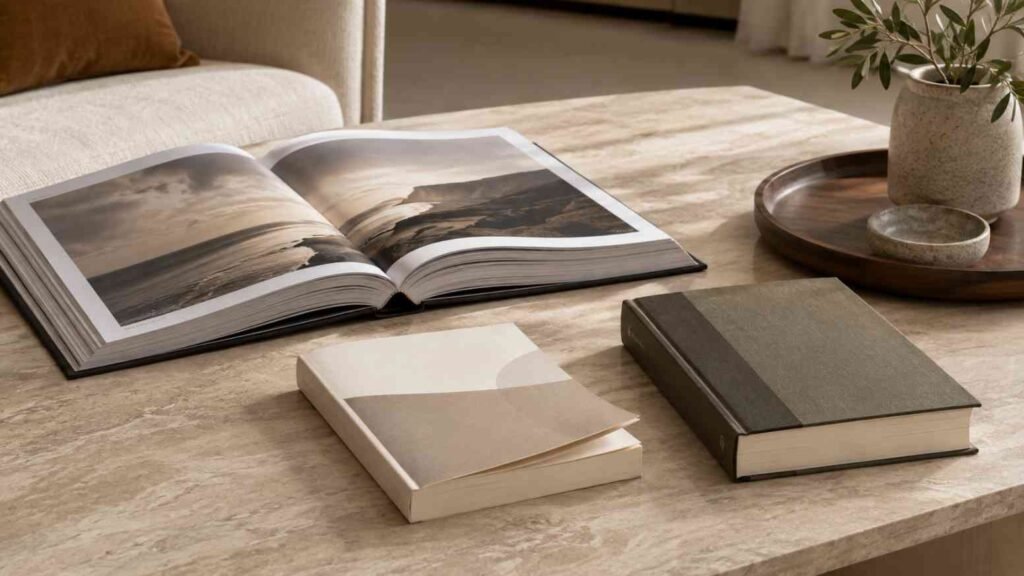
This is where a lot of first-time publishers get confused. The coffee table book vs paperback comparison is the easiest one: paperbacks are small, lightweight, text-forward, and built for portability. A coffee table book is the opposite. It’s heavy, image-forward, and built for permanence and display. You don’t throw a coffee table book in your bag for a commute. You keep it somewhere it can be seen.
The coffee table book vs hardcover distinction is subtler. Most coffee table books are hardcovers, but not all hardcovers are coffee table books. A standard hardcover novel might be 6 x 9 inches with minimal images and text-heavy pages. A coffee table book is typically defined not just by its binding but by its intent and design language: generous white space, full-bleed images, short or entirely absent body text, and a layout that treats every spread as a visual composition.
Think of it this way. A hardcover novel is a hardcover book that happens to be durable. A coffee table book is a visual experience that happens to be bound between two covers.
For small press publishers deciding between formats, here’s the honest take: if your content is primarily image-driven, if your contributors are photographers, illustrators, or visual artists, the coffee table format will serve the work far better than a standard hardcover. The higher production cost is real, but so is the perceived value and the price point you can support.
Coffee Table Book Purpose: Why This Format Exists
The coffee table book purpose has always been two things at once. First, it’s archival. Coffee table books have historically served as the primary way visual culture gets preserved and distributed. Before digital archives, the major photography book was the record of a photographer’s life’s work. Institutions, galleries, and estates relied on large-format print to document what mattered.
Second, the coffee table book purpose is social. These books circulate differently than any other print format. They sit out in the open. They get picked up by visitors. They travel as gifts. According to the American Booksellers Association,art and photography books consistently rank among the top-performing gift categories in independent bookstores, a pattern that’s held even as other print categories faced digital pressure.
For small press publishers specifically, this format is an opportunity. A beautifully produced coffee table book from an independent press can compete visually with anything a major house puts out, and it can carry a price point that reflects the real cost of making something excellent. The perceived value of this format is genuinely higher than any other print object in the consumer market.
Types of Coffee Table Book Worth Knowing
The types of coffee table book you’ll encounter break into several clear categories, each with its own production approach and audience:
- Photography monographs: The classic form. A single photographer’s work, often career-spanning, with minimal text. Think of the kind of work published by houses like Aperture or MACK.
- Artist monographs: Similar structure but centered on a painter, sculptor, or mixed-media artist. Often produced in collaboration with galleries or estates.
- Thematic anthologies: Image collections organized around a subject, a city, a decade, a movement. These are where small presses have carved out serious credibility.
- Fashion and design books: Produced by brands, designers, or fashion houses. Often the most aggressively designed of all the types of coffee table book.
- Architecture and interiors books: Heavy on full-bleed photography, frequently square or landscape format.
- Institutional and exhibition catalogs: Produced alongside museum or gallery shows. A major revenue stream for small presses with institutional partnerships.
Knowing which category your book falls into matters because it shapes your design choices, your print specs, and who your buyer actually is. A photography monograph reader and a fashion book buyer have very different expectations walking in.
What Is a Coffee Table Explained Through Real Examples
Abstract definitions only go so far. Grounding what is a coffee table explained in real, specific examples makes the format concrete.
Consider Eggleston’s Guide by William Eggleston, published by the Museum of Modern Art. It’s a textbook coffee table book definition in action: large format, color photography on coated stock, minimal text, built around the visual sequencing of images. It’s been in print for decades because the format preserves the work in a way no digital screen fully replicates.
On the indie side, MACK Books has built an entire reputation on producing photography coffee table books that are objects in their own right. Their editions are designed, printed, and bound with the same attention you’d give a piece of fine art. They’re expensive. They sell out. Small presses take note.
Another strong coffee table book examples set comes from the fashion world. Books produced around designers like Alexander McQueen or Yves Saint Laurent run to hundreds of pages, feature full-bleed imagery, and retail for well over a hundred dollars. These coffee table book examples demonstrate how premium design and subject matter combine to justify price points that paperback or standard hardcover formats never could.
“The photobook is a medium in its own right, not a poor substitute for the exhibition, but an independent form of presentation for photographic work.” This framing, articulated by curator Martin Parr and photo historian Gerry Badger in their landmark series The Photobook: A History, captures why the coffee table format has endured even as other print categories contracted.
Parr and Badger’s argument applies directly to small press publishers today. The book object isn’t a marketing afterthought. It’s the primary artifact.
A Coffee Table Book for Beginners: The Publisher’s Starting Checklist
If you’re producing your first coffee table book for beginners, the number of decisions can feel paralyzing. Here’s a practical sequence that cuts through the noise.
Step 1: Lock your format before anything else.
Decide on trim size, orientation (portrait, landscape, or square), and approximate page count before you approach a printer or a designer. Every subsequent decision flows from these choices. For a coffee table book for beginners, starting with a 10 x 10 inch square format in the 80 to 120 page range is a manageable entry point.
Step 2: Audit your image resolution.
Every image must be 300 DPI at final print size. If contributors submit files at 72 DPI from a website, those files are unusable. Set this requirement in your contributor agreements from day one.
Since contributor images often come with their own rights and usage questions, it’s worth understanding how to copyright a book in the U.S. before those agreements are finalized, not after.
Step 3: Choose your paper and binding specs.
For interior pages, 100 lb coated matte or gloss is standard. For the cover, you want a minimum of 100 pt board with a UV or soft-touch laminate. Sewn binding holds better over time than perfect binding for large-format books; get a quote on both.
Step 4: Budget for color proofing.
Don’t skip this. A color proof from your printer is the only way to verify that the images in your file match what comes off the press. This is where many first-time publishers get hurt.
Step 5: Plan your pricing backward from production cost.
Coffee table books typically retail at 4 to 6 times their unit print cost to cover distribution, markup, and margin. If your unit cost is $22 per book at a run of 500, your retail price should be in the $88 to $132 range. Use a platform like Printing for Less to get real quotes for short-run offset or digital printing.
If you’re running these numbers as a business rather than a one-off project, it’s also worth working out whether authors need an LLC before you start taking pre-orders.
Step 6: Design for the spread, not the page.
Every layout decision in a coffee table book happens at the two-page spread level. Images that bleed across the gutter need to account for binding. Your designer needs to know this format cold.
The Original Small Press Framework: The VISSO Method
After looking at dozens of small press coffee table books that succeeded and a roughly equal number that didn’t, a pattern in the successful ones emerges. Call it the VISSO Method: Visual Integrity, Intentional Sequencing, Singular Subject, Object Quality.
Visual Integrity means every image in the book belongs there by the same editorial standard. No filler. The moment a spread feels like padding, the whole object suffers.
Intentional Sequencing means the order of images creates meaning that no single image carries alone. This is what separates a great photography book from a portfolio PDF printed large.
Singular Subject means the book is unmistakably about one thing. The best coffee table books could be described in a single sentence, and that sentence is specific. Not “urban photography” but “vacant lots in Detroit between 2009 and 2014.”
Object Quality means the physical production matches the ambition of the content. A book with extraordinary images printed on thin paper with poor ink density is a failure. The object has to earn the images.
VISSO isn’t a formula you fill in. It’s a diagnostic. When a book draft isn’t working, running it against these four criteria usually reveals where the gap is.
What Is a Coffee Table Book in the Context of Contemporary Publishing?

The contemporary small press landscape has made what is a coffee table book a more contested and exciting question than it’s been in decades. Large commercial publishers pulled back from expensive art book production after 2008. The gap that opened has been filled, unevenly but creatively, by independent presses, artist-run imprints, and hybrid gallery-publishers.
This shift has expanded the coffee table book definition beyond photography and fine art. Today you’ll find coffee table books on skateboarding culture, independent music scenes, vernacular architecture, community gardens in specific neighborhoods, and zine-influenced visual essays. The format has absorbed influences from artists’ books and photobook culture simultaneously, producing a genuinely hybrid object that the traditional publishing industry didn’t plan for.
For small presses, this is good news. The perceived authority of the large publisher matters less in this format than it does in literary fiction or narrative nonfiction. What matters is the quality of the object and the credibility of the vision behind it. Those are things a small press can compete on directly.
The coffee table book explained for the contemporary moment looks like this: it’s a format that rewards specificity, rewards production investment, and rewards a clear editorial point of view. Vague, catch-all concepts don’t thrive here. Focused, beautifully executed ones do.
Common Mistakes That Undercut an Otherwise Strong Book
Even publishers who understand the coffee table book purpose intellectually make the same production and editorial errors repeatedly.
The most common one is underestimating the cost of color reproduction. Offset printing at a short run is expensive. Digital printing is more accessible but has its own quality ceiling. Many first-time publishers build a budget around digital print costs and then are shocked when they see the quality gap. Request printed samples from any printer before you commit.
The second mistake is treating text as an afterthought. Even though images carry a coffee table book, the text that does appear needs to be exceptional. A weak introductory essay or sloppy captions undercuts the credibility of the whole object. Hire a real editor even if the word count is small.
The third mistake is choosing a format that doesn’t fit the distribution channel. A 14 x 14 inch book is stunning but it won’t fit on a standard bookstore shelf, won’t ship efficiently, and will intimidate most buyers. The coffee table book size decision has downstream consequences that go well beyond aesthetics.
And the fourth mistake, the one that’s hardest to fix in post-production, is binding that doesn’t lie flat. A coffee table book that springs shut when you set it down is unusable. Sewn signatures and quality adhesive binding matter. This is not a place to cut costs.
Where Small Presses Fit in This Format’s Future
The coffee table book market has held its value while other physical formats struggled. According to data reported by Publishers Weekly, art and photography books have consistently shown resilience as gift-driven categories, with independent booksellers and museum shops serving as the strongest retail channels. That’s a distribution map that works directly in favor of small presses with curatorial credibility.
Print-on-demand platforms have also lowered the floor for experimentation. Services like Blurb allow small presses to produce test editions at very low quantities to validate a concept before committing to an offset print run.
The quality gap between POD and offset offset printing has narrowed, though it hasn’t closed. For a proof-of-concept or a limited artist edition, POD is now genuinely viable.
The audience for coffee table books from independent presses is also increasingly sophisticated. Collectors who follow photobook culture know names like Dashwood Books, RVB Books, and Self Publish Be Happy.
These buyers actively seek out small press editions precisely because they’re not corporate products. That’s an audience that rewards originality and penalizes playing it safe.
Your Next Step as a Small Press Publisher
You now have the full picture of the coffee table book definition, its physical specs, its cultural role, how it compares to other formats, and where the real production decisions get made. The format is demanding. It punishes under-investment and rewards editorial clarity.
If you’re at the stage of deciding whether this format makes sense for your next project, run your concept through the VISSO framework before you spend a dollar on design. If you can answer “singular subject” with a one-sentence description that’s genuinely specific, you’re probably in the right territory. If you’re still describing your book in vague categories, narrow the focus first.
And if you’re already in production, the single most valuable thing you can do right now is order a printed color proof. Everything else you know how to fix. A color profile problem discovered after 500 copies are bound is a very different problem entirely.
The coffee table book isn’t just a format. It’s a commitment to treating print as an experience worth having. Which press you want to be is the question only you can answer.