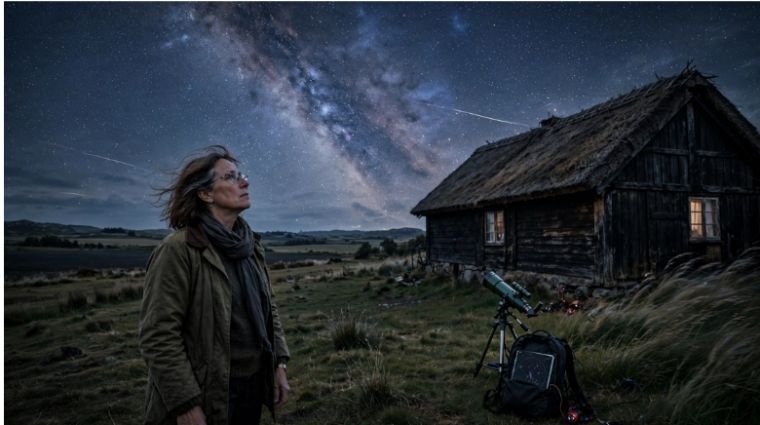
The first thing I wanted from a range dorthe nors book review was a clear answer: is this an astronomy novel, a rural character study, or something stranger? My answer is all three. Dorthe Nors makes the infinite universe feel intimate, then makes a property line feel almost cosmic.
Published in the United States by Graywolf Press on August 18, 2026, Range is translated from Danish by Caroline Waight. It follows Gunn Haven, an astrophysics professor who leaves her institute for a rural area where clear skies suit her research into gamma-ray bursts. Graywolf frames the novel around the distances humans cross through space, time, memory, and community.
That idea of distance became the key to my range dorthe nors book review. Gunn can think about the origins of the universe with confidence. Getting close to another person is much harder.
What Is Range by Dorthe Nors About?
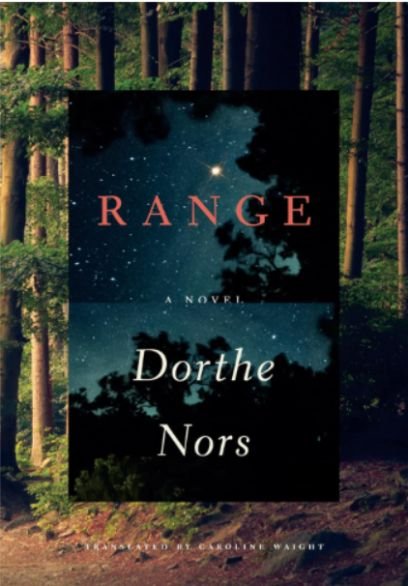
Image Credit: Amazon
Gunn Haven has stepped away from academic life and returned to a rural landscape connected to her childhood. She wants solitude, darkness, and space to work.
The countryside refuses to cooperate.
Gunn Haven and the Pull of the Night Sky
Gunn tracks gamma-ray bursts, some of the most powerful explosions astronomers observe. NASA has documented bursts originating billions of light-years away, including one more than 12 billion light-years from Earth.
That scientific scale gives Nors more than an interesting profession for her protagonist. It creates the novel’s emotional measuring system.
The farther Gunn looks outward, the more the story pulls inward. Her thoughts return to her dead mother, her beloved father, distant colleagues, and a younger protégé she sent away despite missing him intensely.
This is where my range dorthe nors book review moves beyond the basic plot. The universe is not Gunn’s escape route. It becomes the instrument through which readers understand her isolation.
The Gable Woman Turns Space Into Conflict
The tension rises after Gunn wanders onto private land and encounters the threatening figure known as the Gable Woman.
Beside astrophysics, a dispute about land should appear tiny. Nors makes it feel enormous.
The encounter forces Gunn to negotiate ownership, rural hierarchy, memory, fear, and the uncomfortable question of who truly belongs somewhere.
Her neighbors complicate matters further. Brit knows local business almost too well, while Brit’s restless teenage daughter Jenny begins forming a more meaningful connection with Gunn. Foreword Reviews also highlights Gunn’s fragile relationship with Jenny and the novel’s movement toward found family.
Readers interested in how geography and history shape identity may also enjoy autobiography of cotton cristina rivera garza book, which offers another useful direction for exploring place-centered literary fiction.
Why Range Feels Bigger Than Its Rural Setting
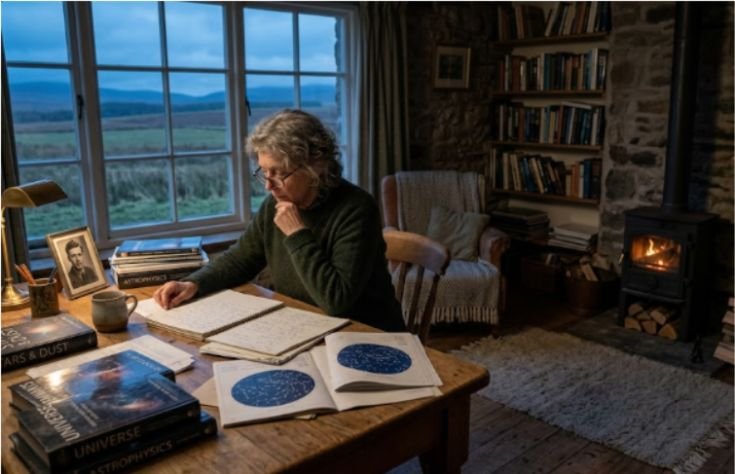
Many novels send characters into isolation so they can escape society. Nors does something sharper. She shows that isolation itself can become another relationship.
The Distance Paradox
My main critical lens for this range dorthe nors book review is what I call the distance paradox.
Gunn studies phenomena so distant that their light can travel across the universe for billions of years. Yet her hardest distances are remarkably small: a fence, a neighbor’s house, an unanswered relationship, or the emotional space between herself and someone she loves.
Cosmic distance can be measured.
Human distance cannot.
That reversal keeps the astrophysics from becoming decorative intellectual scenery. Gunn’s scientific thinking shapes how she approaches life. She understands systems, trajectories, rules, and scale.
People refuse that precision.
The result is a novel where a conversation can feel less predictable than an exploding star.
Grief, Caretaking, and Found Family
Gunn also raises a quieter question: what can caretaking mean for a woman who is not a mother?
Her connections suggest that love does not automatically produce emotional wisdom. She cares deeply for her protégé, yet that care can become intrusive. She values independence while remaining painfully aware of absence.
Her memories of her parents deepen that tension. Loss does not disappear because daily life continues.
What interested me most is that Nors does not offer an easy movement from loneliness toward community. Gunn instead learns to tolerate the disorder that closeness creates.
That emotional instability may appeal to readers intrigued by the surreal and fluid environments explored in city like water dorothy tse book. Both works raise questions about the boundaries between individual identity and the spaces people inhabit.
Dorthe Nors’s Writing Style and Caroline Waight’s Translation
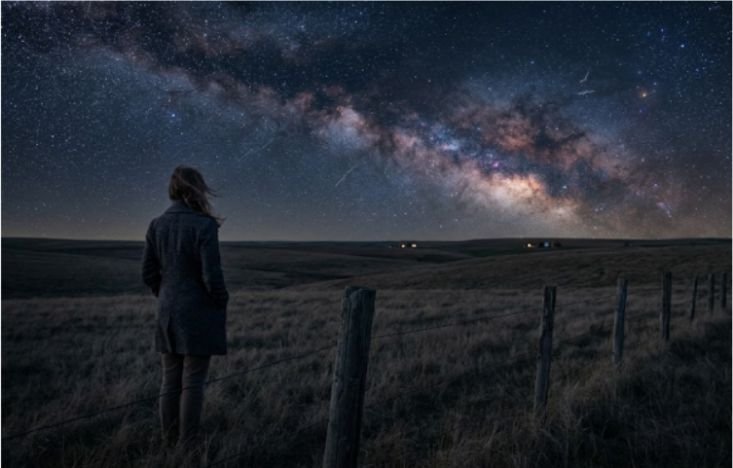
Nors moves comfortably between the physical and philosophical.
One moment Gunn may be splitting firewood or observing plants. The next, her mind reaches toward astronomical time. Neither scale cancels the other.
That matters because a range dorthe nors book review focused only on plot would miss much of the appeal. The novel gains power through recurring details, memories, and ideas rather than constant narrative acceleration.
Graywolf similarly emphasizes the book’s movement between sensory experience and contemplation of the cosmos.
Caroline Waight’s English translation must hold those two registers together. Gunn’s observations need scientific clarity, but her memories require uncertainty and emotional flexibility.
The result feels less interested in explaining Gunn than in allowing readers to gradually map her.
What Works — and What May Challenge Readers
Gunn’s personality is the book’s greatest strength.
She is clever, awkward, independent, lonely, caring, intrusive, and occasionally difficult. Nors does not smooth those contradictions into a conveniently likable heroine.
I think that choice gives Range its credibility.
The countryside also prevents the story from drifting into pure abstraction. The novel may contemplate consciousness and the universe, but it remains filled with trees, firewood, property disputes, gossip, animals, and uncomfortable neighbors.
The challenge is its pacing.
Nors withholds information and circles important emotions before fully revealing them. Readers accustomed to straightforward storytelling may see that as frustrating.
Readers who enjoy atmosphere, psychological unease, and complicated social relationships may find the spoil maile chapman book a natural follow-up.
My range dorthe nors book review therefore lands on admiration rather than universal recommendation. The book’s difficulty is not an accidental flaw. Its uncertainty supports its ideas about how poorly human beings understand one another.
Who Should Read Range?
I would recommend Range to readers of contemporary literary fiction, translated literature, psychologically complex women-centered narratives, and fiction about solitude that refuses to romanticize loneliness.
It should also work for readers interested in science as a way of thinking rather than science fiction as a genre.
Gunn’s astrophysics matters because it changes the scale of everything around her. A disagreement over land remains objectively tiny, yet human consciousness can make it enormous.
Readers who prefer linear plots, frequent twists, or fully explained relationships may find the recursive structure demanding.
Those comfortable with ambiguity are more likely to see why the range dorthe nors book review conversation has centered so strongly on identity, distance, consciousness, and connection.
The Stars Are Vast, but People Are the Real Problem
My final reaction is simple: Range makes the universe appear almost orderly compared with human attachment.
Nors takes a woman capable of studying catastrophic events across unimaginable distances and places her inside conflicts measured in yards, memories, silences, and emotional obligations.
That contrast gives the novel its wit and its ache.
For US readers considering the book, I would not approach Range as an astronomy novel decorated with literary themes. Read it as a literary novel about boundaries that happens to possess a cosmic measuring stick.
That shift makes the central tension of this range dorthe nors book review clearer: Gunn can observe almost impossibly distant objects, but understanding the person standing beside her remains the greater challenge.
FAQs
1. What is Range by Dorthe Nors about?
Range follows astrophysics professor Gunn Haven as she retreats to the countryside, researches gamma-ray bursts, and becomes entangled in grief, neighbors, property conflict, and unexpected connection.
2. Is Range by Dorthe Nors difficult to read?
Its prose is accessible, but the recursive structure, withheld information, and philosophical focus may challenge readers who prefer linear storytelling.
3. Who translated Range by Dorthe Nors into English?
Caroline Waight translated Range from Danish for its Graywolf Press edition.
4. Is Range by Dorthe Nors worth reading?
For readers drawn to literary fiction about solitude, identity, grief, nature, and difficult human connection, this range dorthe nors book review finds it distinctive and rewarding.