
Plot is simply the sequence of events, but the internal transformation of your protagonist is what keeps readers turning pages until 3:00 AM. Readers don’t fall in love with events; they fall in love with dynamic human experiences.
Understanding the primary character arc types in fiction allows you to transform a series of mechanical plot points into an emotionally resonant story that lingers in your reader’s mind long after the final page.
Whether you are plotting a sprawling fantasy series or outlining a intimate literary drama, every narrative relies on how a character responds to central conflict. Here is how master storytellers design internal journeys that capture audiences, resonate with publishers, and elevate draft mechanics.
Beyond the Basics: The Mechanics of Psychological Transformation
A character arc is not merely a subplot; it is the psychological spine of your entire manuscript. It tracks how external narrative pressures force an internal realignment of beliefs, values, and identity.
In narrative psychology, human beings structure their reality around fundamental assumptions. According to research on narrative psychology archived by the National Institutes of Health, individuals construct identity through personal narratives that evolve when confronted with life disruptors. In fiction, this internal conflict usually stems from the tension between two core psychological forces:
- The Lie: The false belief or defense mechanism your character relies on at the start of the story.
- The Truth: The inescapable reality or moral necessity they must accept to achieve true fulfillment or overcome the climax.
When your plot forces these two concepts into direct conflict, your character must choose whether to adapt or break. How they navigate that choice dictates the exact nature of their arc.
Expanding the Core Spectrum: Growth, Static, and Trajectory Arcs
While stories are endlessly diverse, almost every character journey falls into three primary archetypal trajectories. Mastering these models allows you to write intentional, compelling narrative turns.
[ START OF STORY ]
│
┌───────────┼───────────┐
▼ ▼ ▼
Positive Flat Negative
(Growth) (Steadfast) (Fall)
│ │ │
▼ ▼ ▼
Embraces Preserves Embraces
Truth Truth Lie
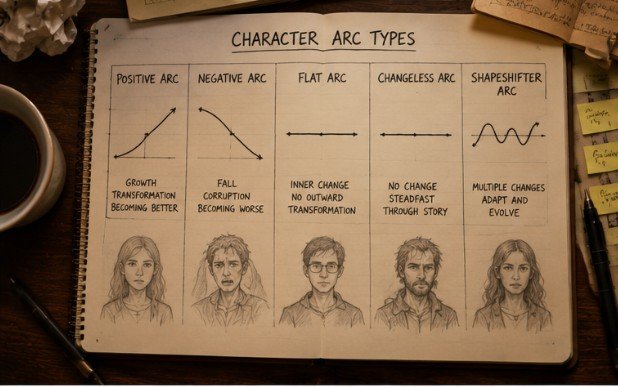
1. The Positive Change Arc (The Growth Narrative)
The positive change arc is the quintessential hero’s journey. Here, the character begins in a state of delusion, emotional isolation, or moral limitation. They hold fast to a destructive “Lie” that protects them from past trauma or uncomfortable reality.
As external stakes escalate, their old coping mechanisms fail. They are forced to confront their internal resistance, discard the Lie, and embrace the Truth.
- The Internal Engine: Fear evolves into courage; self-interest evolves into altruism.
- Classic Example: Ebenezer Scrooge in Charles Dickens’ A Christmas Carol. Scrooge begins trapped in the Lie that wealth equals security and human connection is a vulnerability. Through spectral intervention, he confronts his past choices and shifts toward the Truth of generosity and community.
2. The Flat Arc (The Catalyst Narrative)
A common misconception among novel outline strategies is that a static character represents poor plotting. In reality, the flat arc features a protagonist who already understands the core Truth at the beginning of the narrative. Their internal belief system is tested, refined, and proven steadfast against a corrupt or chaotic environment.
Instead of changing themselves, the protagonist acts as a catalyst that forces the world around them to alter its course.
- The Internal Engine: Resilience, conviction, and moral certainty under pressure.
- Classic Example: Captain America (Steve Rogers). Rogers enters the narrative with an immutable moral compass. The narrative tension does not come from him learning a new lesson, but from his refusal to compromise his principles, which ultimately inspires his allies to change.
3. The Negative Change Arc (The Tragedy or Fall Narrative)
The negative change arc documents a character’s moral decay, disillusionment, or descent into tragedy. Instead of outgrowing their false belief, the character clings tighter to the Lie, rejects the redeeming Truth, or abandons a once-noble conviction for a destructive desire.
Understanding these darker trajectories can prove invaluable when drafting compelling antagonists or cautionary tales. If you find yourself hitting a wall while mapping out complex character motivations, learning how to beat writers block fast can help you unblock your plot structure and keep your story moving forward.
- The Internal Engine: Pride, ambition, or fear driving tragic choices.
- Classic Example: Walter White in Breaking Bad. Walter begins as a mild-mannered teacher seeking security for his family, but gradually succumbs to the intoxicating Lie that power and domination define his worth, culminating in total moral ruin.
Comparative Matrix: Character Arc Trajectories
| Arc Type | Starting Internal State | Climax Choice | Final Outcome |
| Positive Change | Believes a damaging Lie | Accepts the hard Truth | Personal redemption & success |
| Flat Arc | Holds the fundamental Truth | Refuses to abandon conviction | Changes the surrounding world |
| Negative Change | Ignores or rejects Truth | Embraces a destructive Lie | Downfall, corruption, or tragedy |
Evaluating Your Narrative: The 4-Step Arc Integrity Test

Before sending your draft to beta readers or submitting to agents, run your protagonist through this practical framework to ensure their internal path aligns with external stakes.
Step 1: Identify the Lie ──► Step 2: Establish the Catalyst
│
Step 4: Execute the Choice ◄── Step 3: Test the Resistance
- Identify the Core Lie: What specific false belief limits your character in Chapter 1? (e.g., “I can only depend on myself.”)
- Establish the Catalyst Event: What external conflict immediately challenges this false belief?
- Test the Resistance: Does your character double down on their old habit when the pressure increases in Act II? (Characters should resist changing until staying the same becomes too painful).
- Execute the Climactic Choice: During the story’s climax, does your character make a pivotal decision based on their old Lie or their new Truth?
If your character’s final decision doesn’t directly stem from this internal conflict, your plot and character arc are likely disconnected. Refining these structural beats is essential for self-editing, and studying literary craftsmanship through resources hosted by university writing programs, such as Purdue OWL, can help you polish your manuscript to industry standards.
When Traditional Arcs Fail: Misconceptions and Exceptions

Not every compelling story requires a traditional three-act character transformation. Forced character development can often feel unearned or unnatural.
- Episodic Fiction: Series centered on mystery, detective work, or adventure often rely on stable characters (e.g., Sherlock Holmes or Hercule Poirot). The audience tunes in to watch a skilled mind solve a puzzle, not to watch them undergo massive psychological shifts.
- Tragic Inevitability: In certain classical tragedies, characters are bound by fate or structural systemic forces where personal choices cannot alter the outcome.
- Ensemble Overlap: In multi-POV narratives, avoid giving every side character a major growth arc. Doing so overburdens the narrative. Focus your developmental energy on your primary point-of-view characters.
If you struggle with balancing character depth across a large cast, working alongside a professional guide can streamline your editorial process; learning how to become a book editor offers deep insight into how professionals evaluate structural character consistency.
Similarly, if your story spans complex settings, utilizing dedicated writing prompts for world building ensures your environment directly pushes your character’s internal journey.
Frequently Asked Questions
1. What are the four main types of character arcs?
The four primary character arcs are the Positive Change arc, the Flat (or Static) arc, the Disillusionment arc, and the Fall/Corruption arc. Each defines how a protagonist reacts to internal truths and external conflicts throughout a narrative.
2. What are the six types of story arcs?
Based on structural sentiment tracking, the six core story arcs are Rags to Riches (rise), Tragedy (fall), Man in a Hole (fall-rise), Icarus (rise-fall), Cinderella (rise-fall-rise), and Oedipus (fall-rise-fall).
3. What are the types of arcs?
In storytelling, arcs generally divide into character arcs (internal psychological growth or decay) and story/plot arcs (external events and escalating structural conflict). Both work in tandem to create thematic unity within a novel.
4. What are the 5 stages of a story arc?
The five standard stages of a story arc—often referred to as Freytag’s Pyramid—are the Exposition, Rising Action, Climax, Falling Action, and Resolution. These stages map the dramatic tension of the plot.
Crafting Resonance That Lasts
Mastering internal journeys is what separates passive storytelling from unforgettable fiction. Plot provides the external structure, but human transformation delivers the emotional core that makes stories memorable.
By aligning your protagonist’s internal choices with external plot pressures, you turn simple events into meaningful experiences. Test your draft’s internal logic, challenge your protagonist’s deepest assumptions, and let their authentic choices shape the path of your narrative.