A story can contain a hurricane, a villain, and a deadline and still feel flat. The missing ingredient is often not more action but a second struggle happening inside the character. The most useful way to study internal conflict vs external conflict examples is to ask: What pushes against the character from outside, and what pulls them in two directions within?
The Fastest Way to Tell Internal and External Conflict Apart
Internal conflict happens within a character’s emotions, values, beliefs, or desires. It is usually character vs. self: fear versus courage, duty versus desire, loyalty versus ambition.
External conflict comes from outside. The opposing force may be another person, nature, society, technology, a supernatural force, or circumstances the character cannot simply think away. Publishing guides such as Reedsy and 48 Hour Books make the same broad distinction between inward psychological struggles and outside obstacles.
| Conflict type | Pressure comes from | Key question | Simple example |
| Internal | Inside the character | “What must I choose or overcome?” | A student wants to speak but fears embarrassment. |
| External | Outside the character | “What is stopping me?” | A school rule prevents the student from speaking. |
ReadWriteThink teaches four common categories: character vs. self, character vs. character, character vs. nature, and character vs. society. ReadWriteThink conflict lesson Reedsy also discusses technology, supernatural forces, and fate as useful conflict categories.
Why Internal Conflict vs External Conflict Examples Need Context
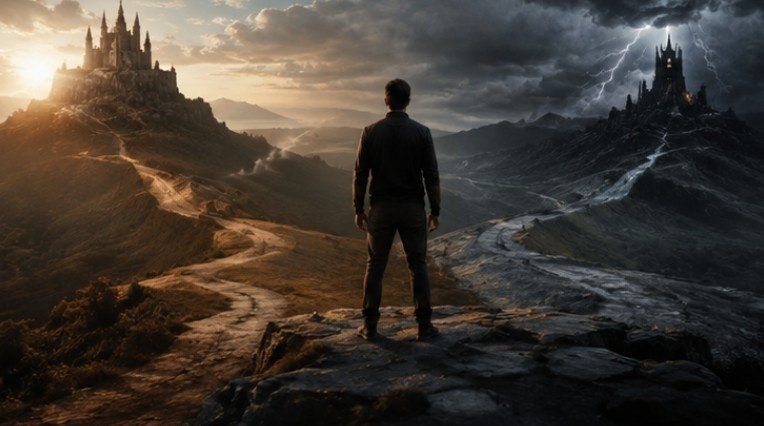
The basic distinction is simple: internal conflict is psychological or emotional; external conflict involves an outside force. The better storytelling question is how one intensifies the other.
Imagine a hiker trapped in a blizzard. The storm is person vs. nature. Now suppose the hiker freezes under pressure because a past decision hurt someone. The weather creates action; the private fear creates meaning.
Purdue OWL’s guidance on writing compelling characters links character goals to story obstacles and explains that characters can become particularly interesting while confronting their own shortcomings in pursuit of what they want.
Internal Conflict Examples That Reveal Character
A person finds a wallet full of cash while struggling to pay rent. Returning it is physically easy but morally difficult. That is internal conflict because two needs or values compete inside one person.
In Shakespeare’s Hamlet, the demand for revenge is complicated by Hamlet’s hesitation and moral reasoning. In The Scarlet Letter, Arthur Dimmesdale’s guilt creates an inward struggle while Puritan judgment creates external social pressure.
Studying published fiction is one of the quickest ways to improve your instincts. This guide on how to learn writing from authors can help you reverse-engineer scenes instead of only admiring them.
External Conflict Examples That Move the Plot
Person vs. person occurs when two characters want incompatible outcomes. Person vs. nature pits a character against weather, wilderness, disease, or another natural threat. Hemingway’s The Old Man and the Sea turns a fishing trip into an extended struggle involving the sea, the marlin, exhaustion, and survival.
Person vs. society appears when laws, customs, institutions, or group expectations block the protagonist. The Hunger Games makes this clear through Katniss Everdeen’s struggle against the Capitol.
Person vs. technology can involve a malfunctioning spacecraft, biased algorithm, hacked medical device, or autonomous system. The strongest version still forces the character to make a meaningful choice rather than making the machine a convenient source of random trouble.
Why Writers and Editors Should Pair the Two
External conflict asks, “What happens next?” Internal conflict asks, “Why does this outcome matter to this person?” Pairing them creates momentum and character development. Reedsy similarly argues that outside problems can bring a protagonist’s inner struggle into observable action.
The Yale-New Haven Teachers Institute also describes conflict as a central problem a protagonist struggles to resolve, whether the problem originates inside the character or from outside forces.
For memoir, the event may be external—a move, divorce, job loss, family rupture, or success—but the narrative gains depth from the private contradiction underneath it. Writers shaping experience can apply the same thinking when learning how to write a book about your life.
Editors can diagnose scenes the same way. Action without emotional stakes may need stronger internal pressure; reflection without change may need an external obstacle. Anyone learning how to become a book editor should practice spotting that imbalance.
Use the Outside-Inside-Choice Test

Run this three-part test on any scene.
First, name the outside pressure: “My protagonist wants X, but Y blocks them.” If Y is vague, the scene may lack external conflict.
Second, name the inside split: “Part of my protagonist wants A, but another part fears, believes, or wants B.” If one side carries no real cost, the internal conflict is weak.
Third, force a choice. Ask what action could solve the external problem while worsening the internal one.
A whistleblower, for example, can protect coworkers by exposing fraud but may betray a trusted mentor. The company creates external pressure; loyalty versus conscience creates internal pressure. One decision advances both.
Common Misunderstandings About Conflict

External conflict does not require a fight scene. A denied loan, family expectation, closed border, or failed computer can provide outside resistance.
Internal conflict is not endless thinking, either. Readers need to see it affect behavior, dialogue, delay, risk, or choice.
Not every scene needs both types. Literary fiction may lean toward interior struggle, while thrillers often foreground external danger. The goal is enough pressure to make choices consequential.
Frequently Asked Questions
1. What is an example of internal and external conflict?
A firefighter battling a wildfire faces external conflict with nature. If they also fear entering the fire after a previous rescue failure, that fear creates internal conflict.
2. What are examples of internal conflict?
Examples include guilt versus self-protection, ambition versus loyalty, fear versus duty, love versus independence, and deciding whether to tell a painful truth.
3. What are external and internal conflicts?
External conflict comes from outside forces such as people, society, nature, or technology. Internal conflict occurs within a character’s beliefs, emotions, desires, or moral choices.
4. What are some examples of an external conflict?
Examples include a rival blocking a promotion, a sailor surviving a storm, a citizen resisting an unjust law, or an astronaut dealing with a failed navigation system.
Conclusion
The best conflict is rarely just a problem standing in a character’s way. It is pressure that makes the character reveal who they are. Start by identifying the outside obstacle, then look for the private fear, desire, belief, or loyalty that complicates the obvious solution. When those forces collide, even a quiet conversation can carry real suspense.
For writers, that means stronger scenes; for literature students, clearer analysis; and for editors, a faster way to diagnose weak stakes. If a scene feels flat, do not automatically add danger. Ask what choice would make success personally difficult for the character instead.