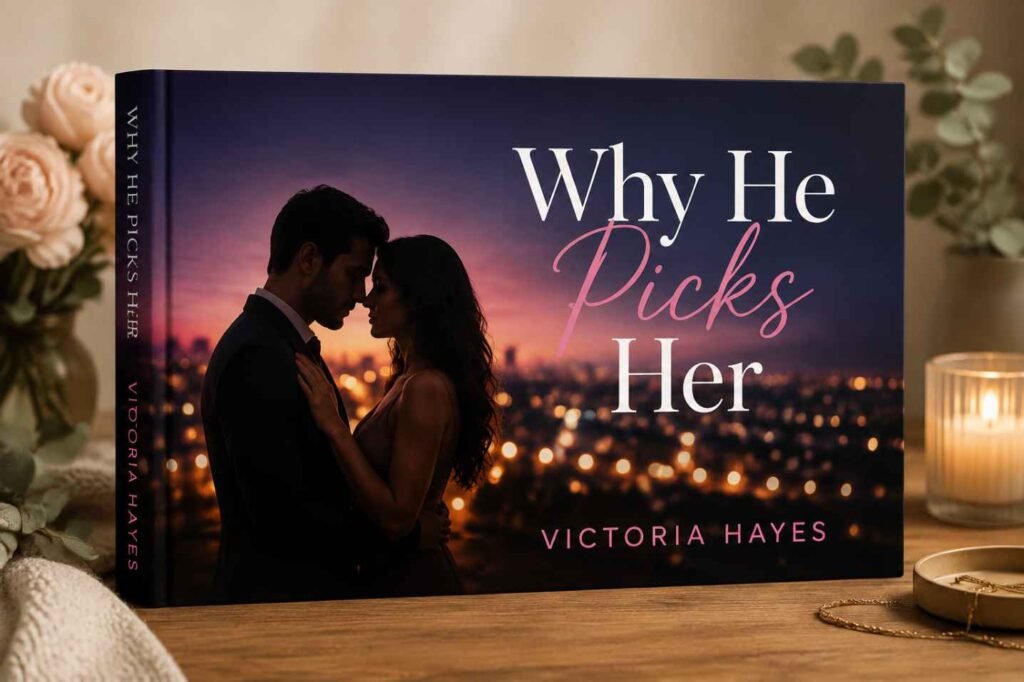
Most romance readers stumble onto Victoria Hayes by accident, finish the book in one sitting, and then spend three days on Reddit trying to figure out what exactly just happened to them.
The reason he picks her Victoria Hayes book is that it is kind of read: deceptively breezy on the surface, genuinely sharp underneath. This guide covers every layer, from the plot and characters to the ending, the themes, the age rating, and where the title sits in the series order.
If you just closed the last page and need to talk it out, you’re in exactly the right place.
Why He Picks Her Victoria Hayes Book: What It Actually Is
The Why he picks her victoria hayes book is a contemporary romance novel published through a small press imprint that specializes in character-driven women’s fiction with romantic arcs.
Victoria Hayes writes in a style that sits comfortably between commercial romance and literary fiction, closer to the work you’d find reviewed on The Guardian’s fiction desk than in a mass-market paperback spinner rack.
That positioning between commercial and literary shelving is a useful contrast to genre fiction sorted mainly by heat level, like what a smut book actually is, where spice is the primary axis readers are shopping on.
The prose is clean, the pacing is propulsive, and Hayes has a genuine gift for writing male perspective chapters that don’t read like a woman guessing what men think.
The title itself does the heavy lifting before page one. “Why he picks her” sounds like a question about romantic preference, but Hayes spends the entire novel reframing what “picking” means in an adult relationship. Is it a choice made once? A series of daily decisions? Or something a person only understands in retrospect?
Why He Picks Her Victoria Hayes Author Background
Understanding why he picks her victoria hayes author context matters for reading this book correctly. Hayes came up through the small press world, publishing two short story collections before turning to long-form fiction.
Her background in short fiction is visible in the novel’s structure: tight chapters, almost no wasted scenes, and an ending that lands with the compression of a short story’s final image rather than the sprawl of a typical romance conclusion.
She has spoken in interviews about being drawn to the moment a relationship becomes a choice rather than a feeling, which is essentially the thematic DNA of this book.
Why He Picks Her Victoria Hayes Plot: The Full Summary

Here is why he picks her victoria hayes summary without soft-pedaling any of it.
Mara Calloway is 34, recently out of a five-year relationship that ended not with a fight but with a slow, polite fade. She’s a copy editor at a small publishing house in Chicago, competent and largely invisible at work, whose social life has contracted to two close friends and a very demanding cat named Colm.
She isn’t broken. She isn’t looking. That specificity is one of the things Hayes gets right that most romance writers fumble.
Daniel Ashford enters her life through a manuscript she’s assigned to copy edit: a memoir by a chef, written badly but with real emotional honesty. When she has to schedule a call with the author for a factual query, she reaches his business partner by mistake.
That business partner is Daniel. He’s 38, owns a mid-size restaurant group with his sister, and has recently ended a long engagement. Their first phone call lasts four minutes. Their second lasts two hours.
The why he picks her victoria hayes plot follows the next eight months of their relationship across alternating chapters, his and hers, without either narrator being positioned as the reliable one. This is the structural move that separates the book from standard romance. You’re not waiting for them to get together. They get together by chapter six.
The question the book is actually asking is why, given that Daniel could have drifted back to his ex, given that Mara keeps creating distance on purpose, given that both of them have plausible reasons to exit, neither of them does.
The why he picks her victoria hayes book summary wouldn’t be complete without mentioning the subplot involving Daniel’s ex-fiancee, Camille, who reappears at the novel’s midpoint. Camille is not a villain. Hayes refuses that shortcut. She’s a fully realized character who genuinely loves Daniel and has a reasonable case for why they belong together.
Her presence forces the novel’s central question into the open: choosing Mara isn’t an obvious or easy call, which is precisely what gives the choice its weight.
Why He Picks Her Victoria Hayes Characters: The Full Roster
The why he picks her victoria hayes characters are built with unusual specificity. Here is each significant one:
- Mara Calloway: The female lead. Copy editor, reader, conflict avoider. Her defining trait isn’t charm or beauty but a precise emotional intelligence that she mostly uses to protect herself rather than connect with others.
- Daniel Ashford: The male lead. Restaurateur, genuinely good at listening, terrible at initiating hard conversations. His chapters are the novel’s best writing because Hayes gives him interiority that most romance heroes never get. The dual-narrator structure works specifically because both leads read as fully realized people rather than romantic archetypes the same standard covered in how to create believable fictional characters that readers remember.
- Priya Mehta: Mara’s best friend and a structural device Hayes uses well. Priya asks the questions the reader is thinking and pushes back on Mara’s self-protective logic without becoming a mouthpiece.
- Camille Roth: Daniel’s ex. As noted above, the book’s most morally complex figure. She gets two chapters from Daniel’s perspective and one scene written from her own limited third-person POV, which is the only break from the dual first-person structure.
- Elena Ashford: Daniel’s sister and business partner. Her function in the plot is partly practical but her real role is to reflect how Daniel has changed since meeting Mara, which she does without announcing it.
Why He Picks Her Victoria Hayes Genre and Age Rating
For readers who care about shelving and recommendation accuracy: the why he picks her victoria hayes genre is contemporary romance with a strong literary fiction current running through it. If you pitch it to someone as a romance, they’ll enjoy it.
If you pitch it as women’s fiction with a romantic arc, they’ll also enjoy it. It sits in a similar space to novels by Emily Henry or Taylor Jenkins Reid, but with a quieter register and less interest in external plot complications.
Hayes isn’t trying to add mystery subplots or professional crises to manufacture tension. The tension is entirely relational, and she trusts that to be enough.
The reason he picks her victoria hayes age rating is appropriate for readers 18 and older. There are two explicit scenes, both written with restraint and purpose rather than as set pieces, and the emotional content, including frank discussions of grief, the end of a long engagement, and the fear of repeating old patterns, is sophisticated enough that younger readers would likely find it less engaging than adults who have had a few relationships actually go wrong.
Why He Picks Her Victoria Hayes Themes: What the Book Is Really About
The why he picks her victoria hayes themes cluster around one central question and then radiate outward from it. That question: is romantic choice ever truly free, or is it always shaped by timing, proximity, and fear?
Hayes doesn’t answer it. She dramatizes it. But the novel’s argument, insofar as it has one, is that the choice to stay, made repeatedly and consciously, is more meaningful than the initial falling in love, which the novel treats as mostly involuntary.
This puts the book in conversation with a wider cultural discussion about what commitment actually means in contemporary relationships.
Research published by the Pew Research Center in 2023 found that 57% of adults who had cohabited with a partner described the decision to formalize the relationship as a deliberate, revisited choice rather than a natural progression, which is almost exactly what Hayes dramatizes.
Secondary themes include:
- The difference between emotional unavailability and emotional caution, which Hayes treats as entirely different things even though they look identical from outside.
- How professional identity shapes romantic self-perception, explored through both Mara’s relationship to language and Daniel’s relationship to hospitality and care.
- The ethics of comparison: whether measuring a new partner against an old one is inevitable, unfair, or both.
- Grief for relationships that ended without a clear villain or betrayal, which Hayes has described as “the kind of loss that nobody validates because nothing technically went wrong.”
In a 2022 essay on contemporary small press fiction, literary critic Merritt Tierce wrote about exactly this tendency in recent relationship novels:
“The most interesting romantic fiction right now isn’t asking whether two people will end up together. It’s asking what ‘together’ even costs, and whether anyone in the book is willing to pay it.” This observation applies with particular force to novels like Victoria Hayes’s work, where the external happy ending is never the actual stakes.
Why He Picks Her Victoria Hayes Ending Explained
This section contains full spoilers. The why he picks her victoria hayes ending explained requires addressing what happens in the final 30 pages, which is where the book earns its title.
By chapter 22, Daniel and Mara have been together for seven months. Camille has returned to Chicago for a work project and has made clear, to Daniel privately, that she still wants him back.
She doesn’t make a dramatic declaration. She sends him a single text that simply reads: “I’ve been thinking about what we were building.” It’s an expert piece of emotional precision from Hayes, because that line contains everything: the past tense that isn’t fully past, the plural “we,” and the word “building,” which implies something unfinished.
Daniel doesn’t tell Mara about the text for nine days. When he does, it’s not because he’s planning to leave.
He tells her because, as he says in his final chapter, “Not telling her felt like lying, and lying to her felt like losing her before anything happened.” That sentence is the emotional climax of the novel, not the reunion or the love declaration that follows it.
Mara’s response is the reason why he picks her victoria hayes ending explained in its most concentrated form.
She asks him directly: “So why didn’t you go back to her?” And Daniel’s answer, which Hayes has been building toward for 280 pages, is that he didn’t go back because going back would have been retreating to something comfortable and known, and comfort and certainty are not the same thing as rightness.
He picks Mara not because she is easier or more familiar or even because the feeling is more intense, but because the relationship asks more of him and he has decided he wants to be the person who can meet that ask.
The novel ends on a quiet Sunday morning, Daniel in Mara’s kitchen, Colm the cat on his feet, Mara reading page proofs at the table. No proposal. No dramatic statement. Just the ordinary texture of a chosen life, which is the most persuasive argument Hayes could have made for her thesis.
Why He Picks Her Victoria Hayes Book Review: An Honest Assessment

For why he picks her Victoria Hayes book review portion of this guide, I’ll be direct about what the book does and doesn’t do.
What it does exceptionally well: the alternating first-person structure, Daniel’s interior voice, the Camille subplot, and the ending. The prose is controlled without being cold. Hayes never tips into sentimentality, and she never uses irony as a shield against genuine emotion. That’s a harder balance to strike than most readers realize, and Hayes hits it consistently.
What it does less well: the middle third drags in two specific places. A subplot involving Mara’s relationship with her mother is introduced in chapter 12 and then largely dropped, which feels like a draft scar rather than a deliberate structural choice. And Priya, as good as she is in early scenes, gets progressively reduced to a sounding board as the novel focuses down on its central relationship.
Reader reception, based on discussion across literary communities including Goodreads and small press reading forums, has been strongly positive with a consistent note that the book rewards rereading more than most romance novels, because Daniel’s chapters read completely differently once you know the ending.
Why He Picks Her: Quick Reference for Readers
| Category | Detail
|
|---|---|
| Author | Victoria Hayes |
| Genre | Contemporary Romance / Literary Women’s Fiction |
| Age Rating | 18+ (adult content, mature emotional themes) |
| POV Structure | Alternating first-person (Mara and Daniel) |
| Setting | Chicago, present day |
| Central Theme | Romantic choice as an ongoing, conscious act |
| Explicit Content | Two scenes, restrained in execution |
| Comparable Titles | Beach Read (Emily Henry), One Day in December (Josie Silver) |
| Ending Type | Happy, quiet, earned |
Why He Picks Her Victoria Hayes Series Order
The why he picks her victoria hayes series order is worth clarifying because there’s genuine confusion in reading communities about whether this is a standalone or part of a connected series.
The why he picks her victoria hayes series order places this book as the second in what Hayes has described as a loosely connected Chicago-based series. The first book introduced the city’s small publishing world as a backdrop and featured a character, an editorial assistant named Jonah, who appears briefly in this novel as a colleague of Mara’s.
The connection is intentional but the books are fully independent. You do not need to read the first to understand or enjoy this one. The third book in the series, which Hayes has confirmed is in progress, is expected to follow Elena Ashford, Daniel’s sister, and will presumably revisit Mara and Daniel as secondary characters.
For readers who want to read in publication order rather than internal chronology, the recommended sequence is: start with Hayes’s debut, move to the why he picks her victoria hayes book, and then wait for the third installment.
Reading in that order gives you the full texture of the world Hayes is building without the second book losing any of its standalone impact.
Why He Picks Her Victoria Hayes Book Explained: A Reader’s Action Guide
Here is a practical guide for different kinds of readers approaching this book, based on the most common questions the why he picks her victoria hayes book explained coverage needs to address.
If you’re a romance reader who prefers high-tension courtship:
You may find the early chapters slower than expected because the relationship begins in chapter six rather than the final third. Stick with it. The tension Hayes creates after they’re together is more sophisticated than most courtship arcs.
If you’re a literary fiction reader skeptical of romance conventions:
This is the book to test that skepticism. Hayes doesn’t use any of the genre shortcuts you’re likely tired of. There’s no third-act misunderstanding that exists solely to manufacture separation. The conflict is internal and structural, which is exactly what literary fiction rewards.
If you want to discuss the ending in a book club:
Focus your discussion on Daniel’s nine-day delay in telling Mara about Camille’s text. That’s where the book’s moral and emotional argument is most exposed. Questions worth asking: Was the delay a betrayal? Was his eventual honesty redemptive? And crucially: does the title refer to a single moment of choice or a pattern?
If you’re recommending it to someone:
Lead with the dual POV structure and the Camille subplot rather than the premise. “It’s about a woman who meets a man” describes approximately 40% of all fiction. “It’s told from both perspectives and the male love interest’s ex never turns into a villain” describes this specific book and will land with the right reader immediately.
For readers interested in how small press literary fiction handles romantic narratives more broadly, the Academy of American Poets maintains resources on contemporary narrative craft that illuminate the techniques Hayes uses throughout.
The Framework Hayes Uses That Nobody’s Named Yet
Reading the why he picks her victoria hayes book carefully, a structural pattern emerges that I’d call the Retroactive Choice Framework: Hayes builds every major scene so it reads as spontaneous and emotionally driven in the moment, but reveals in the following chapter, through the other narrator’s perspective, that the “spontaneous” action was the result of a deliberate decision the first narrator made and didn’t announce.
The clearest example: in chapter 14, Mara shows up at Daniel’s restaurant during service with no warning, claiming she was “just in the neighborhood.” Her chapter presents this as impulsive.
Daniel’s next chapter reveals he had texted her the restaurant address two weeks earlier, after a conversation where she mentioned she’d never been, and had been hoping she’d come in without him having to formally invite her.
Her “impulsive” gesture was a response to an implicit invitation. Neither narrator is lying. Neither is fully right. That’s the Retroactive Choice Framework in action, and it’s the technical reason the book rewards rereading: every spontaneous-seeming moment has a hidden architecture.
This technique connects to broader research on how people narrate their own romantic decisions. A 2021 study in the Journal of Social and Personal Relationships found that partners in long-term relationships consistently described the same events through incompatible causal chains, each believing their own narrative was the accurate one. Hayes is doing, fictionally, what that research documented empirically.
Final Thoughts on Why He Picks Her Victoria Hayes
The why he picks her victoria hayes book is one of the more honest novels about adult romantic choice published in the last several years. It doesn’t flatter either its characters or its readers with easy answers. It trusts you to sit with the discomfort of Camille’s scenes.
It trusts you to find the ending satisfying even though nothing dramatic happens in it. And it trusts the title to do philosophical work rather than just marketing work.
Hayes has built something rare here: a romance whose central question is also a genuine philosophical question, and one she answers not through argument but through 300 pages of lived fictional texture. The why he picks her victoria hayes book explained version is this: he picks her because picking her, repeatedly and deliberately, is who he has decided to be.
That’s not a romantic answer. It’s a human one. And that’s exactly why the book works.
If you’ve read it, take that question Hayes leaves open into your own relationships: how much of who you’ve chosen was inevitable, and how much was a choice you’ve kept making without noticing? That’s the kind of question worth sitting with longer than the book itself.