
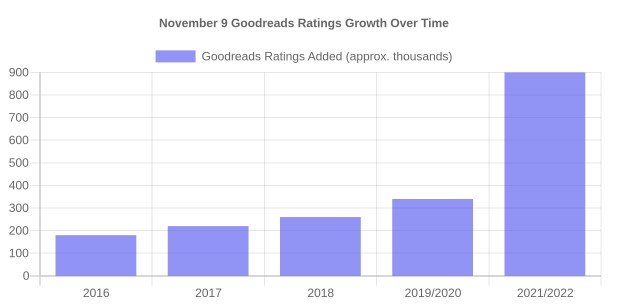
Over 2 million readers have rated November 9 on Goodreads, making it one of the most discussed romance novels of the past decade. If you keep hearing about it and want to know what is the book november 9 about before you commit your weekend to it, you are in the right place.
This guide covers the complete november 9 summary, every major character, the twist that breaks the internet every few months, the november 9 ending explained in plain terms, and whether the book is actually worth your time. No vague hedging, just straight answers.
What Is the Book November 9 About? The Short Version
The november 9 plot follows Fallon O’Neil and Ben Kessler, two strangers who meet in Los Angeles on November 9th. Fallon is moving to New York the same day, and Ben is a novelist who decides, somewhat impulsively, to spend the entire day with her. By the time the day ends, they make a pact: they will meet again on November 9th every year for five years, with no contact in between. No texts, no calls, no social media. Just one day a year.
That premise sounds romantic, and it is. But the november 9 plot does not stay comfortable. Each annual chapter peels back a layer of both characters that the previous year carefully kept hidden. By the time you reach year five, the story has recontextualized nearly everything you thought you understood about what was happening.
The november 9 genre sits squarely in new adult contemporary romance, but with a psychological suspense edge that earns it comparisons to stories built on slow-burn reveals rather than slow-burn feelings.
November 9 Author: Who Wrote It and Why It Matters
The november 9 author is Colleen Hoover, a Texas-born writer who self-published her debut novel Slammed in 2012 and became one of the most commercially successful romance authors alive today. November 9 was published by Atria Books on November 10, 2015, and it reflects the narrative techniques Hoover had refined across roughly six novels by that point: emotionally charged dialogue, unreliable emotional framing, and endings that recast the whole story.
What separates the november 9 author’s approach here from a standard romance writer is the structural choice. Hoover told readers in a 2016 interview with The New York Times that she wanted the annual chapter format to mirror the way we reconstruct our memories of people each time we see them again. That is a literary instinct, not just a plot device, and it shows in the pacing.
Hoover has also been covered extensively for the “BookTok” phenomenon, where her catalog drove a reported 40% spike in physical book sales for her titles between 2021 and 2022 according to Publishers Weekly. November 9 was part of that wave, but it had a devoted following long before TikTok discovered it.
November 9 Summary: Year by Year

The november 9 book summary is best understood chapter by chapter, since the structure is the story.
Year One (age 18/19): Fallon and Ben meet at a diner in Los Angeles. Fallon has visible burn scars on her body from a fire two years earlier that ended her acting career. Her father, a famous actor, never properly acknowledged the accident or its impact on her. Ben is charming, creative, and immediately attached. They spend the day together, and the chemistry is undeniable. The no-contact pact begins here.
Year Two: Both return to the diner. The gap has changed them. Fallon has built a new life in New York. Ben has been writing. The tension between what they feel and what the pact forbids creates most of this chapter’s momentum. Something Ben says hints at a deeper knowledge of Fallon’s past that he does not explain.
Year Three: The relationship deepens physically and emotionally. But cracks appear. Fallon notices inconsistencies in how Ben describes certain events. The reader starts asking questions the novel is deliberately not answering yet.
Year Four: The november 9 summary takes a sharp turn here. Fallon discovers something about Ben that changes the nature of everything that came before. She leaves. The pact is shattered. Whether she comes back for year five is the engine of the final section.
Year Five: The november 9 ending explained fully. Fallon and Ben are both at the diner. What they say to each other and how they say it constitutes the emotional climax of the whole book. The ending is not ambiguous, but it asks the reader to decide whether forgiveness is earned or just chosen.
November 9 Characters: Who You Are Actually Reading About
The november 9 characters are deliberately written as two incomplete people who become clearer through each other, for better and worse.
Fallon O’Neil is 18 at the start of the novel. Her scars are physical and psychological. Her father’s fame and emotional absence shaped her identity around performance and approval, and losing her acting career after the fire left her without a self-concept to fall back on. She is sharp, funny, and genuinely likable, which makes her vulnerability land harder when it surfaces.
Ben Kessler is the more complicated of the two november 9 characters. He presents as effortlessly charismatic and spontaneous, but the november 9 book summary reveals that his behavior has been more calculated than it appeared. His motivation is not malicious, exactly, but it is not innocent either. Hoover gives him enough interiority that you understand him even when you are angry with him.
Secondary characters, including Fallon’s father and Ben’s family, appear briefly but precisely, each illuminating something specific about the leads rather than existing for independent subplots. It is a useful technique for aspiring authors studying character development before researching practical concerns such as how to copyright a book.
November 9 Ending Explained: The Twist and What It Means
This is the section most people are here for, so here it is directly. If you have not read the book, this is the spoiler section. The november 9 ending explained requires going back to the fire.
Fallon’s scars came from a house fire when she was 16. In year four, she discovers that Ben was there the night of the fire. Not as a rescuer. As someone connected to how it started. Ben has known who Fallon was from the moment they “met” in the diner. The entire first encounter was not accidental. He sought her out, and the pact was his invention, partly driven by guilt he never disclosed.
Fallon leaves. The november 9 book explained through its final chapter argues that Ben’s feelings were real even if his starting point was not. The book does not pretend the deception was acceptable. But it asks whether origin poisons everything that comes after it.
Fallon returns on year five. They talk. The final pages do not skip to a neat reunion. They end on a choice in progress, which is more honest than most romance endings and also more uncomfortable.
The november 9 ending explained this way reveals Hoover’s actual thesis: love built on a lie is still love, but you have to rebuild the structure from scratch if you want it to hold.
November 9 Themes: What the Story Is Really Doing

The November 9 themes operate on multiple levels, and if you read the novel only as a romance, you will miss about half the book. Its layered storytelling can offer valuable lessons whether you plan to write a novel or make a picture book.
The central november 9 themes include:
- Identity after loss: Fallon’s arc is entirely about reconstructing a self after external markers of identity are removed.
- Guilt and atonement: Ben’s arc asks whether guilt-driven care can become genuine love, and whether that matters to the person receiving it.
- The reliability of memory and narrative: Each annual chapter subtly reframes the previous one, which is a structural argument about how we curate our own stories.
- Consent and transparency in intimacy: The novel is not shy about the fact that withholding truth from someone you love is a form of control, even when it feels like protection.
These november 9 themes are why the novel generates genuine literary discussion in addition to fan enthusiasm. A book that is only asking “will they end up together” would not sustain that kind of attention.
November 9 Genre and Age Rating
The november 9 genre is new adult contemporary romance. “New adult” as a category targets readers roughly 18 to 25, featuring protagonists in that age range navigating adult situations for the first time. The november 9 genre designation matters because it signals the level of emotional and sexual content.
On the november 9 age rating: the book contains explicit sexual content, strong language, and references to trauma including fire-related injury, parental neglect, and emotional manipulation. Most booksellers and the novel’s own community tag it as appropriate for readers 17 and older, though the content is solidly adult in register. The november 9 age rating is not formally assigned by a governing body the way film ratings are, but reader consensus on platforms like Goodreads consistently places it at 18 plus for the explicit scenes and trauma content.
Parents checking for a teenager should know: this is not a young adult novel despite the college-age characters. The november 9 age rating reflects adult content throughout.
November 9 Series Order: Where Does It Fit?
The november 9 series order question comes up because Hoover has written interconnected books. November 9 is a standalone novel. It is not part of a named series. There are no direct sequels, no prequels, and no companion novels with the same characters.
The november 9 series order in the broader Colleen Hoover context places it within her standalone works, alongside titles like Ugly Love (2014), Confess (2015), and It Ends with Us (2016). Some readers detect tonal or thematic connections across these books, but the november 9 series order does not require reading any other title first or after. You can start and finish here without missing context.
If you are building a Hoover reading order and want to understand her narrative evolution, November 9 sits comfortably after Ugly Love as a more structurally complex follow-up.
November 9 Book Review: Is It Actually Good?

The November 9 book review question deserves a real opinion, not a summary of other people’s views. Here is mine directly, shaped by what the novel reveals about how writers can master the art of storytelling.
The structure is the novel’s greatest achievement. Using the annual chapter format to make every previous chapter feel slightly different in retrospect is a genuinely skilled narrative move, and Hoover executes it without telegraphing the mechanics too early. The november 9 plot does not feel like it is setting up a twist; it feels like it is telling a love story until suddenly it is doing both.
The weakness is in the emotional resolution. The november 9 ending explained the twist clearly and honestly, but the decision to end on an open-but-leaning-positive note can feel like Hoover wanted it both ways: the literary credibility of ambiguity and the genre satisfaction of reunion. Readers who want a definitive ending will find year five slightly frustrating.
The november 9 book review from the broader reading community reflects this split. On Goodreads, it holds a 4.21 out of 5 from over 2.3 million ratings as of 2024, which places it in the top tier of the genre. Critical reception was warmer than for some of her later books precisely because the structural ambition here is harder to dismiss.
“Hoover has a gift for making you root for people you should probably know better than to trust. That is a very specific literary skill, and November 9 is its clearest demonstration.” This sentiment, widely echoed in reader roundtables on Goodreads and in editorial reviews, captures why the november 9 book review tends toward positive even from readers who prefer more restrained romance narratives.
The november 9 book review verdict: read it if you want a romance that does something structurally interesting. Skip it if explicit content or morally complicated protagonists are not for you. It earns its reputation.
Key Data: November 9 at a Glance
| Category | Details |
|---|---|
| November 9 Author | Colleen Hoover |
| Publication Date | November 10, 2015 (Atria Books) |
| November 9 Genre | New Adult Contemporary Romance |
| Page Count | 310 pages |
| November 9 Age Rating | 18 plus (explicit content, trauma themes) |
| Goodreads Rating | 4.21 / 5 (2.3 million ratings, 2024) |
| November 9 Series Order | Standalone novel |
| Main Characters | Fallon O’Neil, Ben Kessler |
| Core Narrative Device | Annual chapter structure (five years) |
What Is the Book November 9 About? A Practical Reading Guide
Here is a concrete decision framework for anyone deciding whether to pick this up.
Read it if:
- You enjoy romance novels where the structure itself is doing narrative work, not just the plot.
- Morally gray protagonists are something you can sit with without needing them to be fully redeemed on the page.
- You want to understand why the november 9 author became a cultural phenomenon before her later titles hit.
- The november 9 genre of new adult romance appeals to you and you want a strong example of the form.
Skip it if:
- Explicit sexual content is not something you want in a book.
- You need a protagonist whose past actions are fully exonerated by the end.
- Open-ended emotional conclusions frustrate you more than they satisfy you.
Before you start, do this: Read the first chapter of Year One without looking anything up. If Ben’s voice does not hook you by page 20, the rest of the novel is not going to convert you. Hoover’s prose style is polarizing, and this is the cleanest test of whether it works for you specifically.
After finishing, the november 9 book explained most fully through a second read. Year One in particular reads almost like a different chapter when you know what Ben knows in that diner.
November 9 Book Explained: The Framework That Makes It Work
I would call the structural logic of this novel the “Retroactive Ledger” approach, and it is what makes this book harder to replicate than it looks. Most romance novels are additive: each chapter adds information and moves the relationship forward.
The november 9 book explained through the Retroactive Ledger framework works differently. Each new year’s chapter does not just add; it revises. Information from year three changes how you read year one. The twist does not arrive as a sudden external event; it was baked into chapter one and only becomes visible in retrospect.
This is structurally closer to literary fiction techniques than genre romance conventions, which is partly why the november 9 book review tends to be more mixed among pure genre readers and more positive among readers who also consume literary fiction. Hoover is using romance genre expectations as a container for a narrative structure that those conventions usually do not accommodate.
Understanding the november 9 book explained this way also makes the november 9 themes about memory and narrative reliability feel less like thematic decoration and more like the actual point of the exercise.
If you want to go deeper into how contemporary small press and trade fiction handles unreliable narration and structural experimentation, the community discussions at places like Literary Hub cover these techniques across a wide range of titles and are worth following alongside your reading.
Final Take
The question of what is the book november 9 about has a simple answer and a real one. Simply: it is a love story with a five-year structure and a twist. Really: it is a novel about whether the story you tell yourself about a relationship can survive contact with the story the other person was telling themselves at the same time.
The november 9 summary gives you the plot. The november 9 book explained gives you the structure. But neither fully prepares you for how the november 9 ending explained hits when you have spent a few hours inside Fallon and Ben’s alternating chapters. That is the thing about structurally ambitious romance: the mechanics only work if you care about the people first, and Hoover earns that.
So here is the question worth sitting with after you finish: if you found out that someone sought you out on purpose before the moment you thought was accidental, would that make the relationship less real or just differently real?