
Most students stare at a blank page for 45 minutes before writing a single word. That’s not a focus problem. That’s a structure problem. If you don’t know exactly what a book report is supposed to do, you can’t write one confidently. So here’s the direct answer: a book report is a structured written assignment that proves you read a book, understood its content, and can communicate its meaning clearly. This guide breaks down every piece of the process, from the first sentence of your introduction to the last line of your conclusion, so you can stop guessing and start writing.
What Is a Book Report, Exactly?
A book report is not a review. That distinction matters more than most teachers explain upfront. A review is your opinion about whether a book is good. A book report is a demonstration that you actually read and understood the book. You’re not a critic here. You’re a reader reporting back.
What is a book report explained in its simplest form? It’s a document with three jobs: summarize the book’s content, identify its key elements (characters, plot, themes, setting), and show that you engaged with the material in a thoughtful way. In a well-written report, the reader should be able to walk away with a clear picture of what the book is about without having read it themselves.
According to Purdue University’s Online Writing Lab, book reports are foundational assignments designed to assess reading comprehension and basic writing ability. They appear most commonly in middle school and high school, but college courses in literature, history, and social sciences frequently require them too.
The scope of a book report can vary. A book report for students in fifth grade looks nothing like one assigned in a college freshman composition course. But the underlying structure stays consistent across every level: introduction, summary, analysis, and conclusion. Master that structure once and you can scale it up or down to fit any assignment.
Book Report Format: The Four Core Sections
Every solid book report follows a predictable format. Predictable is a good thing here, not a creative limitation. Your teacher is grading dozens of these. A clear, logical format makes your work easier to read and easier to grade well.
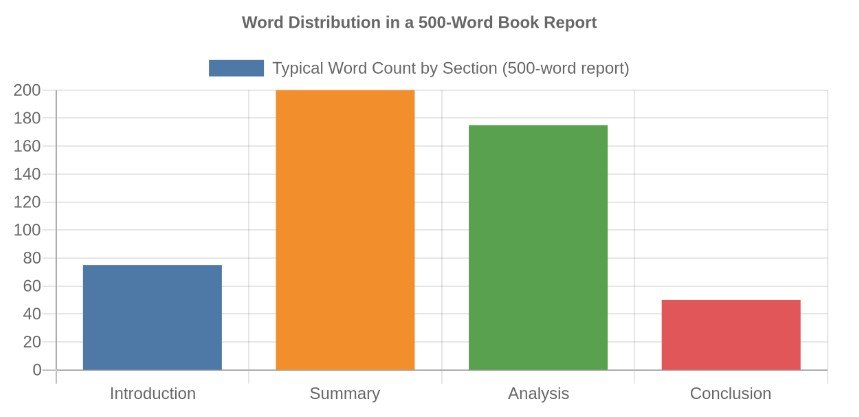
Here’s the standard book report format broken into its four sections:
| Section | Purpose | Approx. Length
|
|---|---|---|
| Introduction | Identify the book, author, genre, and your central observation | 1 paragraph |
| Summary | Walk through plot, characters, and setting without spoiling everything | 2 to 4 paragraphs |
| Analysis | Discuss themes, author’s purpose, and your critical response | 1 to 3 paragraphs |
| Conclusion | Summarize your findings and offer a final recommendation or insight | 1 paragraph |
This is the core book report structure used at most academic levels. Your teacher may ask you to add specific sections like a personal reflection or a vocabulary section, but those always bolt onto this frame rather than replace it.
How to Start a Book Report Without Freezing Up
The blank page problem is almost always a first-sentence problem. You think you need something clever and profound. You don’t. And you need something accurate and clear.
Here’s a simple framework I call the BIG-3 Opener for how to start a book report. Your first sentence should contain three things: the book title (in italics), the author’s full name, and one specific claim about what the book does. That’s it. No elaborate wind-up needed.
Something like: “In Roll of Thunder, Hear My Cry, Mildred D. Taylor traces a Black family’s fight to keep their land and dignity in 1930s Mississippi.” That sentence tells the reader who wrote the book, what it’s called, and what the book is fundamentally doing. You’ve cleared the runway. Now you can take off.
After that opening sentence, your book report introduction should cover four details: the author, the genre or category, the publication year, and a sentence previewing what your report will cover. Keep it tight. One paragraph. Teachers do not want a two-page preamble before you even name the book.
Book Report Outline: Build This Before You Write a Word
Skipping the outline is the number one reason book reports come out muddled. Students who skip it end up repeating themselves, losing track of their argument, and padding with vague sentences that say nothing. Spend 10 minutes on your book report outline and save yourself an hour of confused rewriting.
Here’s the outline structure I’d recommend for a standard 500 to 750 word assignment:
- I. Introduction – Title, author, genre, publication year, brief thesis statement about the book’s central idea
- II. Plot Summary – Beginning (setup and main characters), middle (central conflict), end (resolution, no full spoilers unless required)
- III. Character Analysis – Name and describe the protagonist, one or two supporting characters, and their roles in the story
- IV. Themes and Author’s Purpose – What bigger ideas does the book explore? What did the author seem to want readers to take away?
- V. Personal Evaluation – Your honest assessment, supported by evidence from the text
- VI. Conclusion – Restate your thesis, close with a broader observation or recommendation
That outline is your contract with yourself. Every paragraph you write should serve one of those six points. If a sentence doesn’t fit any of them, cut it or rework it.
How to Summarize a Book for a Report
Knowing how to summarize a book for a report is the single skill that separates a mediocre report from a good one. A lot of students either summarize too much (basically retelling the entire book chapter by chapter) or too little (three sentences that could describe any book ever written).
The right summary hits the major plot points, names the central conflict, introduces the key characters, and gives the reader enough context to understand your analysis. You are not replacing the book. You are orienting the reader so your analysis makes sense.
A reliable method for how to summarize a book for a report is what I call the Three-Act Compression technique. Break the book into its beginning, middle, and end. Write two to three sentences for each act. That gives you six to nine sentences of summary, which is exactly the right density for most assignments. Specific scenes and direct quotes add texture, but only include them if they support a point you’re making in your analysis section.
One thing to watch: avoid summarizing the book in the present tense throughout and then accidentally switching to past tense. Pick one and stay consistent. Most teachers prefer present tense for literary analysis (“the protagonist struggles with…”) and past tense for historical summaries (“the author published this book in…”). Check your assignment sheet if you’re unsure.
What Is a Book Report Template You Can Actually Use?
A book report template is useful when you’re writing under time pressure or when you want to make sure you haven’t missed a required section. Think of it as your assembly guide, not a script.

Here’s a functional book report template built around the four-section format:
Introduction Paragraph: “[Book Title] by [Author Name], published in [Year], is a [genre] that [brief description of the book’s central subject or conflict]. This report examines the book’s main characters, central themes, and the author’s overall message.”
Summary Paragraphs: Paragraph one covers the setup: where the story takes place, who the main character is, and what situation they find themselves in at the start. Paragraph two covers the conflict: what goes wrong, what challenge the character faces, and what’s at stake. If needed, paragraph three handles the resolution without giving away every detail.
Analysis Paragraph(s): “One of the central themes in [Book Title] is [theme]. The author develops this theme through [specific example from the text]. This suggests that [interpretation or inference].”
Book Report Conclusion Paragraph: “[Book Title] is a [adjective] work that [restate what the book does]. Readers who [brief profile of ideal reader] will find this book particularly [relevant/moving/thought-provoking]. Overall, [final evaluative statement].”
Fill in those brackets with your actual content and you have a fully functional draft. From there, you revise for flow and add your own voice.
How to Write a Book Report That Stands Out
Here’s something most guides skip: the students who get high marks on book reports aren’t the ones who followed the template most obediently. They’re the ones who had something specific to say about the book. Specificity is everything.
Compare these two sentences. “The book had an interesting theme about friendship.” That tells a reader nothing. Now try: “Taylor uses the friendship between Cassie and Jeremy to complicate easy racial binaries, showing that connection across difference is possible even when society punishes it.” That second version has a real observation in it.
When you think about how to write a book report that actually earns its grade, the secret is in the analysis section. Don’t just describe what happens. Say what it means. Use phrases like “this suggests,” “the author implies,” or “this scene demonstrates” to signal that you’re interpreting, not just retelling.
The Reading Rockets research hub at WETA Public Television, which compiles reading comprehension studies from peer-reviewed sources, emphasizes that summarization skills directly predict writing quality. Students who practice structured summarization before drafting produce reports with stronger coherence and better-supported arguments.
“The ability to identify the most important ideas and restate them in one’s own words is not just a reading skill. It is the foundation of academic writing at every level.” This consensus from literacy researchers at the National Council of Teachers of English, as synthesized in their Professional Learning Resources, reflects decades of classroom-based research on writing instruction.
Book Report for Students: Grade-by-Grade Differences
A book report for students in third grade and a book report for a high school junior are the same animal at different stages of development. The core structure stays the same, but the depth of analysis scales up dramatically.

Here’s how expectations typically shift by level:
- Elementary (grades 3 to 5): Focus is almost entirely on plot summary and basic character description. One to two pages, minimal analysis expected.
- Middle school (grades 6 to 8): Summary remains important but theme identification becomes required. Students are expected to make at least one interpretive claim supported by the text.
- High school (grades 9 to 12): Analysis takes center stage. Students are expected to connect themes to larger social or historical contexts, cite the text with page numbers, and write with a distinct argumentative voice.
- College/university: The “book report” becomes a “critical essay” in most departments, but the underlying structure is identical. The difference is in the sophistication of the thesis and the use of secondary sources.
Knowing where you are on that spectrum matters before you sit down to write. A middle schooler who writes a college-level analysis may confuse their teacher. A high schooler who writes an elementary-level summary will definitely disappoint theirs.
Common Book Report Mistakes (and What to Do Instead)
Seven years of watching student writing and these are the problems that show up constantly, regardless of grade level:
Retelling instead of reporting. If your entire paper is “and then this happened, and then this happened,” you’ve written a plot summary, not a book report. Always include at least one paragraph of analysis.
Vague thesis statements. “This book is about friendship” is not a thesis. “This book argues that genuine friendship requires moral courage, even when that courage comes at a personal cost” is a thesis. Be specific about what the book is saying, not just what it’s about.
Ignoring the book report conclusion. Students rush the ending because they’re tired of writing. But the book report conclusion is your final impression. A strong conclusion restates your central observation in new language and closes with something that gives the reader a reason to care. Don’t throw it away with a lazy “Overall, this was a good book.”
Wrong tense switching. Commit to one tense and stay there throughout your summary and analysis sections.
Not using the book report format as a checklist. Before you submit, run through each section of the format and confirm you’ve addressed it. Most grading rubrics map directly to that structure.
A Book Report Example Walkthrough
Rather than invent a vague fictional example, here’s what a book report example introduction looks like for a real, widely-assigned book at the middle school level. The book is The Giver by Lois Lowry.
Introduction paragraph: “In The Giver, published in 1993, Lois Lowry builds a society where all pain, color, and genuine choice have been erased in the name of sameness. The novel follows twelve-year-old Jonas as he is selected to receive humanity’s suppressed memories from an elderly man called The Giver. This report examines how Lowry uses Jonas’s awakening to argue that a life without suffering is also a life without meaning.”
That is a strong book report example opener because it names the book, author, and year; sets up the story’s basic situation; and previews a specific thematic argument. Notice it doesn’t start with “The book I read is…” and it doesn’t ask a rhetorical question. It just gets to work.
From there, a competent book report introduction would transition directly into the summary. No filler. No “now I will tell you about the plot.” Just start the plot.
What Is a Book Report? The Final Word on Why It Matters

What is a book report, at its core? It’s proof that reading happened and thinking followed. The assignment exists because reading without reflection is close to passive entertainment, and schools need a way to confirm that students are doing the harder cognitive work: identifying meaning, drawing inferences, and communicating both clearly.
What is a book report explained to a student who doesn’t see the point? It’s a skill that transfers everywhere. Learning how to summarize a complex source, identify its central argument, evaluate its execution, and present your findings clearly is exactly what you’ll do in a college research paper, in a professional briefing, or in any situation where you have to report on something you’ve studied. The assignment format scales. The thinking pattern stays with you.
Small press publishing, which shapes so much of contemporary literary culture, depends on readers who can engage deeply with text. The Community of Literary Magazines and Presses (CLMP) notes that independent literary culture thrives when readers develop genuine analytical relationships with books, not just surface-level familiarity. That relationship starts exactly where you are: learning to read attentively and report back honestly.
So before you write your next one, build your book report outline first, use the book report template to frame your sections, and spend the most time on your analysis. That’s where grades are won or lost, and that’s where your actual thinking shows up on the page.
What book are you reporting on right now? The structure above works for any of them.