
Some historical novels recreate the past. Olga Ravn’s novel makes the past feel feverish, physical, and dangerously close. In this The Wax Child book review, I examine why its wax-doll narrator turns a familiar story of persecution into something stranger and harder to forget.
Translated from Danish by Martin Aitken, the novel follows Christenze Kruckow, a noblewoman caught in Denmark’s early 17th-century witch trials. The English edition appeared in 2025 and reached the 2026 International Booker Prize longlist. It did not advance to the six-book shortlist.
What Is The Wax Child About?
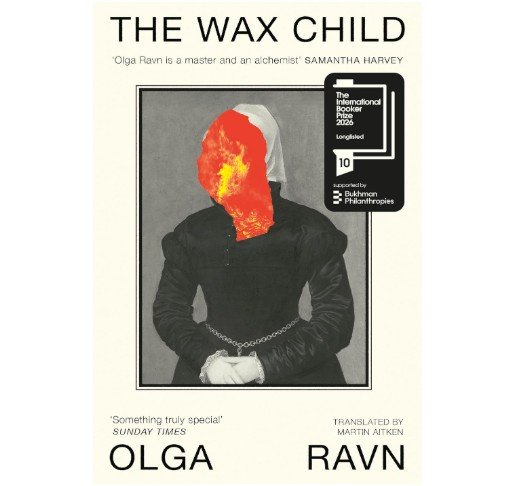 Image Source: Amazon
The story begins in Denmark in 1620, when Christenze shapes a small child from beeswax. She carries it beneath her arm, warming and moulding it against her body. The doll has closed eyes and ears, yet it watches and listens. This impossible witness narrates the book.
Christenze rejects the narrow life expected of an unmarried noblewoman. She rides horses, drinks wine, reads late, and understands herbs and the human body. Those freedoms make her visible. In a frightened community, visibility quickly becomes evidence.
When a priest’s wife becomes mentally unwell, suspicion circles Christenze. She flees towards Aalborg, but rumours travel faster. Soon, several women face accusations, interrogation, betrayal, and punishment.
Although the outcome feels inevitable, the women never become interchangeable victims. Each has her own fears, desires, and limits. The plot of this The Wax Child book review matters less as a mystery than as an examination of how panic gathers momentum.
The novel draws on the historical Christenze Kruckow, a Danish noblewoman convicted of witchcraft. She was executed in 1621 by beheading rather than burning, a distinction connected to her noble status.
The Wax-Doll Narrator Makes the Novel Unforgettable

The strongest reason to read the novel is its narrator. For this The Wax Child book review, I see the doll as more than a Gothic novelty. It becomes a form of memory that cannot be intimidated, cross-examined, or forced to confess.
A Witness Outside Human Law
The wax child has no legal standing, fixed body, or accepted voice. That distance lets it observe the machinery of accusation without sharing the community’s assumptions.
Objects, weather, flesh, smoke, and landscape seem to speak through it. Time gathers like mist, heat, and rumour rather than moving neatly forward. Official Booker material similarly emphasises how the doll witnesses violence and the cruelty of laws after suspicion takes hold.
Courts preserve charges, names, and sentences. They rarely preserve touch, hunger, loyalty, or the sound of neighbours turning against one another. Ravn’s narrator fills that emotional absence.
The doll also unsettles the boundary between object and person. It has no ordinary senses, yet it perceives more than the human characters. That contradiction gives the narrative its haunting power.
My Three-Layer Reading of the Wax Child
My original approach is to read the doll across three connected layers.
First, it is an enchanted object inside the plot. Second, it acts as an unofficial archive for women reduced to accusations. Third, it represents rumour itself: shaped by human hands, warmed through repetition, and eventually treated as alive.
That third layer changed the novel for me. The doll and the witch hunt develop through the same process. People create them, feed them, and then behave as though neither can be controlled.
This interpretation gives the The Wax Child book review a wider relevance. Ravn is not only writing about belief in magic. She is showing how repeated claims can harden into accepted truth.
Historical Horror Built From Rumour and Authority
This The Wax Child book review would feel incomplete without addressing the novel’s political force. Its horror does not depend on a hidden monster. It comes from institutions that convert uncertainty into punishment.
Ravn shows how accusation becomes self-supporting. A woman’s independence suggests guilt. Her fear suggests guilt. Her attempt to escape suggests guilt. Even friendship becomes suspicious. Once authorities accept the premise, every response confirms it.
The historical setting gains texture from court records, religious thinking, folk practices, magic spells, and early modern fears. Critics have praised Ravn’s mixture of archival material, poetic imagery, and unsettling physical detail.
Yet the novel does not behave like conventional historical fiction. It values sensory and emotional truth over tidy explanation. Readers experience the fear before receiving a clear account of it.
Female Solidarity Without Sentimentality

Many witch-trial novels portray accused women as a perfectly united group. Ravn chooses a harsher and more believable path. The women care for one another, exchange knowledge, and create private forms of safety. They also fracture under terror.
That tension shapes my central verdict in this The Wax Child book review. The novel respects solidarity because it does not romanticise it. Torture and public panic do not simply reveal character. They damage it.
Betrayal becomes part of the system’s design. Authorities isolate the women, turn their words against them, and make survival appear dependent on naming someone else.
Readers drawn to stories about exile, political fear, and public history entering private life may also appreciate The Nights Are Quiet in Tehran book. Ravn’s novel is more surreal, but both works examine how power reshapes intimacy.
Olga Ravn’s Style: Hypnotic or Too Elusive?
Ravn writes with a poet’s instinct for image, rhythm, and bodily detail. Martin Aitken’s translation keeps the voice strange without making it stiff. The prose can be beautiful, but it is rarely comfortable.
In this The Wax Child book review, I found the style strongest when physical detail anchors the abstraction. Wax softens. Smoke catches in the throat. Rooms hold whispers. The landscape appears to remember what people deny.
The brief scenes and fragmented structure also imitate the workings of rumour. Readers receive impressions, partial testimonies, and strange associations rather than a calm historical account.
The same technique may frustrate readers who want firm chronology, conventional punctuation, or direct psychological explanations. Some scenes arrive like visions rather than complete dramatic sequences.
That is not a weakness for every reader. However, it is the novel’s clearest barrier. The prose demands attention and a willingness to leave certain images unresolved.
Is The Wax Child Worth Reading?
Yes, especially for readers of literary horror, feminist historical fiction, folklore, and experimental translated literature. At 192 pages, it is short but not light. Its images and moral questions linger well beyond its length.
My The Wax Child book review recommends reading it slowly. Do not force every image into a literal explanation. Instead, track how warmth, bodies, objects, and rumours repeatedly change shape. That pattern reveals the book’s deeper structure.
Readers seeking a fast plot, reassuring answers, or traditional historical realism may struggle. Readers willing to accept uncertainty will find unusual imaginative power.
The novel should particularly appeal to readers of authors such as Margaret Atwood, Angela Carter, and Shirley Jackson. It shares their interest in social control, female experience, and the violence hidden beneath respectable institutions.
The Final Melt: My Verdict
The Wax Child is not simply a witch-trial story with an eccentric narrator. It studies how communities manufacture guilt and call the result truth.
Its wax child sees what legal history misses: fear moving between bodies, friendship collapsing under force, and authority feeding on its own claims. The narrator may be physically small, but its perspective expands the novel beyond one historical prosecution.
My final The Wax Child book review verdict is four out of five stars. The dreamlike form occasionally blurs the human drama, but the imagery, historical tension, and nonhuman voice remain exceptional.
Read it when you want a novel that feels less like a conventional story and more like a spell with evidence hidden inside it.
Frequently Asked Questions
1. Is The Wax Child based on a true story?
Yes. It draws on Christenze Kruckow, a Danish noblewoman executed for witchcraft in 1621.
2. Who narrates The Wax Child?
A small beeswax child created by Christenze narrates the novel as an eerie, nonhuman witness.
3. Is The Wax Child difficult to read?
Its short length helps, but its fragmented and poetic style requires patience with ambiguity.
4. What genre is The Wax Child?
It blends historical fiction, literary horror, feminist fiction, folklore, and experimental translated literature.