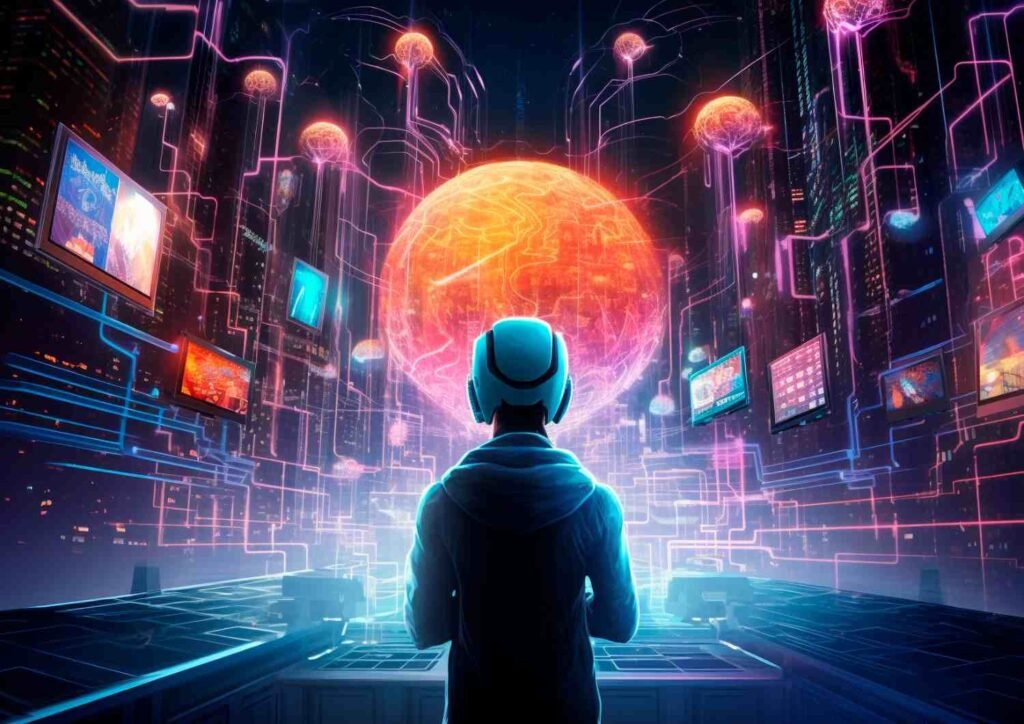
Imagine stepping into a digital space where your office, favorite store, entertainment venue, and social circle can exist in the same interactive world. That experience may sound futuristic, but the technologies powering metaverse environments are already taking shape through AI, virtual reality, augmented reality, blockchain, spatial computing, digital twins, IoT, and high-speed networks.
What makes the metaverse interesting to me is not one flashy device or platform, but the way these technologies connect to create immersive, responsive, and increasingly realistic digital experiences.
Table of Contents
ToggleWhat Technologies Actually Power the Metaverse?
The core metaverse technology stack includes extended reality, AI, spatial computing, blockchain, IoT, digital twins, 3D reconstruction, real-time engines, cloud computing, edge computing, and advanced networks. XR gives people access to virtual spaces, AI makes those spaces intelligent, and infrastructure technologies keep them responsive.
How Do VR, AR, Haptics, and Wearables Create Immersion?
Virtual reality replaces a user’s physical field of view with a computer-generated environment. Augmented reality keeps the real world visible while overlaying digital information through phones, smart glasses, or other displays. Mixed reality lets virtual objects respond to physical spaces.
The interface layer can also include haptic gloves, sensory suits, and other cybernetic systems that simulate touch, vibration, resistance, or movement. Together, VR, AR, MR, haptics, and wearables form the extended reality layer connecting people with immersive digital environments.
How Does AI Build Smarter Avatars and Virtual Worlds?
Artificial intelligence gives virtual environments intelligence and flexibility. Natural language processing can help non-player characters respond more naturally, while machine learning can personalize recommendations, digital assistants, and user experiences. Computer vision can interpret faces, gestures, objects, and surroundings.
Generative AI can accelerate avatar creation, 3D asset production, textures, dialogue, and text-to-space worldbuilding. This could make it considerably faster and less expensive to populate large virtual environments with interactive content.
What Role Do Blockchain, NFTs, DeFi, and Web3 Play?
Blockchain can provide an ownership and transaction layer for an open metaverse. NFTs can represent digital land, clothing, collectibles, tickets, or avatar items. Smart contracts can automate ownership rules and transfers, while cryptocurrency and decentralized finance can support peer-to-peer digital payments.
However, blockchain does not automatically make assets interoperable. An item cannot move seamlessly between platforms unless both ecosystems support compatible identities, file formats, rendering rules, permissions, and technical standards. Today’s metaverse platforms remain largely separate rather than operating as one universal digital economy.
Why Do Spatial Computing, 3D Modeling, and Digital Twins Matter?
Spatial computing helps devices understand depth, movement, surfaces, objects, and position. LiDAR, depth cameras, motion tracking, computer vision, and spatial mapping allow software to understand three-dimensional physical environments.
Real-time 3D engines such as Unity and Unreal Engine manage lighting, animation, physics, and interactive objects. 3D reconstruction can turn physical buildings, products, and locations into virtual assets, while digital twins create data-connected replicas of factories, cities, stadiums, machinery, and infrastructure.
These applications are especially relevant to American manufacturing, construction, healthcare, architecture, transportation, and smart-city development.
How Do IoT, Cloud, Edge Computing, 5G, and 6G Keep It Running?
The Internet of Things connects physical sensors and devices to digital systems. Data from machinery, traffic infrastructure, buildings, or medical equipment can update a virtual model in real time.
Cloud computing supplies scalable storage and processing, while edge computing moves workloads closer to users to reduce latency. Low latency matters because delays between physical movement and virtual responses can make immersive experiences uncomfortable.
5G improves bandwidth and responsiveness for mobile XR in many deployments, while future 6G networks are being researched for even greater capacity and lower latency.
How Do These Metaverse Technologies Work Together?
The technologies-powering-metaverse ecosystem becomes clearer when we follow the data. IoT sensors can capture activity from the physical world. A digital twin can represent that activity virtually. AI can analyze it, cloud and edge systems can process it, and a real-time 3D engine can visualize it. Finally, an AR or VR interface lets a person interact with the result.
Imagine a US factory where an engineer views a digital twin of a machine, receives an AI-generated maintenance warning, and follows AR repair instructions. The same architecture can support healthcare training, education, real estate, retail visualization, entertainment, remote collaboration, and smart-city planning.
What Challenges Could Slow Metaverse Adoption?
Privacy and cybersecurity become more complex when immersive devices collect movement, voice, gaze, biometric, and environmental information.
Interoperability presents another major challenge. Standards such as OpenXR and 3D formats including glTF and USD can improve compatibility, but today’s platforms are still largely separate. A universal metaverse where identities, avatars, and digital assets move freely does not yet exist at scale.
Frequently Asked Questions (FAQs)
1. What are the main technologies powering metaverse platforms?
The core technology stack includes VR, AR, mixed reality, haptics, AI, machine learning, NLP, blockchain, NFTs, spatial computing, IoT, digital twins, real-time 3D engines, cloud computing, edge computing, and advanced wireless networks.
2. Is blockchain required for the metaverse?
No. Virtual worlds can operate without blockchain. It becomes useful when a platform needs decentralized ownership, verifiable digital assets, smart contracts, cryptocurrency payments, or portable digital identity.
3. Can the metaverse work without a VR headset?
Yes. People can access many virtual experiences through smartphones, PCs, tablets, and AR devices. VR provides deeper immersion, but it is not the only gateway into virtual environments.
4. Why are digital twins important to the metaverse?
Digital twins connect physical systems with virtual models. Organizations can use them to monitor conditions, simulate changes, train employees, and test decisions before applying them in the physical world.
Where Is Metaverse Technology Headed Next?
I expect the most meaningful progress to come from convergence. AI will make virtual spaces easier to build, spatial computing devices should become more capable, digital twins will receive richer real-time information, and cloud-edge infrastructure will support increasingly demanding experiences.
For US companies and consumers, the near-term opportunity may come less from one giant universal virtual world and more from practical applications in training, manufacturing, healthcare, immersive commerce, design, entertainment, and workplace collaboration.
The metaverse is still evolving, but many of the technologies behind it are already changing how we build, work, learn, shop, and interact with digital information.