The metaverse has moved beyond science-fiction hype into something more practical: a growing ecosystem of immersive 3D experiences for gaming, work, education, shopping, creation, and social connection.
In this metaverse-guide-everything-you-need-to-know, I’ll explain what the metaverse means today, how it works, where Americans already encounter it, and what still needs to improve.
Table of Contents
ToggleWhat Is the Metaverse in Simple Terms?
The metaverse is a persistent, shared 3D virtual environment that blends physical life with immersive digital spaces. Supporters often describe it as an evolution toward a spatial internet, where people do more than look at digital content on flat screens; they interact with it around them.
That vision combines extended reality, virtual reality, augmented reality, mixed reality, artificial intelligence, real-time 3D engines, spatial computing, and, in some ecosystems, blockchain-based economies. TechTarget notes that today’s metaverse remains fragmented, so there is not yet one universal virtual world with seamless interoperability.
How Does the Metaverse Actually Work?
Metaverse experiences use software that renders interactive 3D environments in real time. Real-time 3D engines control avatars, objects, physics, lighting, and user actions as they happen.
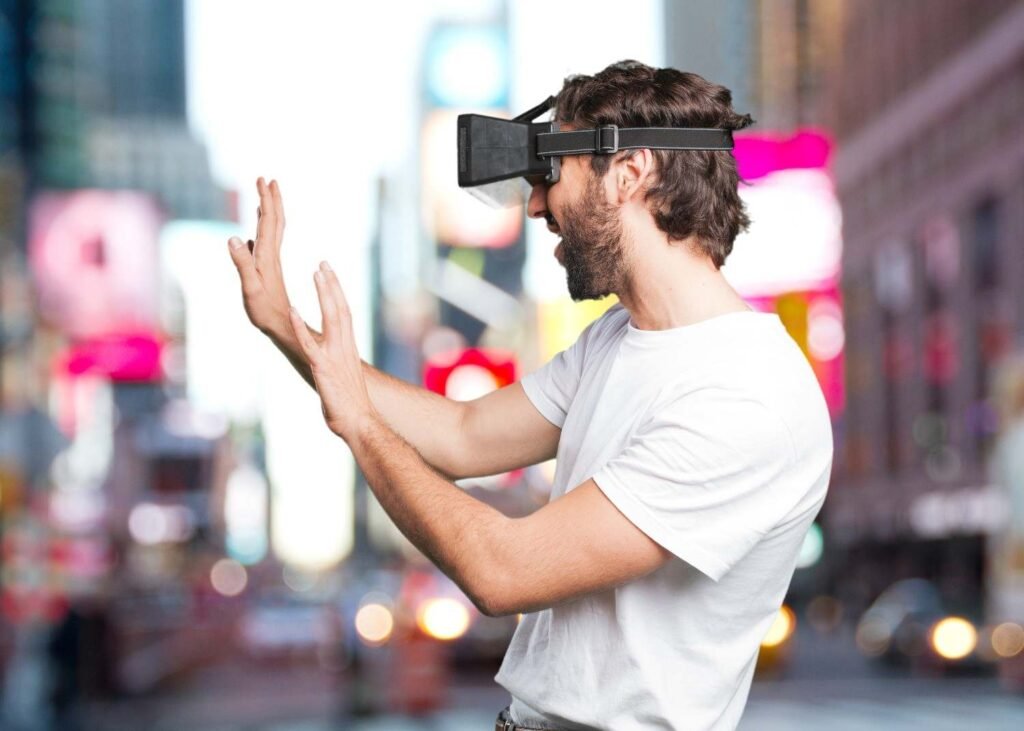
Virtual reality places users inside digital environments through headsets. Augmented reality adds digital information to the physical world, while mixed reality lets virtual objects interact with real surroundings. Spatial computing helps devices understand rooms, movement, surfaces, and digital object placement.
Meta’s developer tools show this through features that recognize physical spaces and anchor virtual content to real locations.
Why Do AI, Digital Twins, and Blockchain Matter?
Artificial intelligence can help developers create 3D objects, digital characters, personalized interactions, and changing environments faster. Generative AI may also make immersive creation easier for people without advanced 3D-design skills.
Digital twins recreate physical objects, buildings, factories, or systems digitally. U.S. companies can use them for planning, training, maintenance, and simulations before making expensive real-world changes.
Blockchain can support digital ownership, smart contracts, tokens, and virtual economies in some ecosystems, but it is not required for the metaverse.
What Can You Do in the Metaverse Today?
Gaming and social interaction remain the clearest entry points. Roblox supports 3D worlds where users can play, communicate, create, and attend digital experiences. Fortnite similarly describes the metaverse as a real-time social entertainment environment where people connect in 3D spaces.
Immersive technology can also support virtual concerts, classrooms, employee training, product demonstrations, collaborative workspaces, fitness experiences, virtual commerce, and design simulations.
How Can Americans Access the Metaverse?
You do not need expensive equipment to begin. Many metaverse-style platforms work on smartphones, PCs, tablets, and gaming consoles. A VR or mixed-reality headset simply creates a stronger sense of presence.
For U.S. consumers, Meta Quest provides VR and mixed reality, while Roblox and Fortnite work on devices many people already own. I recommend choosing the experience first and buying extra hardware only if it adds real value.
Is the Metaverse the Same as VR or Web3?
No. Virtual reality is one technology used to enter immersive environments, while the metaverse is the broader concept of interactive digital spaces.
Web3 focuses more on decentralization, blockchain networks, cryptocurrencies, smart contracts, and digital ownership. Some metaverse projects use Web3 infrastructure, but many popular platforms do not.
That is why a modern metaverse-guide-everything-you-need-to-know should explain the metaverse as a technology ecosystem instead of reducing it to VR headsets, NFTs, or cryptocurrency.
How Are US Businesses Using Metaverse Technology?
American businesses can use immersive technology for training, collaboration, product visualization, simulation, and design. Digital twins can test processes, while virtual training can recreate risky or expensive scenarios safely.
McKinsey describes the metaverse as an evolution of the internet that brings together AR, VR, AI, and spatial computing.
For American businesses, the important question is not whether they need a flashy virtual headquarters. It is whether immersive technology can improve training, customer experiences, product development, collaboration, or operational efficiency.
What Are the Biggest Risks?
Privacy matters because immersive systems may process movement, voice, surroundings, gaze, and behavior. Account theft, scams, impersonation, and malicious links also carry into virtual worlds. U.S. parents should review age settings, communication tools, purchasing controls, and privacy features for children.
Interoperability remains another challenge because users still cannot freely move every avatar, identity, item, or purchase between competing ecosystems.
This limitation is important because the original vision of the spatial internet assumes that people should eventually be able to move more smoothly between digital environments.
Is the Metaverse Dead?
The hype has cooled, but the technology continues developing. Attention has shifted from virtual-land speculation toward mixed reality, spatial computing, AI, digital twins, immersive gaming, and practical business uses. That may strengthen the industry by rewarding useful experiences over futuristic promises.
Instead of disappearing, many technologies previously grouped under the metaverse label are becoming more specialized and practical.
What Does the Future of the Metaverse Look Like?
I expect gradual development rather than one universal virtual world appearing overnight. Hardware should become lighter, AI should make 3D content easier to create, and spatial computing should connect digital information more naturally with physical surroundings.
Interoperability remains the biggest missing piece. Until platforms can share identities, assets, and experiences more freely, the metaverse will remain a collection of separate ecosystems rather than one completely connected spatial internet.
Frequently Asked Questions (FAQs)
1. What is the metaverse for beginners?
The metaverse is a collection of interactive digital environments where people can socialize, work, play, learn, shop, and create through avatars and immersive technologies.
2. Do you need a VR headset to use the metaverse?
No. Many experiences work on PCs, phones, tablets, and gaming consoles. VR and mixed-reality headsets simply provide more immersion.
3. Is blockchain required for the metaverse?
No. Blockchain can support digital ownership and virtual economies, but many immersive platforms operate without it.
4. What should readers learn from metaverse-guide-everything-you-need-to-know?
Readers should understand VR, AR, AI, spatial computing, real-time 3D engines, blockchain economies, digital twins, privacy, interoperability, and practical immersive technology use.
The Bigger Picture
When I look at the metaverse today, I see less of a single virtual universe and more of a gradual shift from a flat internet toward richer spatial experiences. For U.S. users and businesses, the useful approach is to focus on what works now: immersive gaming, training, mixed reality, digital twins, AI-assisted creation, and 3D collaboration.
The strongest platforms will succeed by offering useful, entertaining, safe, and accessible experiences.