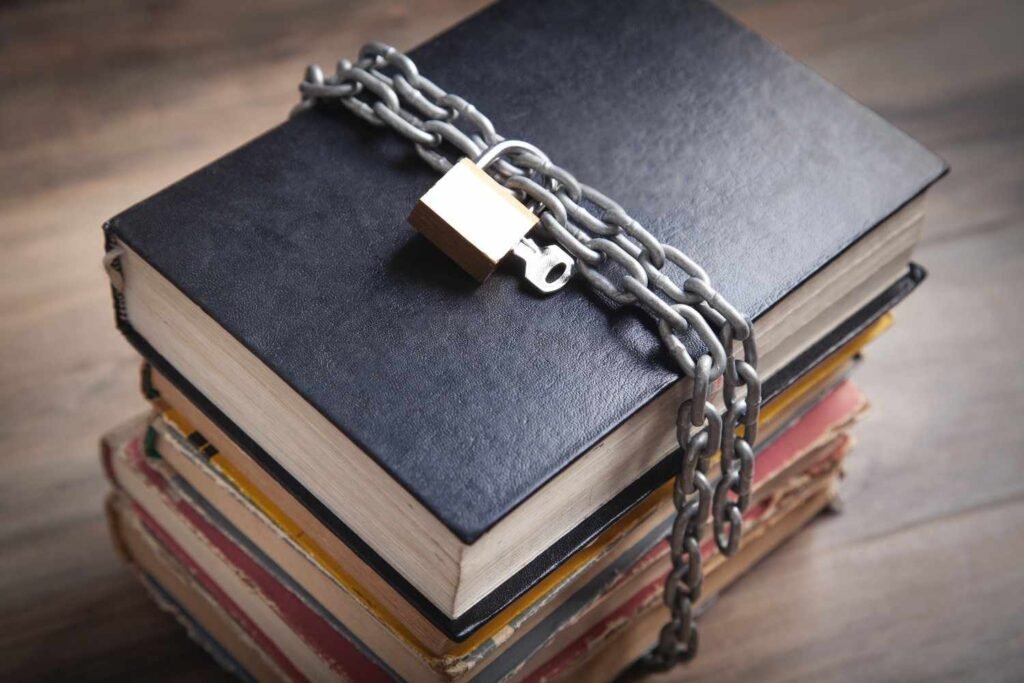
The history of book censorship is a story about power: who may speak, which ideas may circulate, and who decides what others can read. I see the same tension repeating across centuries. Rulers once burned manuscripts in public squares; today, Americans debate school library removals, parental permission rules, internet filters, and access to digital books.
When Did Book Censorship Begin?
Early governments often suppressed writing to impose political or moral order. In 213 BCE, China’s first emperor, Qin Shi Huang, ordered the destruction of philosophical and historical writings tied to rival traditions. Historians debate the purge’s scale, but it remains a major example of state control over ideas.
Ancient Rome also linked authority with morality. The office of censor, created in 443 BCE, supervised the census and public conduct. It was not a modern book-review office, but its name shaped our word “censorship.” In 8 CE, Emperor Augustus exiled the poet Ovid. His erotic Ars Amatoria conflicted with Augustan moral reform, making the case an early example of literature colliding with official values.
How Did Religion and the Printing Press Change Book Bans?
Before mass printing, authorities could suppress a text by seizing a limited number of handwritten copies. Johannes Gutenberg’s movable-type press, developed around 1440, transformed distribution and alarmed religious and political authorities because books could reach much larger audiences.
Governments and churches responded with licensing, confiscation, prosecution, and prohibited-book lists. William Tyndale’s English New Testament, printed in 1526 after work begun the previous year, was condemned in England, and copies were burned. In 1559, Pope Paul IV issued the Index Librorum Prohibitorum.
Later editions restricted works associated with Copernicus, Galileo, and René Descartes, showing how censorship could shape theology, science, and philosophy.
Why Were Books Censored in 18th- and 19th-Century America?
As Western censorship shifted from heresy toward blasphemy, sedition, abolitionism, and obscenity, the United States developed its own conflicts. The First Amendment limited government suppression of speech and the press, but it did not end disputes over supposedly dangerous or immoral reading.
Before the Civil War, Southern authorities and booksellers suppressed anti-slavery publications. Harriet Beecher Stowe’s Uncle Tom’s Cabin, published in 1852, was unavailable or effectively blocked in parts of the South because slaveholders considered it abolitionist propaganda. Its ability to influence attitudes toward slavery demonstrated how a novel could become a powerful political force.
Victorian morality produced another form of control. The federal Comstock Act of 1873 restricted mailing material labeled obscene and targeted information about contraception and abortion. Officials later used obscenity rules against literature including James Joyce’s Ulysses, giving authorities wide discretion over writing about sexuality, anatomy, and reproductive health.
How Did Totalitarian Regimes Use Book Censorship?
In May 1933, pro-Nazi university students burned tens of thousands of books across Germany with support from Nazi officials. They targeted Jewish authors, pacifists, socialists, communists, and writers labeled “un-German.” The bonfires attacked both ideas and the people connected to them.
The Soviet Union relied on state publishing controls and banned dissident writing. Authors and readers responded with samizdat, an underground practice in which prohibited texts were typed, copied, and passed privately. It proved that governments could restrict distribution without eliminating demand for forbidden ideas.
What US Court Cases Define Modern Book Censorship?
The Supreme Court’s 1973 decision in Miller v. California created a three-part test for obscenity. A work must appeal to prurient interest under community standards, depict specifically defined sexual conduct in a patently offensive way, and, taken as a whole, lack serious literary, artistic, political, or scientific value. Offensiveness alone is not enough.
School libraries raise a different issue. In Board of Education v. Pico in 1982, a Supreme Court plurality concluded that the First Amendment limits a public school board’s power to remove library books simply because officials dislike their ideas. Schools may make educational and age-appropriateness decisions, but viewpoint suppression can create constitutional problems.
Why Are Books Still Challenged in US Schools and Libraries?

Modern challenges occur through school boards, library reviews, state laws, organized pressure campaigns, temporary removals, and parental-permission rules. Recent disputes frequently involve books about race, LGBTQ+ identities, sexuality, abuse, and systemic discrimination.
The American Library Association tracked 4,235 unique titles challenged in 2025. It also documented 5,668 books banned from libraries and another 920 placed under access restrictions.
PEN America separately recorded 6,870 public-school book-ban instances during the 2024–2025 school year. The totals should not be combined because the organizations use different definitions and counting methods.
Digital censorship adds another layer. Schools and libraries can block websites, restrict databases, remove e-books, or filter search results. Technology companies also moderate content under private platform rules rather than the First Amendment, so government censorship and private platform moderation operate under different legal standards.
Frequently Asked Questions (FAQs)
1. What is the difference between a challenged and banned book?
A challenge requests the removal or restriction of a title, while a ban occurs when access is actually withdrawn because of an objection.
2. What was the first book banned in America?
Thomas Morton’s New English Canaan, outlawed by Puritan authorities in 1637, is often identified as colonial America’s first banned book.
3. Can public schools legally ban books?
Schools may select age-appropriate materials, but removing library books solely to suppress disfavored ideas can raise First Amendment concerns.
4. Why are books commonly challenged today?
Frequent objections involve sexual content, profanity, violence, religion, race, gender identity, LGBTQ+ themes, and perceived age inappropriateness.
What Does This History Teach American Readers?
The history of book censorship shows that the justification changes—from religious unity and public morality to national security and child protection—while the central struggle remains control over ideas. Efforts to restrict access can also affect important works, including Black literary classics everyone should read, limiting opportunities to understand history, identity, injustice, and cultural experience.
I believe families should guide their children, and schools should carefully consider age appropriateness and educational purpose. However, one objection should not automatically determine what every student or library patron may read.
A free society does not require approval of every book. It requires transparent review procedures, informed discussion, and respect for intellectual freedom.