Some books are frightening through supernatural monsters. This one frightened me by showing what happens when authority no longer needs to hide its cruelty. In this On Earth As It Is Beneath book review, I examine Ana Paula Maia’s short, punishing novel without revealing its final outcome.
Translated from Portuguese by Padma Viswanathan and published in English by Charco Press, the novel was shortlisted for the 2026 International Booker Prize. It takes place in a remote Brazilian penal colony built on land where enslaved people were once tortured and killed. The institution promises rehabilitation but achieves little beyond confinement.
A Spoiler-Light Look at the Story
The penal colony is approaching closure. Resources are disappearing, the heat is oppressive, and the outside world has abandoned most of the prisoners and staff.
Melquíades, the increasingly unstable warden, responds by transforming the prison into a private hunting ground. During full-moon nights, inmates are released into the surrounding wilderness. The warden then pursues them with rifles.
Among the remaining prisoners is Bronco Gil, a physically imposing convicted murderer who also appears in Maia’s Of Cattle and Men. Gil knows he is not innocent, yet his strength and survival instincts make him the closest figure the novel has to a traditional protagonist.
The premise could have produced a simple chase thriller. Maia chooses something more unsettling. The hunt matters, but the institution that permits it matters more. My On Earth As It Is Beneath book review therefore reads Melquíades as more than an isolated psychopath. He represents the final stage of a system already built around domination.
Why the Penal Colony Feels So Terrifying
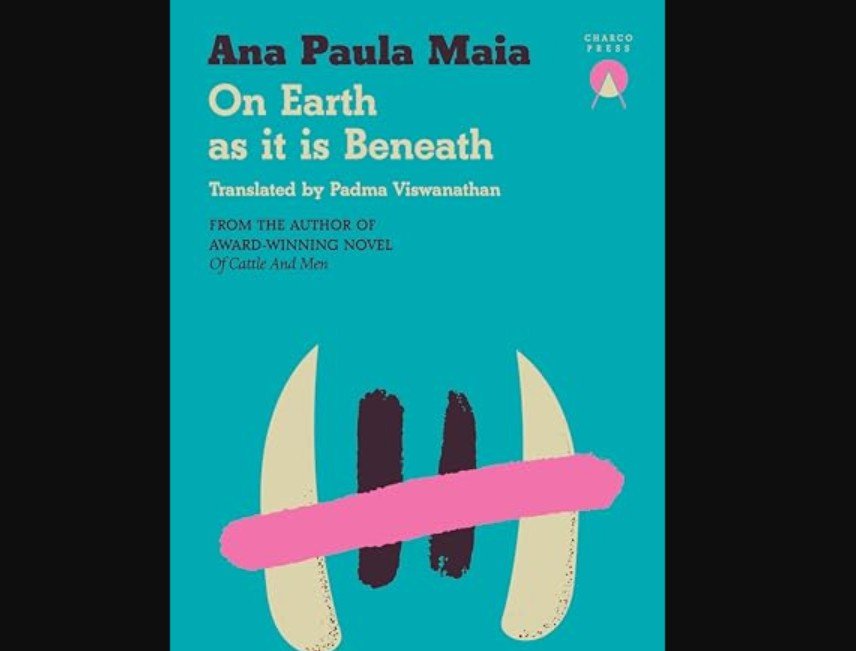
Image source: Goodreads
Violence Is Buried in the Land
The prison does not stand on neutral ground. Human remains lie beneath it, connecting the modern penal colony to the violence of slavery.
Whenever the men disturb the earth, the past returns. The prison has not replaced colonial brutality. It has simply reorganized that brutality under a new name.
This connection gives the title its force. What exists beneath the ground shapes everything happening above it. The dead become part of the institution’s foundations, even when its living occupants refuse to recognize them.
Readers interested in how land can preserve histories of displacement and institutional violence may also explore border territory place waste dissent, which examines protest, contested space, and communities treated as obstacles to political progress.
Maia has explained that Kafka’s “In the Penal Colony” and Michel Foucault’s Discipline and Punish influenced the novel. She also researched prison systems while considering the visible and invisible walls that confine people.
Work Becomes Another Form of Captivity
The prisoners dig, butcher, carry, repair, salt hides, and bury bodies. These repeated tasks create much of the novel’s rhythm.
Labor is supposed to support rehabilitation. Here, it reduces human life to physical repetition. The men work because the institution demands movement, not because their efforts offer progress.
This became one of my strongest observations while preparing this On Earth As It Is Beneath book review. Melquíades does not create the colony’s violent logic. He removes its remaining restraints.
Before the hunting begins, the prison has already trained its occupants to accept exhaustion, decay, and death as ordinary conditions.
Ana Paula Maia’s Writing Style and Translation

Image source:Wikipedia
Spare Prose With a Machine-Like Rhythm
Maia writes with blunt precision. Her sentences feel stripped to the bone. She concentrates on sweat, dust, wounds, animals, tools, and rotting matter without turning them into decorative horror.
The violence often arrives in a practical tone. That restraint made it harder for me to dismiss. Highly dramatic descriptions can sometimes create emotional distance. Maia’s cold observations deny the reader that protection.
A brutal death may pass within a few lines. A small act of tenderness toward a horse may receive greater emotional weight. Critics have also identified this movement between extreme cruelty and unexpected sorrow.
Padma Viswanathan Preserves the Rough Texture
Padma Viswanathan’s translation keeps the English prose narrow, repetitive, and physical. She has described her approach as preserving the original’s rough language, biblical undertones, and deliberate repetition.
The repeated vocabulary reinforces confinement. Readers encounter the same actions, materials, and sensations because the characters have few opportunities to experience anything else.
The translation also protects the novel’s moral tension. Bronco Gil never becomes a polished hero. Melquíades never turns into a theatrical villain. Both remain frighteningly physical men shaped by violence and power.
Readers drawn to fierce translated fiction could follow this novel with the she who remains book, particularly for another examination of survival, authority, and social control.
Bronco Gil and the Novel’s Moral Ambiguity
Bronco Gil gives the story its emotional weight. He has committed terrible violence, and Maia never asks us to forget it. However, the prison’s cruelty still makes his survival feel urgent.
This produces the central moral question in my On Earth As It Is Beneath book review: does guilt give an institution unlimited permission to destroy someone?
Bronco’s concern for animals and occasional vulnerability do not erase his crimes. They reveal that a violent person can still possess tenderness, memory, and fear.
The International Booker reading guide also highlights the tension between his brutality and humanity. That contradiction makes him difficult to admire but equally difficult to abandon.
The novel refuses the comfort of innocence. Prisoners can be guilty, guards can be trapped, and a corrupt system can still be worse than the people it contains.
My Three-Stage Tension Map
I experienced the novel’s tension in three distinct stages.
At first, suspense grows from scarcity. Water, animals, workers, and institutional order are disappearing. The colony feels like a machine shutting down while human beings remain locked inside it.
In the middle, the tension becomes moral. I stopped asking which characters deserved punishment and started asking who had gained the power to define punishment.
Near the end, the story becomes physically urgent. Survival and escape move to the foreground, but the buried history never disappears.
This structure explains why such a short novel feels larger than its page count. The plot becomes narrower while its ethical implications become wider. The chase accelerates, yet the questions become heavier.
What Works and What May Divide Readers
The atmosphere is the novel’s greatest achievement. Heat, isolation, hunger, insects, dirt, and decay create pressure on nearly every page. The setting never feels like scenery. It acts as another method of confinement.
The pacing is equally controlled. Maia avoids lengthy explanations and unnecessary backstories. Each scene either increases danger or expands the moral problem.
The abrupt ending may divide readers. I found its sharpness consistent with a book that refuses comfort. Others may feel they have reached the climax of a longer, partially untold story.
A minor amnesia-related development also feels slightly more convenient than the surrounding plot. It is one of the few moments when I noticed the story’s machinery rather than its atmosphere.
The content is relentlessly bleak. Readers should expect executions, animal deaths, abuse, human remains, racism, and institutional cruelty.
Who Should Read This Book?
This novel suits readers of literary horror, prison fiction, dystopian stories, Brazilian literature, and morally complicated thrillers.
American readers who appreciate the harsh settings associated with Cormac McCarthy may recognize a similar severity. However, Maia’s language is leaner and more directly concerned with labor, incarceration, and institutional power.
Choose this book when you want a fast reading experience that demands slow reflection. Avoid it when you need emotional relief, sympathetic heroes, or a reassuring resolution.
My rating is 4.5 out of 5 stars. The minor structural weaknesses never outweighed its atmosphere, controlled prose, and ethical force.
No Comfort, No Escape, No Regrets
My final verdict in this On Earth As It Is Beneath book review is simple: the novel becomes terrifying because it refuses to separate personal cruelty from historical violence.
The prison feels like a living inheritance. Its walls, soil, routines, and leaders repeat the same message. Power becomes monstrous when nobody outside the system is required to witness it.
Maia delivers a brutal story without turning suffering into empty spectacle. She makes readers observe how institutions hide violence behind routine, punishment, and supposedly practical decisions.
Read it in one sitting, but leave some space before beginning your next book. This novel may be slim, yet it leaves mud on the mind.
Frequently Asked Questions
1. Is On Earth As It Is Beneath a horror novel?
Yes. It combines psychological horror, literary fiction, prison drama, and dystopian suspense.
2. Is this On Earth As It Is Beneath book review spoiler-free?
Yes. It explains the central premise, themes, characters, and tone without revealing the final outcome.
3. How violent is On Earth As It Is Beneath?
It contains executions, animal deaths, abuse, human remains, racism, and sustained institutional cruelty.
4. Is On Earth As It Is Beneath worth reading?
Yes, especially for readers who value concise translated fiction, moral ambiguity, and oppressive atmosphere.