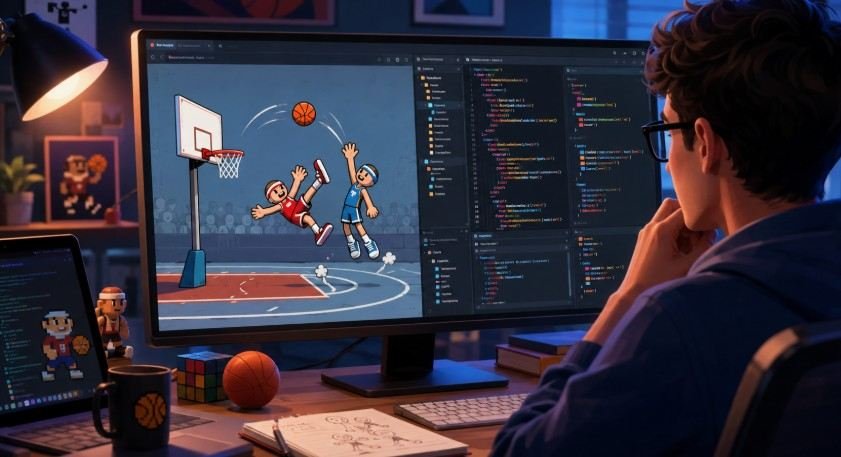
A GitHub link can make a browser game look open source, but that assumption can cause trouble. Searching for basket random git hub brings up playable pages, repositories, mirrors, and collections containing Basket Random—but their ownership, licenses, and code quality can differ dramatically.
Basket Random itself is a physics-driven basketball game developed by RHM Interactive. Its appeal is deliberately simple: two floppy players per team, one-button controls, unpredictable physics, changing courts, and a race to five points. The official Android listing reports more than one million downloads, while browser versions let players compete against the CPU or another person locally.
The GitHub side of the story is more complicated.
Table of Contents
ToggleWhat Does Basket Random Git Hub Actually Mean?
The phrase generally describes GitHub repositories or GitHub Pages websites connected with Basket Random. Some contain a playable deployment, some store game assets, and others are large browser-game collections that happen to include Basket Random.
GitHub itself did not develop the game.
GitHub is simply being used as a repository and hosting platform. GitHub Pages can publish static websites containing HTML, CSS, JavaScript, images, and other browser assets directly from a repository.
That makes it particularly convenient for lightweight web games.
Harvard’s CS50 material offers a useful explanation of the underlying workflow: Git tracks changes to files, while GitHub stores repositories remotely and enables features such as cloning, branches, forks, pull requests, and static-site publishing. Harvard CS50 Git and GitHub guide
Which Basket Random GitHub Repositories Are Actually Available?
This is where search results deserve closer inspection.
The basketrandom-org GitHub profile exists and describes itself as related to Basket Random. However, as of September 3, 2026, its public GitHub profile shows zero public repositories. That means articles describing a current public BasketRandom.github.io repository under that organization may be working from outdated or incorrect information.
The public baseinfinite/basket-random repository, meanwhile, does exist. Its visible root includes index.html, style.css, a scripts directory, and a box2d.wasm.js file. GitHub showed three commits and 15 forks when checked.
Other repositories contain Basket Random as one title among much larger unblocked-game libraries.
| Type | What You May Find | Best Use |
| GitHub Pages deployment | Playable browser build | Playing or testing |
| Dedicated repository | HTML, CSS, scripts and assets | Studying implementation |
| Game collection | Basket Random plus many games | Browsing only |
| Fork or mirror | Copy of another repository | Experimentation after license checks |
The distinction matters because finding code publicly accessible on GitHub does not automatically mean you have permission to redistribute it.
Basket Random Controls Are Simpler Than Many Guides Suggest
Some older articles list separate keys for moving, jumping, and shooting. Standard versions of Basket Random do not work that way.
The normal two-player controls are:
Player 1: W
Player 2: Up Arrow
Each button controls the team’s jumping and interaction with the ball. Timing, momentum, character position, and the game’s ragdoll physics determine whether the action becomes a block, rebound, throw, or awkward miss.
Major current listings from RHM Interactive’s Android version and CrazyGames confirm this one-button control design. The first team to five points wins, and conditions can change after baskets.
Why the Random Physics Matter
Basket Random rewards adaptation more than precise combinations of buttons.
One round may produce long-limbed players. Another can change the ball, court, clothing, or physical behavior. A strategy that produced an easy basket moments earlier may fail completely after the reset.
For beginners, waiting for the ball to approach your player is often more effective than repeatedly pressing the control key.
How to Evaluate a Basket Random Repository
Before downloading or running unfamiliar code, perform a quick repository audit.
First, inspect the repository owner. Check whether the account explains its connection to the project and whether the repository has meaningful history rather than a single unexplained upload.
Next, examine the files. Browser versions commonly need an HTML entry point and supporting scripts or assets. Unexpected executables, installers, browser extensions, or unrelated downloads deserve additional scrutiny.
Then review the commit history, issues, forks, README, and deployment URL. These signals cannot prove that code is safe, but they provide context.
NIST specifically recommends obtaining open-source components through trustworthy repositories and paying attention to software provenance and integrity. NIST open-source software security guidance
Use This Five-Point Repository Test
Ask:
- Who uploaded the repository?
- Is its history understandable?
- Can I identify what the main files do?
- Does it contain a clear software license?
- Does the live site request anything unnecessary?
If the repository asks you to install an extension, executable, unusual browser permission, or unrelated program simply to play a basic browser game, reconsider using it.
Public Code Does Not Automatically Mean Open Source
This is one of the most important misconceptions surrounding game repositories.
A repository can be publicly visible without granting everyone unrestricted permission to copy, modify, republish, or commercially exploit its contents.
The Open Source Initiative explains that genuine open-source licenses provide defined permissions to use, modify, and share software.
For standardized license identifiers such as MIT, Apache-2.0, and GPL variants, developers can also consult the SPDX License List.
Copyright still applies to software. The U.S. Copyright Office specifically recognizes computer source code as the human-readable instructions written by programmers for source-code guidance
So before publishing your own Basket Random mirror, modifying its artwork, or using repository assets commercially, locate the repository’s LICENSE file and determine what it actually permits.
If no clear license is supplied, do not assume that public visibility equals permission.
How Developers Can Experiment With a Repository
If a repository clearly permits modification, GitHub provides a straightforward development workflow.
You can browse a public repository without creating your own copy. If you want to experiment, fork it into your account or clone an authorized project locally.
A typical workflow is:
git clone REPOSITORY-URL
Make the permitted changes, test them locally, commit the changes to your branch, and—if the upstream project accepts contributions—submit a pull request.
GitHub describes a fork as a separate repository connected to an upstream project, allowing developers to experiment without directly changing the original. Pull requests then provide a mechanism for proposing those changes back to maintainers.
This process is useful for learning web development even if you never publish a modified game.
What About Basket Random Unblocked Versions?
GitHub Pages is frequently associated with “unblocked” browser games because static sites can run without traditional game installers.
That does not mean a GitHub Pages URL is guaranteed to work on a school, university, workplace, or managed Chromebook. Administrators can restrict entire domains, individual URLs, scripts, or game content.
More importantly, users should respect network and device policies rather than attempting to defeat institutional restrictions.
For personal devices and permitted environments, GitHub-hosted games can offer a lightweight way to run browser content. GitHub also supports HTTPS for Pages sites, including github.io deployments.
Common Problems and Quick Fixes
If the game opens but does not respond, click inside the game window before pressing W or the Up Arrow. Embedded games sometimes need keyboard focus first.
If graphics fail to appear, reload the page and check whether JavaScript has been disabled.
If a cloned version shows a blank page, inspect developer tools for missing asset paths. GitHub Pages projects frequently break when scripts or images reference incorrect relative directories.
If modifications stop working after an update, compare your branch against the latest upstream changes before replacing files manually.
Above all, do not solve a simple browser-loading problem by installing unknown executables or extensions.
FAQ
1. What is basket random git hub?
It generally refers to GitHub repositories, mirrors, or GitHub Pages deployments connected with Basket Random. GitHub hosts the files; it is not the original developer of the game.
2. Can I play Basket Random directly from GitHub?
Some repositories publish playable versions through GitHub Pages. Others contain only files or assets, so availability depends on how the repository has been configured.
3. Can I modify a Basket Random GitHub repository?
Only when you have the necessary permission. Check the repository’s license before copying, modifying, redistributing, or publishing its code and assets.
4. What are the correct Basket Random controls?
Standard desktop versions use one control per player: W for Player 1 and the Up Arrow for Player 2. Timing and ragdoll physics handle most movement.
Final Takeaway
The most useful way to approach basket random git hub is not to hunt for whichever “unblocked” link appears first. Treat GitHub as a development platform: inspect who published the repository, understand its files, verify the license, and run only code you trust.