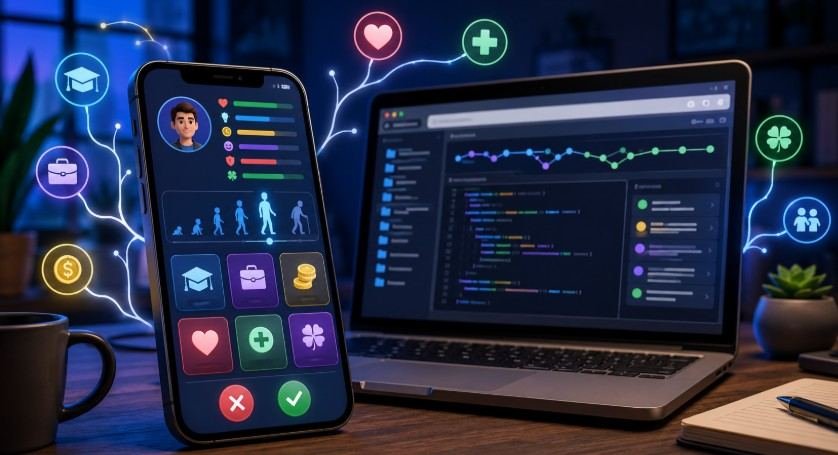
Search GitHub for BitLife and you will quickly discover something important: there is no single official bitlifegithub edition waiting to replace the mobile game. Instead, GitHub contains a changing collection of browser projects, fan-made life simulators, mirrors, experimental clones, and tools that modify game data.
That distinction matters. Some projects simply run HTML and JavaScript in a browser, while others ask users to download files or alter their BitLife installation. Those are very different levels of risk.
The official BitLife listing on Google Play currently shows more than 50 million downloads and identifies Candywriter, LLC as the developer. The listing was updated August 26, 2026.
Table of Contents
ToggleWhat Does bitlifegithub Actually Mean?
The term bitlifegithub is best understood as a search phrase rather than the name of an official product.
GitHub lets developers publish source code, host static websites through GitHub Pages, collaborate on projects, and create modified or inspired software. That flexibility explains why searching for BitLife there produces several different kinds of results.
A recent snapshot of GitHub’s BitLife topic showed six public repositories, including browser implementations, clones and projects related to modified versions.
The important question, therefore, is not simply “Where can I play BitLife on GitHub?” It is “What kind of project am I looking at?”
| GitHub project type | What it generally offers | Risk level |
| Browser-based project | Runs through HTML/JavaScript in a browser | Lower if no downloads are required |
| Fan-made simulator | Gameplay inspired by BitLife | Usually moderate |
| Save editor | Changes locally stored game data | Higher technical risk |
| Unlocker or mod | Alters official game files or features | Higher security and compatibility risk |
| Unblocked mirror | Rehosts browser-accessible game content | Trustworthiness varies widely |
Browser Versions Are Not the Same as Official BitLife
One example currently visible on GitHub is bitlifefreeonline/bitlife. Its repository describes a static browser-based life simulation project that can run from an index.html file and be hosted through services such as GitHub Pages.
Another repository, bitlifeunblockedonline/bitlifeunblockedonline.github.io, contains HTML, CSS, JavaScript and game assets and describes itself simply as a BitLife online game.
These projects demonstrate why browser searches can be confusing. Being hosted on GitHub does not mean Candywriter created, reviewed, licensed or endorsed a project.
For the official game, users should compare anything they find with Candywriter’s verified listings. Apple’s App Store identifies Candywriter, LLC as BitLife’s developer for iPhone and iPad, while Google’s listing covers Android and currently also lists Windows availability through its supported environment.
GitHub Also Contains BitLife-Inspired Games
Not every repository is trying to reproduce the original application.
For example, robert1811/life-simulator describes itself as a vanilla JavaScript project inspired by BitLife, InstLife and AltLife. It includes careers, relatives, education, skills, purchases and other life-simulation mechanics. Its own README also describes the project as unfinished and buggy.
That makes it better understood as an independent programming project than as an official browser port.
For curious developers, projects like this can actually be more interesting than a mirror. Opening files such as index.html and JavaScript folders shows how a text-based simulation can connect player choices, statistics and random events without requiring users to modify the official game.
What About BitLife Editors and Unlockers?
This is where users should become considerably more cautious.
yntha/bitlife-edit, for example, is not a browser game. It is a utility designed to dump BitLife save files into readable data, patch variables and process encrypted game files. Building it also requires additional development dependencies.
Another frequently mentioned project, zeropse/bitlife-unlocker, previously distributed files intended to unlock BitLife content on Android.
However, the repository was archived on October 2, 2025 and now explicitly states that it is no longer maintained. That makes older guides presenting it as a continuously updated solution misleading.
Modifying files can also create compatibility problems after official BitLife updates, overwrite saves, break installations or conflict with the developer’s rules. A working modification from one version should never be assumed to work safely with another.
A Five-Minute Safety Test Before Using a Repository
GitHub itself is a legitimate development platform, but a GitHub account or repository should not automatically receive the same trust as an official application.
Use this quick test before opening or downloading anything.
Check the project purpose. Read the README before clicking external links. Determine whether you are looking at a web game, clone, editor or downloadable modification.
Inspect recent activity. Check the latest commit, releases, archived status and unresolved issues. A project untouched for years deserves extra scrutiny.
Prefer browser-only projects. If your goal is simply to experiment with a life simulator, a static project that runs locally in a browser generally creates fewer complications than modifying application files.
Be skeptical of outside download links. The FTC malware protection guidance warns that unfamiliar websites offering free games or software may expose users to malware. Its consumer guidance specifically recommends downloading software only from sources you know and trust.
Keep devices updated. CISA recommends promptly installing software updates because updates address security weaknesses that attackers can exploit.
There is a broader reason for that caution. NIST’s open-source software guidance recommends obtaining open-source components through trustworthy repositories and assessing their provenance and vulnerabilities.
Similarly, OWASP’s software supply-chain guidance explains that third-party dependencies and compromised source code can introduce vulnerabilities into otherwise legitimate software.
Carnegie Mellon University’s Software Engineering Institute also emphasizes evaluating suppliers, outside software and open-source components as part of software supply-chain risk management. CMU Software Engineering Institute guidance
GitHub Pages Does Not Mean “Official”
One persistent misconception deserves correcting.
A URL ending in github.io means the website is using GitHub Pages hosting. It does not prove that the content is an authorized version of BitLife.
Likewise, stars and forks measure community activity, not security certification. A repository with many forks can still contain outdated code, questionable external links or assets whose licensing is unclear.
For U.S. players, school and workplace network policies also matter. A site being technically accessible does not override an organization’s acceptable-use restrictions. “Unblocked” should not be interpreted as “approved.”
When Should You Use the Official Game Instead?
Choose the verified Candywriter release if you care about current features, saved progress, purchases, account reliability or developer support.
A GitHub project makes more sense when your goal is exploring source code, testing a fan-built simulator or seeing how a browser life-simulation project works.
The safest rule is simple: the more a repository asks you to change on your device, the more verification it deserves.
Frequently Asked Questions
1. Is bitlifegithub an official BitLife version?
No. The term generally refers to BitLife-related repositories, browser projects, clones or tools hosted on GitHub. Official BitLife releases are distributed by Candywriter.
2. Can BitLife be played through GitHub Pages?
Some community projects run through GitHub Pages or directly from static HTML files. They should be treated as third-party projects rather than official BitLife releases.
3. Are BitLife GitHub mods safe?
Safety varies by repository. Review its source, maintenance history, downloads and external links before running files. Avoid projects whose origin or behavior you cannot verify.
4. Why do some BitLife GitHub projects stop working?
Unofficial projects may become incompatible after browser changes, dependency updates or new BitLife releases. Developers may also abandon or archive repositories.
The Smarter Way to Explore BitLife on GitHub
The attraction of bitlifegithub is understandable: GitHub can turn a simple search for a game into a look behind the curtain at browser development, JavaScript simulations and community experimentation.
But that openness is exactly why users need to distinguish a playable static project from an editor, an abandoned repository or an unofficial modification. Start by reading the README, checking maintenance activity and avoiding unnecessary downloads. If your only objective is playing the current BitLife experience, the verified Candywriter release remains the simplest choice. If you want to learn how life simulators are built, GitHub becomes far more valuable when you explore the code instead of blindly installing it.