A questions 27 and 28 karen tei yamashita book review needs to answer more than whether this 464-page novel is worth reading. What matters is how Karen Tei Yamashita turns a government loyalty test into a study of memory, citizenship, archives, and the damage caused when complicated lives are reduced to binary answers. For me, the book’s power lies in that refusal to simplify.
Published by Graywolf Press on April 28, 2026, Questions 27 & 28 spans generations of Japanese American experience around World War II. Instead of a conventional plot, Yamashita builds a polyvocal archive from documents, voices, genres, and real figures.
What Questions 27 & 28 Is Really About
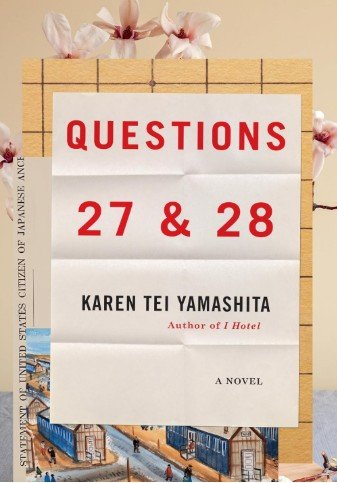
Image Credit: Amazon
The title comes from two questions on the 1943 loyalty questionnaire given to Japanese Americans incarcerated during World War II. Question 27 asked about military service. Question 28 demanded unqualified allegiance to the United States while requiring respondents to forswear allegiance to the Japanese emperor.
The wording created a trap. Many Issei could not become U.S. citizens, while many Nisei were U.S.-born citizens already imprisoned without individual charges. The National Park Service notes that negative answers or refusals could lead to a disloyal classification and segregation at Tule Lake.
That history shapes this questions 27 and 28 karen tei yamashita book review. The questionnaire becomes the book’s governing metaphor. Yamashita keeps asking who defines loyalty, who controls the record, and what happens when official categories fail real people.
Loyalty Becomes a Moral Problem
Executive Order 9066, signed on February 19, 1942, enabled the forced removal and incarceration of Japanese Americans from the West Coast. The National Archives records that about 122,000 people were forcibly moved, nearly 70,000 of them U.S. citizens.
Yamashita makes loyalty unstable. It can mean duty to country, family, community, justice, or memory. Those commitments do not always align, and the novel refuses to pretend they do.
A Polyvocal Novel Built Like an Archive
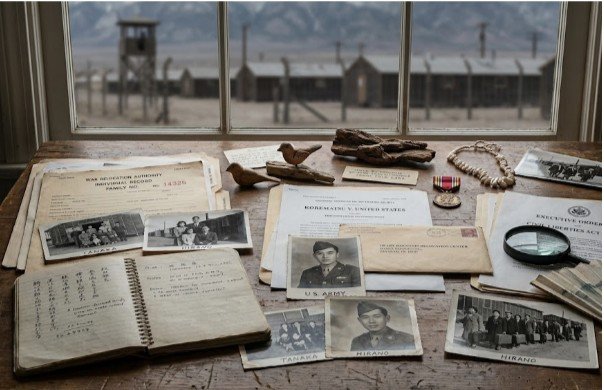
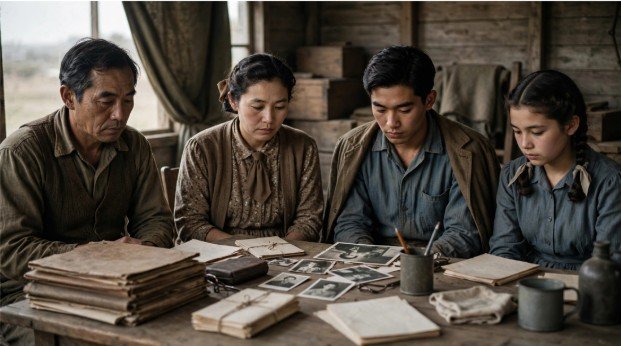
The novel uses 23 vignettes and mixes prose with letters, oral histories, testimony, haiku, government records, photographs, and other documentary forms. The effect resembles entering an archive where fact and fiction press against each other.
Why the Fragmentation Works
The structure can feel difficult. Names shift, time jumps, and sections end without conventional closure. I think that discomfort is productive because archives rarely arrive as tidy stories.
My reading method is simple: treat each vignette as evidence rather than a conventional chapter. Ask three questions: Who is speaking? What kind of record is this? What can this form reveal or hide?
I call this the archive-reading test. It provides a practical way to navigate Yamashita’s complexity without demanding that every connection become obvious immediately. That is the original lens I find most useful when approaching the novel.
Salvage, Spoilage, and Residue
Densho notes that Yamashita organizes the novel into three parts: “The Salvage,” “The Spoilage,” and “Residue.” Their structure draws inspiration from publications connected with the Japanese American Evacuation and Resettlement Study.
“Salvage” looks toward migration. “Spoilage” moves into wartime incarceration. “Residue” considers activism, memory, repair, and what remains after an event ends.
This is where the questions 27 and 28 karen tei yamashita book review becomes more than a plot assessment. The structure suggests that history leaves residue in families, institutions, scholarship, politics, and inherited memory.
Real Figures, Fictional Energy, and Archival Truth
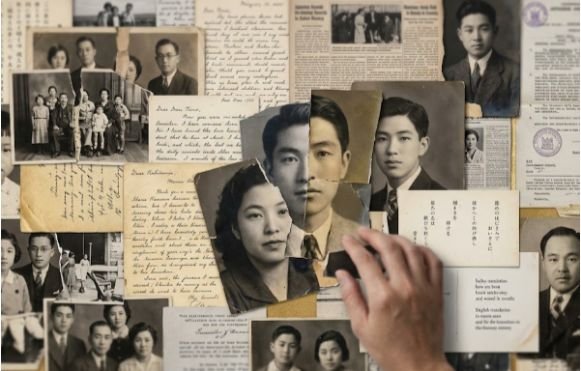
Yamashita includes real artists, scholars, activists, and researchers alongside fictionalized material. That choice creates productive tension between documentation and invention.
For me, this is the novel’s sharpest intellectual move. Many historical novels hide their research seams. Yamashita exposes them and asks how evidence gets selected, framed, preserved, and interpreted.
For that reason, this questions 27 and 28 karen tei yamashita book review treats form as part of the argument. Yamashita is not trying to recreate one authoritative version of the past. She shows why authority itself deserves scrutiny.
The result feels closer to historical investigation than a traditional dramatic reconstruction. Readers must decide how documents, recollections, artistic choices, and institutional records speak to one another.
Is Questions 27 & 28 Difficult to Read?
Yes. Readers expecting one protagonist, a linear timeline, and steady plot momentum may struggle. Densho also describes the novel as demanding trust because its chapters can initially feel disjointed.
Difficulty, however, is not failure. The method works better when you stop expecting conventional momentum. Read one or two vignettes, pause, and look up unfamiliar historical figures when curiosity strikes.
Any balanced questions 27 and 28 karen tei yamashita book review should make this clear: the novel rewards active readers more than passive ones. Its fragmentation asks you to make connections rather than simply receive them.
For Readers of Earth 7 Deb Olin Unferth Book and Experimental Fiction
Readers interested in the earth 7 deb olin unferth book may find an unexpected connection here. The settings differ sharply, but both novels ask what can be preserved after large-scale loss.
Deb Olin Unferth looks toward ecological collapse, disappearing life, and possible futures in Earth 7. Yamashita turns toward historical memory and the archive. Both books use unconventional storytelling to explore preservation rather than treating it as an abstract theme.
Readers drawn to unstable truth and narrative authority may also want the attention seeking behavior aea varfis van warmelo book as a related internal read. Aea Varfis-van Warmelo’s novel approaches truth through an unreliable narrator, while Yamashita questions the authority of documents and historical narratives.
Who Should Read This Novel?
I recommend Questions 27 & 28 to readers of Asian American literature, archival fiction, and experimental historical novels. It also suits literature students interested in form and historiography.
This questions 27 and 28 karen tei yamashita book review would not call it an easy entry point for readers wanting fast historical drama. Its reward comes from accumulation. Each fragment changes the meaning of those around it.
Readers interested in how fiction can challenge official versions of American history will find even more to consider. The book turns research into something active rather than decorative.
My Verdict: This Book Refuses the Easy Checkbox
The best thing about Questions 27 & 28 is that it never turns history into a tidy moral exhibit. Yamashita keeps the contradictions alive. The archive talks back, categories break down, and the reader has to participate.
My final take in this questions 27 and 28 karen tei yamashita book review is strongly positive. The novel is ambitious, demanding, and formally inventive without using experimentation merely for effect.
Read the documents as carefully as the fiction. Keep a notebook nearby for unfamiliar names. Most importantly, let the connections build slowly.
The mess is part of the meaning.
FAQs
1. What is Questions 27 & 28 by Karen Tei Yamashita about?
It explores Japanese American history through the 1943 loyalty questionnaire and its consequences across several generations.
2. Is Questions 27 & 28 based on real history?
Yes. The novel combines fiction with real historical figures, archival research, oral histories, government documents, and documented events.
3. Is Questions 27 & 28 hard to read?
It can be challenging because of its fragmented, polyvocal structure, but experimental-fiction readers may find that form especially rewarding.
4. Is this questions 27 and 28 karen tei yamashita book review positive?
Yes. I recommend it for patient readers who enjoy ambitious literary fiction, archival storytelling, and historically grounded experimentation.