
You found a tool with an oddly specific version number, and now you’re second-guessing your entire writing setup. Fair. Most authors waste more time choosing software than actually writing, and picking the wrong tool at the start of a 90,000-word project is genuinely painful.
The short answer: the name “Moxhit4.6.1” does not correspond to any verified, commercially available, or widely reviewed book writing software in active distribution as of 2025. If someone recommended it to you in a forum or via a download link, treat that with serious caution. But the question you’re really asking is bigger: what software should you actually use to write a book? That’s where this article is worth your time.
Should I Use Moxhit4.6.1 Software to Write a Book, or Is It a Red Flag?
Before anything else, let’s be direct about what the research shows. A search across major author communities including the KBoards Writers’ Cafe, Reddit’s r/writing subreddit, and the Alliance of Independent Authors resource library turns up zero verified mentions of “Moxhit4.6.1” as a recognized piece of manuscript writing software. That matters. When software circulates without a traceable publisher, without user reviews on reputable sites, and without a clear update history, it is almost always either abandoned freeware, a repackaged tool with an unofficial name, or something you genuinely don’t want running on a machine that holds your manuscript.
The version number format “4.6.1” implies maturity and active development, but that kind of naming is easy to fake. A lot of shady or simply forgotten programs carry version numbers like that to appear credible. So if you’re asking should I use moxhit4.6.1 software to write a book, the honest answer is: not until you can verify who built it, where it’s hosted officially, what permissions it requests, and whether real authors in real communities are using it and talking about it by that name.
The good news is that the ecosystem of author writing tools right now is genuinely excellent, and several options are free or close to it.
What the Best Book Writing Software Actually Needs to Do

Writing a book is not the same as writing a memo or a blog post. Your software needs to hold a lot of complexity without getting in your way. Here’s what separates a real best software for writing a book from something that just technically opens a blank page.
Organization is the first thing. A 300-page novel has chapters, scenes, character arcs, research notes, and timelines all running at once. A tool that treats your whole manuscript as one flat document forces you to scroll through an ocean of text every single session. That burns time and kills momentum.
The second thing is portability. Your draft should never be hostage to a single device or a single format. Any serious novel writing software exports to .docx, .pdf, and .epub without requiring you to reformat everything by hand.
Third: distraction-free writing modes actually matter, especially for small press authors who work in stolen hours between day jobs. A cluttered interface is a productivity leak, and there’s real research behind this. A 2013 study from the American Psychological Association found that task-switching costs people up to 40% of productive time. A clean, focused writing interface is not a luxury feature.
Fourth is version control. You will write a chapter, delete it, and then desperately want it back three weeks later. Every serious piece of writing software for beginners and professionals alike should have some form of snapshot or backup system.
A Breakdown of the Tools Authors Are Actually Using
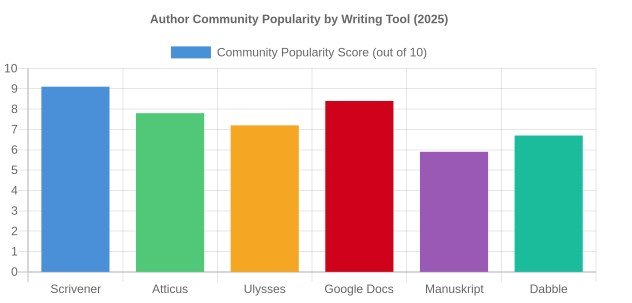
Below is a comparison of the most widely used options across the author community in 2025. These are the tools that come up again and again in small press conversations, indie author forums, and traditional publishing workshops.
| Tool | Best For | Price | Formats | Platform
|
|---|---|---|---|---|
| Scrivener 3 | Long-form fiction and nonfiction | $59 one-time | .docx, .pdf, .epub, .mobi | Mac, Windows, iOS |
| Atticus | Writing and book formatting in one place | $147 one-time | .epub, .pdf (print-ready) | Browser-based |
| Ulysses | Mac/iOS writers who prefer Markdown | $6.99/month | .docx, .pdf, .epub | Mac, iOS only |
| Google Docs | Collaboration, free book writing software for beginners | Free | .docx, .pdf, .odt | All platforms |
| Manuskript | Open-source Scrivener alternative | Free | .odt, .pdf | Windows, Mac, Linux |
| FocusWriter | Distraction-free drafting, free book writing software | Free | .txt, .rtf, .odt | Windows, Mac, Linux |
| Dabble | Novel writing software with goal tracking | $10/month | .docx, .pdf | Browser, iOS, Android |
The Case for Scrivener and Its Strongest Alternatives
Scrivener is still the gold standard for best writing software for authors who work on long projects. It’s been around since 2007, it has a massive, vocal user community, and its binder-based organization system genuinely changes how you think about structuring a book. I’d pick it for any novel over 60,000 words without hesitation. The one-time price of $59 is among the best software values in any creative field.
But Scrivener has a learning curve that stops a lot of writers cold in week one. If you’ve started it and felt overwhelmed by the interface, that’s a real and common experience, not a personal failing. The tutorial alone takes several hours. For anyone in that position, the Scrivener alternatives below are worth a serious look.
Atticus is the most interesting challenger right now. It functions as both manuscript writing software and book formatting software in one tool, which matters enormously if you’re publishing through a small press or going indie. You draft your chapters, then format directly for print and digital inside the same app. That alone eliminates a whole layer of workflow complexity that used to require a separate tool like Vellum (which is Mac-only and costs $250).
Dabble sits in an interesting middle ground. It’s a cloud-based best novel writing app with a clean interface, chapter-level organization, and a plot grid feature that helps pantsers and planners alike track story structure. The goal-tracking system is genuinely motivating for writers who work better with daily word count targets visible on screen.
For anyone who wants free book writing software with real organizational features, Manuskript deserves a look. It’s open-source, actively maintained on GitHub, and gives you a Scrivener-like structure at zero cost. The formatting export options are thinner than paid tools, but for drafting a novel, it handles the job.
Book Writing Apps Worth Considering for Mobile Writers
Small press authors don’t always write at a desk. A lot of the best first-draft work happens on phones and tablets during commutes, lunch breaks, and the ten quiet minutes before the rest of the house wakes up. The ecosystem of book writing apps for mobile has improved significantly in the last three years.
Ulysses on iOS is probably the best mobile-first writing experience available right now. It syncs seamlessly across Mac and iPhone, the Markdown-based interface stays out of your way, and the sheet organization system works well for chapter-level drafting. If you’re deep in the Apple ecosystem, it’s the best novel writing app for mobile use, full stop.
Dabble’s mobile app is cross-platform and keeps all your work in sync across devices without any configuration effort. Whether you’re drafting Southern gothic literature for beginners or revising a full-length novel, that matters more than it sounds. Any time you have to transfer files manually or worry about which version of a chapter is current, you’re burning writing time on logistics instead of pages.
Google Docs remains a surprisingly capable free book writing software option on mobile. The collaboration features are unmatched if you have a co-author or an editor working in real time with you. It won’t organize your chapters visually, but if you’re disciplined about using headings and a clear file structure, it does the job for drafting.
“The best writing software is the one you actually open every day. No tool fixes a blank page if you don’t sit down with it.”
Jane Friedman, publishing industry expert and author of The Business of Being a Writer, has consistently emphasized in her widely read newsletter that workflow friction is one of the top reasons authors abandon drafts before completion. This view is echoed across the author community and holds regardless of which best book writing software you choose.
Should I Use Moxhit4.6.1 Software to Write a Book: A Decision Framework

Here’s a framework I call the VAVE Check: Verified, Auditable, Viable, Established. As BookTok is changing reading culture in America, new writing and publishing tools continue to attract attention. Run any software recommendation through these four questions before you put a single word of your manuscript into it.
- Verified: Can you find the official developer website with a current domain registration, real contact information, and a clear publishing history? If the software only exists on third-party download sites, that’s a serious warning sign.
- Auditable: Is there a public record of version history, patch notes, or a changelog? Legitimate author writing tools document their updates. Moxhit4.6.1 has no publicly auditable version history in any author-facing community or software repository.
- Viable: Do real authors in active communities discuss using it by name and recommend it based on their own finished projects? Check forums, review sites like Goodreads’ author resources, or the Alliance of Independent Authors before trusting any unfamiliar writing software for beginners.
- Established: Has the tool been around long enough to have a support community, a bug-fix record, and genuine user documentation? For manuscript writing software, longevity matters because your project may take years.
Moxhit4.6.1 passes none of these four checks based on available evidence. That does not mean a tool by that name couldn’t exist in some niche context, but it does mean you should not put your manuscript into it without verifiable answers to all four questions first.
Book Formatting Software: The Step Authors Forget Until It’s Too Late
Writing the draft is one problem. Getting that draft into a format a printer, retailer, or reader can actually use is a completely different problem, and a lot of first-time authors discover this at the worst possible moment, right before their launch date.
The main players in book formatting software right now are Atticus, Vellum (Mac-only), and Adobe InDesign for authors who want professional print-design control. Atticus is the most accessible for the average small press author because it handles both writing and formatting and runs in any browser.
Vellum produces gorgeous ebooks and print interiors but requires a Mac and costs $249.99 for unlimited publishing. InDesign gives you total control but has a steep learning curve and a subscription model that starts around $22.99 per month.
For authors on a tight budget, the free tier on Reedsy’s book editor is a legitimate option. It formats manuscripts to industry-standard ebook and print PDF outputs at no cost, and it’s trusted by thousands of indie and small press authors. Not glamorous, but it works and it’s free.
A Practical Checklist: Choosing Your Writing Tool

Before you download anything, run through this checklist. It takes five minutes and will save you from switching tools mid-project, which is one of the most common ways authors lose weeks of momentum.
- Do you write primarily on one device or across multiple devices and platforms?
- Is your budget closer to zero, under $60 one-time, or are you open to a subscription?
- Do you need book formatting software built in, or will you format separately?
- Are you writing a novel, a nonfiction book, or a collection? (Collections need different organizational structures than linear narratives.)
- Do you prefer organizing chapters visually, or do you work linearly from top to bottom?
- Will you be collaborating with a co-author or sharing drafts with an editor in real time?
- Have you verified the tool passes the VAVE Check described above?
Answer those seven questions, and the right tool from the table above becomes obvious pretty quickly. If you write across Mac and PC, need built-in formatting, and have a $150 budget, Atticus is your answer. If you want the richest feature set for a long novel—whether it explores American Transcendentalism or another complex subject—and work on one computer, choose Scrivener. If your budget is zero and you collaborate with others, Google Docs plus Reedsy for formatting covers everything.
Writing Software for Beginners: Where to Actually Start
If this is your first book and the whole landscape of best book writing software feels overwhelming, here’s the simplest possible path: start in Google Docs, finish your first draft, then move to Atticus or Reedsy when you’re ready to format. You can always migrate a manuscript later. You can’t finish a draft you never started because you spent three weeks choosing software.
The best writing software for authors who are early in their career is almost always the least complicated one that gets out of the way. Features matter less than consistency. A writer who opens Google Docs every morning and writes 500 words will finish a book before a writer who spends those same mornings comparing feature sets of novel writing software options.
The same logic applies to the question of whether you should use moxhit4.6.1 software to write a book. Even setting aside the verification concerns, chasing an unfamiliar tool with no community support means you’re betting your project on a tool with no safety net. That’s a risk no manuscript is worth taking when proven book writing apps exist at every price point, including free.
The Final Answer on Moxhit4.6.1
No. Based on every available signal, you should not use Moxhit4.6.1 software to write a book. There is no verified publisher, no documented user community, no auditable version history, and no presence in any major author resource library as of 2025. The naming convention does not match any established software product in the novel writing software or manuscript writing software space.
What you should do instead is decide what you actually need from your writing tool, run through the VAVE Check for anything unfamiliar, and pick from the verified, widely used options covered above. The right author writing tools exist. They’re trusted, updated, and backed by real communities of writers who can help you when something goes wrong.
Your book deserves a foundation you can count on. The software you write in should be the least interesting part of your creative process, not a source of doubt or risk. Pick something proven, open it tomorrow morning, and write the first chapter. That’s the move.
What’s stopping you from starting that first chapter today?