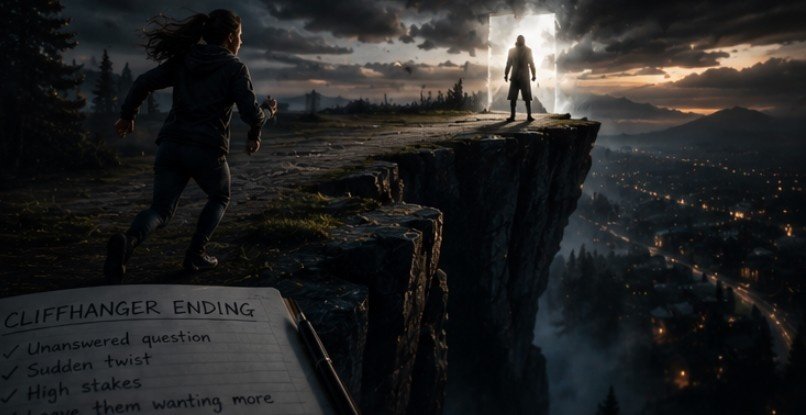
The Zeigarnik Effect—a psychological phenomenon first observed by Lithuanian psychologist Bluma Zeigarnik in the 1920s—reveals that the human brain retains uncompleted or interrupted tasks much better than completed ones.
When a story resolves all its tension at the end of a chapter, the brain marks that task as “finished,” giving the reader a natural stopping point to close the book. Learning how to write a cliffhanger ending relies on intentionally exploiting this psychological quirk, creating an open cognitive loop that forces the reader’s brain to demand closure.
THE ZEIGARNIK LOOP
┌───────────────────┐
│ Rising Tension │
└─────────┬─────────┘
│
▼
┌───────────────────┐
│ Interrupted Action│
│ (The Cut) │
└─────────┬─────────┘
│
▼
┌───────────────────┐
│ Cognitive Tension │
└─────────┬─────────┘
│
▼
┌───────────────────┐
│ Reader Demands │
│ Closure │
└─────────┬─────────┘
│
▼
┌───────────────────┐
│ Page Turned │
└─────────┬─────────┘
│
└──────────────► Rising Tension
Flow: Rising Tension → Interrupted Action (The Cut) → Cognitive Tension → Reader Demands Closure → Page Turned → Rising Tension.
The Neuroscience of the Open Narrative Loop

When a story delivers an unexpected twist or halts right before a crucial outcome, it triggers a spike in dopamine—the neurotransmitter responsible for anticipation and drive. This neurochemical response is not merely a reaction to drama; it is an evolutionary mechanism designed to keep humans focused on unresolved threats or opportunities.
Literary researchers and cognitive scientists note that narrative suspense activates the brain’s predictive processing networks. According to research on story comprehension from institutions like Stanford University, readers continuously build mental models of what will happen next.
When a writer severs a scene right before confirming or denying those predictions, the reader experiences a sudden visual and cognitive disruption. To resolve the discomfort of the unknown, the reader feels a physical urge to flip the page.
However, relying solely on cheap shocks can lead to narrative fatigue. If every chapter ends with a literal gun pointed at a character’s head, readers quickly become desensitized.
| Cliffhanger Archetype | Emotional Driver | Best Used For |
| Immediate Danger | Fear & Urgency | Action scenes, thrillers, climactic sequences |
| Shocking Revelation | Disorientation & Curiosity | Mysteries, psychological dramas, midpoint shifts |
| The Impossible Choice | Empathy & Moral Tension | Character-driven fiction, literary drama, romances |
Deconstructing the Anxious Halt: Anatomy of a Great Cliffhanger
To build suspense that feels earned rather than manipulative, you must understand the key structural elements of a high-tension scene transition.
1. Plant a Burning, Specific Question
A cliffhanger fails if the reader does not clearly grasp what is at risk. It is not enough for something “scary” to happen; the scene must implant a hyper-specific question in the audience’s mind. Instead of asking, “Will Sarah survive?” narrow the scope: “Will Sarah use her last bullet on the lock or on the figure approaching her?” Specificity heightens the stakes.
2. Isolate the Sensory Reaction
When the central event hits, shift the narrative lens away from broad exposition and focus down on a visceral, sensory detail. Instead of describing the full chaos of a sudden explosion, end the chapter on the smell of ozone, a high-pitched ringing in the ears, or a single drop of blood hitting a letter. Cutting off the scene at the moment of impact forces readers to turn the page to discover the physical consequences.
3. Tighten the Line Length at the Cut
Pacing is inherently visual on the page. As you build toward the cliffhanger, shorten your sentences and paragraphs. Rapid, punchy phrasing speeds up the reader’s eye, mimicking an elevated heart rate. When you hit the final line of the chapter, deliver a single, sharp sentence that leaves the scene hanging in mid-air.
Before sending your manuscript out to beta readers or submitting it to agents, running your manuscript through targeted developmental editing tips for fiction writers can help identify chapters where the tension sags right before the break.
Three Cliffhanger Models That Keep Audiences Hooked
While physical peril is a classic choice, sophisticated storytelling relies on varied narrative disruptions.
The Physical Threat (Immediate Peril)
This model drops a character directly into physical danger or an unavoidable disaster. The trick to executing this cleanly is to cut the scene after the threat presents itself, but before the character can react.
Example: The glass beneath Clara’s boots cracked, spiderwebbing out over the frozen ravine. She shifted her weight, but the ice gave way completely.
The Paradigm Shift (Revalatory Shock)

Instead of putting a character in danger, this approach rewrites the rules of the world or the relationships within it. A hidden secret comes to light, an ally reveals a betrayal, or a new piece of evidence reframes everything the protagonist believed.
Example: Julian pulled the heirloom watch from the pocket of the fallen soldier. Scratched inside the casing was his father’s distinctive signature—dated three years after his supposed funeral.
The Dilemma (Moral Impossibility)
Often the most emotionally devastating format, the dilemma forces a protagonist to choose between two equally agonizing outcomes. The scene ends the precise moment the choice is thrust upon them, leaving the reader desperate to see which value system the character upholds.
Example: The doctor handed Mark the syringe. “We only have enough antidote for one of them,” she said, nodding toward his daughter and his brother. “You have ten seconds.”
CLIFFHANGER DECISION TREE
|
Is the tension physical?
/ \
YES NO
/ \
[ Physical Threat Model ] Is it information-based?
/ \
YES NO
/ \
[ Paradigm Shift Model ] [ Moral Dilemma Model ]
The “Tension Audit”: A 4-Step Checklist for Writers
Use this quick test at the end of any chapter to evaluate whether your cliffhanger works or falls flat:
- The Stakes Test: What does the protagonist stand to lose in the next 30 seconds of story time if things go wrong? (If the answer is “nothing major,” increase the stakes).
- The Resolution Test: Have you accidentally resolved the immediate problem before ending the chapter? (If yes, move your chapter break 2–3 paragraphs backward).
- The Micro-Pacing Test: Is your final sentence concise, active, and free of unnecessary adverbs?
- The Ear Test: Read the final paragraph aloud. Does it end on a strong, resonant word that leaves an echo?
Once your draft passes this audit and your chapter breaks are razor-sharp, thorough proofreading techniques for writers will ensure that small typos or clumsy punctuation don’t shatter the carefully built suspense.
Misconceptions: When NOT to Use a Cliffhanger
While cliffhangers are powerful narrative tools, overuse can undermine a story’s emotional weight.
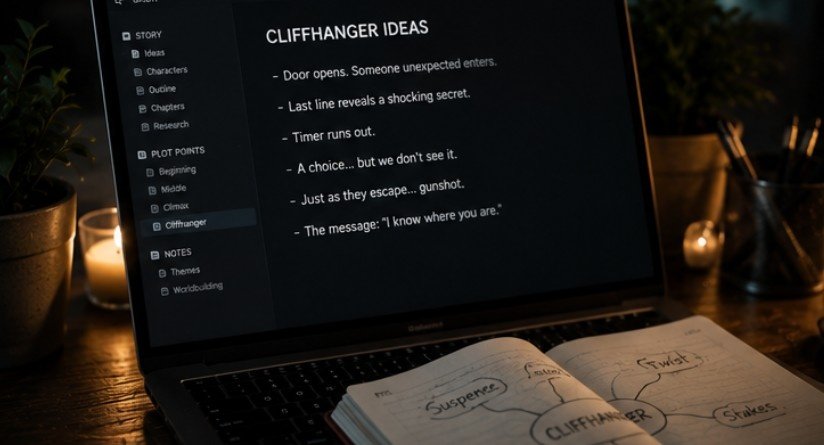
- The False Alarm Trap: Ending a chapter with a dramatic gasp, only to reveal on the next page that the character simply dropped a teacup, breaks trust with your audience. Readers will quickly realize you are manipulating them with cheap tricks.
- The Book-End Exhaustion: If you are writing a multi-book series, ending a full-length novel on a total, unresolved cliffhanger without providing any sense of emotional closure for the main plot arc can alienate your audience. The primary conflict of the book should feel satisfied, even if a new, larger threat looms on the horizon.
- The Climax Rule: During the ultimate climax of your story, avoid artificial cuts. Readers want to experience the full emotional payoff of the resolution without frustrating interruptions.
When your manuscript achieves the right balance of pacing, tension, and narrative closure, review these guidelines on how to submit writing to literary magazines to pitch your work effectively to publishers and editors. For more information on literary structures and classic narrative traditions, explore open resources at the Library of Congress.
Frequently Asked Questions
1. Can you give me an example of a cliffhanger ending?
A classic example is a story ending as a detective opens a door, gasps, and the scene cuts black before revealing what is inside the room.
2. What is a cliffhanger example?
In The Empire Strikes Back, the film ends with Han Solo frozen in carbonite and Luke Skywalker learning Darth Vader is his father, leaving major storylines entirely unresolved.
3. How does cliffhanger end?
A cliffhanger ends abruptly at a point of high suspense, unresolved danger, or sudden revelation, intentionally leaving the main conflict or question unanswered until the next section.
4. How to write a good ending for a short story?
Focus on emotional resonance or a meaningful shift in perspective rather than a huge plot twist. Resolve the central character arc while leaving room for thematic reflection.
Master the Cut
Writing a captivating cliffhanger isn’t about tricking your audience into turning the page—it is about honoring the natural psychology of curiosity. By introducing a sharp, unresolved question, anchoring the moment in visceral sensory detail, and cutting the scene at the absolute peak of tension, you create a narrative drive that feels irresistible.
Look at your current manuscript’s chapter breaks today: find the moments where you settled the action too neatly, pull back the resolution, and leave your readers hanging on the edge.