
A face does not become memorable because a writer lists twenty details. Research on face memory suggests the opposite: distinctive features and meaningful context do more work than a neutral inventory. That is the lesson in how to describe physical traits in fiction. Give readers enough to form an image, then let movement, viewpoint, and story significance finish the job.
Physical Description Is Selection, Not Documentation
Writers often approach appearance like an identification form: six feet tall, brown hair, green eyes, narrow nose, medium build. The information is clear, but it rarely feels alive.
Instead, ask three questions: What would the viewpoint character notice first? What makes this person easy to distinguish? What detail has emotional or story value?
Face-memory research supports that emphasis. A study by Vicki Bruce, A. Mike Burton, and Neil Dench found that faces deviating more from an average appearance tended to be rated as more distinctive. Later MIT research found that some face photographs are consistently more memorable across observers, although memorability cannot be reduced to one simple trait.
For fiction, “a crooked front tooth she hides when she laughs” may do more than five lines of measurements.
Start With the Core Physical Categories
When a scene needs a fuller introduction, begin with broad categories: height and build, hair, facial features, skin, distinctive marks, and movement.
Think in categories rather than inventories. Height and build establish silhouette; hair and facial features help recognition; skin, scars, freckles, wrinkles, or birthmarks can add specificity. Movement matters too: a tall character who folds himself into every doorway feels different from one who enters chin-first and takes up the room.
That principle also helps writers create believable fictional characters: appearance becomes characterization when it affects behavior, relationships, or how other people respond.
Use Adjectives Clearly, but Do Not Stack Them

English has a conventional order for multiple adjectives. A common pattern places opinion before size, age or shape, color, origin, material, and purpose. The Excelsior University Online Writing Lab guide to adjective order explains why phrases such as “long black hair” sound more natural than scrambled sequences.
Grammar, however, is not a license to pile descriptors into one sentence. “She had beautiful long wavy dark brown hair” is understandable, but “Her dark hair fell in loose waves past her shoulders” creates an image.
Try limiting yourself to two modifiers. If you need more, turn one trait into action, comparison, or consequence.
Try the Three-Detail Recognition Test
Before keeping a character description, run this quick edit.
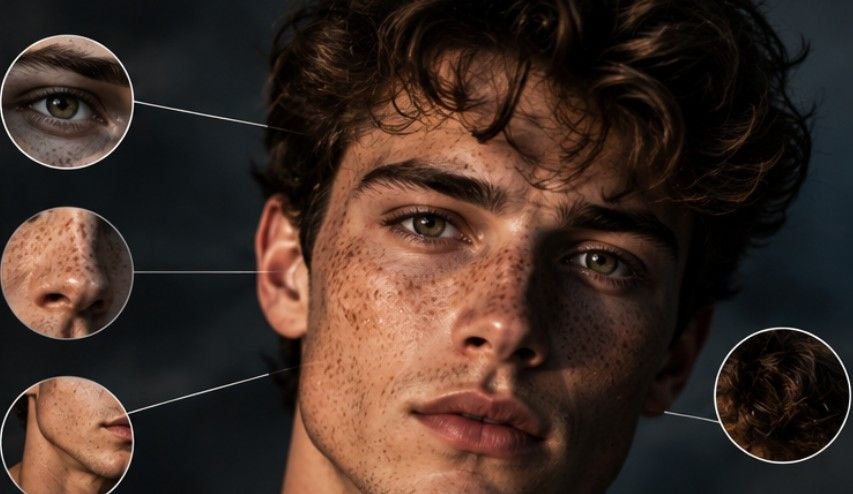
1. Choose One Silhouette Detail
Pick something visible from a distance: height, build, posture, hairstyle, or clothing shape.
2. Choose One Close-Up Marker
Use a feature that distinguishes the person: a chipped tooth, heavy brows, a pale scar, deep smile lines, or a cluster of freckles.
3. Choose One Behavior-Linked Trait
Show the body doing something. A nervous character rubs the callus on his thumb. A runner shifts onto the balls of her feet. A tired professor keeps pushing silver hair out of his glasses.
Now remove other details and reread. If you can still recognize the character, much of the deleted material was probably unnecessary.
This technique can also build emotional depth in fiction because appearance becomes connected to habit, memory, or conflict.
Let Point of View Change the Description
No character sees another person neutrally.
A child may notice jangling bracelets before age. A jealous rival may fixate on posture. Someone meeting an ex after ten years may notice what changed and miss what stayed the same.
Research supports tying faces to context. In a study of incidental face memory, emotionally relevant contexts increased the likelihood that participants remembered associated semantic and episodic details. For fiction, attach appearance to an event, reaction, or relationship.
That is also why concrete imagery can help explain why readers connect with contemporary poetry: a physical image becomes stronger when it carries emotional meaning.
Describe Identity Without Turning People Into Labels

Physical description becomes clumsy when race, disability, weight, age, or skin tone is used as shorthand for personality.
Separate observation from judgment. “She used a wheelchair” is an observation. “She looked helpless in the wheelchair” is a judgment that may reveal more about the observer than the person.
Language preferences also vary. American Psychological Association guidance on disability language notes that person-first and identity-first wording can both be appropriate, depending on individual and community preference.
Avoid assuming that physical features prove moral qualities. A narrow face does not make someone cruel, and broad shoulders do not automatically mean confidence.
Common Mistakes That Flatten Description
Avoid the mirror scene where a character inspects every feature merely so the author can report it. Exact measurements can also feel clinical unless the plot requires them; “a little taller than her sister” often reads more naturally than “five feet seven.”
Do not give every character equal descriptive space. Save close attention for people readers need to remember, and let appearance keep changing during the scene: hair gets wet, faces redden, shoulders slump, and posture shifts under stress.
Frequently Asked Questions
1. How do you describe a person’s physical characteristics?
Start with noticeable features such as height, build, hair, face, skin, posture, and distinctive marks. Choose details relevant to the viewpoint, action, or story instead of listing everything.
2. What are 5 physical traits?
Five common physical traits are height, body build, hair, facial features, and skin characteristics. Posture, gait, scars, freckles, tattoos, and other distinguishing marks also work.
3. What are 50 personality traits?
Personality traits describe behavior, not appearance. Examples include curious, patient, ambitious, shy, generous, impulsive, loyal, stubborn, cautious, witty, compassionate, competitive, organized, adaptable, and anxious.
4. What are some examples of physical traits?
Examples include curly hair, broad shoulders, freckles, a shaved head, gray eyes, a limp, a scarred hand, deep wrinkles, a tall frame, or hunched posture.
Final Takeaway
Learning how to describe physical traits is really learning what to leave out. Readers do not need a complete visual file; they need a few details that help them recognize a person and understand why that person matters. Start with one broad impression, add one distinctive marker, then connect another trait to movement, emotion, or point of view.
Keep grammar clear, avoid stereotypes, and let description change as the scene changes. The best test is simple: if a detail disappeared, would the character become harder to recognize, understand, or feel? If not, cut it. Precision beats inventory every time.