Readers do not abandon books because the plot is unoriginal; they put them down because the story’s internal clock feels wrong. A reader’s brain processes narrative time through cognitive beats, meaning their sense of momentum is dictated by structural rhythm rather than page count.
If your story feels sluggish or chaotic, learning how to fix pacing in writing is the most effective way to restore narrative momentum.
Pacing isn’t just about moving quickly; it’s about controlling narrative density. When a story stutters, it is usually because the writer is confusing motion with progress. Fixing it requires adjusting sentence mechanics, managing narrative distance, and balancing scene types.
The Neuroscience of Reader Engagement and Pace
A narrative’s speed depends on how the human brain processes information while reading. According to research on reading mechanics published by the National Center for Biotechnology Information, readers process text through rapid eye movements called saccades, pausing on words to extract meaning.
When a page is dense with long, uninterrupted paragraphs, processing time increases, signaling to the brain that time has slowed down.
| Technique | Fast Pacing (Accelerated Time) | Slow Pacing (Expanded Time) |
| Sentence Length | Short, fragmented, punchy | Long, complex, lyrical |
| Focus | Immediate action, external stakes | Internal reflection, sensory detail |
| White Space | High (frequent paragraph breaks) | Low (dense, descriptive blocks) |
| Narrative Motion | Skipping real-time events | Exploding a single second |
When you overload a scene with background details during a high-stakes moment, you create cognitive friction. The reader’s brain slows down to digest the description, destroying the tension. Conversely, moving through emotional climaxes without internal reflection deprives the reader of catharsis.
Mastering the Mechanics: Rhythm, Scene Types, and Density
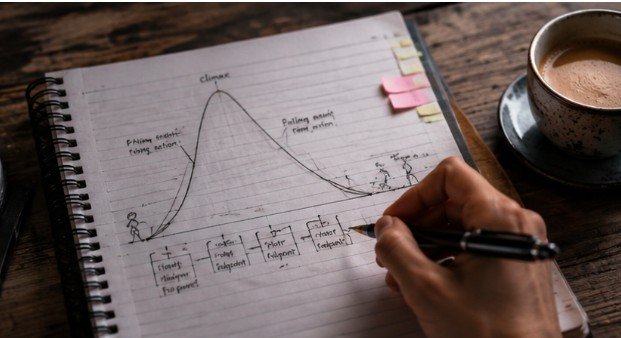
To gain control over your story’s speed, you need to adjust three core levers: structural rhythm, scene variation, and information density.
1. Structural Rhythm and Sentence Length
Your sentence structure dictates the reader’s heart rate. Short, declarative sentences force fast reading. They mimic adrenaline, elevated blood pressure, and quickened breaths. Long, compound sentences invite contemplative reading, encouraging the brain to linger on images and ideas.
If you need a scene to move faster, strip away conjunctions and subclauses. If you need a moment to feel weightier, expand the syntax.
2. Strategic Scene Variation
A story held at maximum speed causes fatigue; a story stuck in low gear induces boredom. Great stories alternate between two distinct modes:
- Scene: Real-time action, dialogue, and conflict where time moves at a 1:1 ratio.
- Sequel: Slower, reflective moments where characters process shock, evaluate choices, and set new goals.
Without sequels, high-action stories lack emotional stakes. Without scenes, character-driven stories become static essays.
3. Controlling Information Density
Pacing drops when writers engage in “tracking”—showing every minor physical movement a character makes. You do not need to show a character walking across a room, grabbing a doorknob, and turning it unless that door is booby-trapped. Skip routine movements.
Similarly, avoid “info-dumping.” Withhold non-essential backstories until the reader explicitly needs them to understand a character’s current choice.
Writers navigating these structural choices must balance developmental editing with mechanical formatting. For example, ensuring your manuscript adheres to standard submission parameters can streamline the revision process.
If you are preparing your work for publication, reviewing proper manuscript formatting guidelines for writers ensures that your focus remains strictly on narrative structure rather than stylistic clutter.
The Pacing Diagnostic Checklist: How to Test Your Draft

If you suspect your draft’s momentum is off, run your manuscript through this step-by-step diagnostic process to find the problem area.
- The Page Density Test: Look at your manuscript from a distance. Are your pages wall-to-wall text with minimal white space? Break up large blocks of prose during tense moments to increase visual momentum.
- The Dialogue Tag Audit: Highlight every dialogue tag. If you rely heavily on adverbs (she said angrily, he shouted loudly), cut them. Action beats keep dialogue moving faster than descriptive tags.
- The “So What?” Filter: Read each scene and ask: Does this scene alter a character’s course of action or reveal crucial information? If the answer is no, cut the scene or collapse it into summary prose.
- The Sensory Blast: Pick a critical scene that feels rushed. Add three distinct sensory details—a smell, a specific texture, or a physical sensation—to force the narrative to pause in that moment.
When Fast Pacing Fails: Exceptions and Common Pitfalls

Speed is not the ultimate goal of narrative pacing. A common mistake among new writers is assuming that faster is always better.
If you push through plot points too quickly, your story loses emotional resonance. Readers need time to care about a character before that character faces danger. If a tragedy occurs on page two, the reader feels nothing because the narrative hasn’t established empathy yet.
Literary fiction, historical fiction, and world-heavy fantasy often rely on deliberate, slower pacing to build atmosphere. Academic institutions like the Iowa Writers’ Workshop frequently emphasize that narrative atmosphere requires time to develop. Slowing down to explore setting and subtext is not a flaw, provided those details build thematic weight.
Writers interested in exploring how different genres treat pace and narrative craft can benefit from analyzing contemporary literature. Exploring the difference between book review and literary criticism offers valuable insight into how professional critics evaluate narrative rhythm and structure.
Frequently Asked Questions
1. What is an example of pacing in writing?
Pacing is how fast or slow a story unfolds. For example, using short, punchy sentences during a chase scene creates high speed, while detailed descriptions during a character’s quiet morning slow the story down.
2. What three techniques can an author use to speed up pacing?
To accelerate pacing, an author can shorten sentence and paragraph lengths, cut unnecessary transition descriptions, and focus heavily on high-stakes dialogue and action while trimming internal monologues.
3. How to improve the pacing of a story?
Improve pacing by alternating between high-action scenes and reflective pauses. Trim filler movements, vary your sentence structures, withhold backstories until necessary, and ensure every scene advances the plot or deepens character development.
4. How to tell if pacing is too fast?
Pacing is too fast if emotional moments feel unearned, plot twists happen without impact, or readers report feeling disconnected from the characters. If big events occur without processing time, the story is rushing.
Elevating Your Narrative Rhythm
Pacing is the invisible rhythm that keeps readers turning pages late into the night. It isn’t an arbitrary art form; it is a deliberate manipulation of focus, syntax, and time. By learning when to compress routine moments and when to expand critical scenes, you transform a series of events into a compelling experience.
Once you have mastered these structural revisions and polished your narrative rhythm, the next step is sharing your work with the literary world. Navigating the submission process requires strategic planning.
Learning how to submit writing to literary magazines can help you place your polished work in front of editors who appreciate finely tuned narrative craft. Take a hard look at your current draft, apply the diagnostic checklist, and cut away anything that stands between your reader and the heart of your story.