This pseudotooth review is for readers wondering whether Verity Holloway’s debut is worth its demanding, dreamlike journey. My verdict is yes, but only if you enjoy fiction that refuses to separate fantasy, trauma, memory, and bodily experience into tidy boxes.
What Is Pseudotooth About?
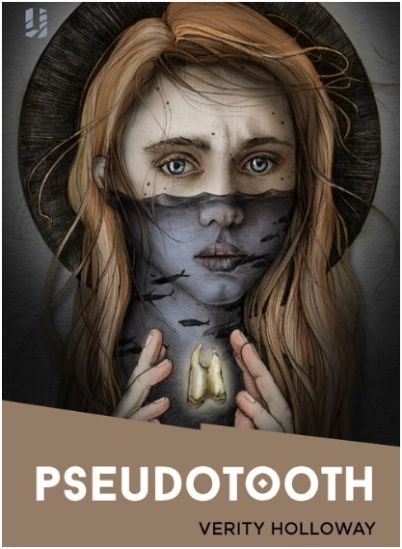
Image source: Goodreads
Published by Unsung Stories in March 2017, Pseudotooth follows Aisling, a young woman experiencing unexplained blackouts and pseudo-seizures. Doctors cannot identify a clear cause, while her family often treats her symptoms as weakness, inconvenience, or performance.
Aisling is sent to recover in rural Suffolk, where she finds a Tudor priest hole. The discovery draws her toward an unfamiliar world governed by fear, enforced purity, and mysterious disappearances.
The official synopsis presents the novel as an adult portal fantasy examining trauma responses, social difference, acceptance, and exclusion. That description fits, but it understates how unstable the reading experience becomes. The portal may be physical, psychological, symbolic, or all three.
Why This Dark Portal Fantasy Feels Different

Literary Prose Creates an Unreliable Reality
The strongest element in my pseudotooth review is Holloway’s literary approach. The language does not behave like conventional commercial fantasy. Visions, journals, historical references, and altered spaces keep reality in constant motion.
That style creates genuine unease. Aisling’s surroundings never feel fully trustworthy, yet her fear remains emotionally credible. The uncertainty is not a puzzle with one convenient answer. It reflects how other people repeatedly define her condition without listening to her.
Holloway spent years developing the manuscript and struggled to classify its genre or intended audience. This creative history helps explain why the finished novel resists simple categories.
Trauma, Illness, and Bodily Autonomy
The central conflict is not simply whether Aisling is “really” ill. The novel asks who has the authority to decide what her body means.
Her relatives, doctors, and other authority figures offer competing explanations. Each explanation reduces her freedom and turns her body into something other people believe they can interpret or control.
This theme gains further weight from Holloway’s comments about living with Marfan syndrome. She has explained that sickness and disability influence her writing, while rejecting the use of illness as an easy symbol for evil.
Readers drawn to fiction about voice, agency, and imposed identity may also enjoy Autonomous Voices.
Where Pseudotooth May Lose Some Readers

An honest pseudotooth review must admit that the ambiguity can become exhausting. The plot moves in manic bursts, and the boundary between hallucination, memory, dream, and portal fantasy rarely settles.
Some scenes develop atmosphere more effectively than narrative momentum. In my assessment, the novel’s emotional logic is clearer than its physical logic. Aisling’s feelings of danger, judgment, and entrapment remain understandable, even when the rules of her surroundings do not.
Other reviewers have similarly identified the novel’s genre blending and uneven, rapidly changing plot as both fascinating and challenging.
Readers seeking detailed world-building, quick explanations, or a tidy conclusion may feel denied rather than intrigued. The book rewards interpretation, not certainty.
My Three-Part Reality-Pressure Test
To make this pseudotooth review more useful, I assessed the story through three questions.
Does the ambiguity generate emotion? Yes. The confusion places readers close to Aisling’s unstable sense of safety.
Does it strengthen the themes? Mostly. The blurred reality reinforces the damage caused by disbelief, unwanted labels, and forced definitions.
Does it consistently support the plot? No. The novel sometimes sacrifices momentum for symbolic intensity.
My overall assessment is 4 out of 5 for prose, 4.5 for thematic ambition, and 3.5 for narrative clarity. That imbalance creates much of the novel’s appeal, but it also forms its greatest barrier.
Who Should Read Pseudotooth?
This novel suits readers who enjoy psychological horror, literary fantasy, gothic imagery, unreliable perception, and stories about marginalized people resisting control.
It may appeal to fans of portal fantasy that treats escape as dangerous rather than comforting. US readers should expect a distinctly British setting and vocabulary, although no specialist cultural knowledge is required.
Approach the novel slowly. Do not read only for plot mechanics. Track repeated images, authority figures, bodily reactions, and moments when someone attempts to define Aisling. Those patterns offer more meaning than a simple map of the fantasy world.
Final Bite: Beautiful, Unsettling, and Proudly Unruly
My final pseudotooth review verdict is that Holloway’s novel deserves attention because it takes formal risks for a clear purpose. Its confusion can frustrate, but its language, atmosphere, and treatment of bodily autonomy leave a sharper mark than many cleaner fantasies.
Read the opening chapters before committing. When the unstable voice feels magnetic rather than irritating, continue. This strange novel will not meet readers halfway, and that is precisely why it may remain memorable.
Frequently Asked Questions
1. Is Pseudotooth a horror or fantasy novel?
It combines literary fantasy, psychological horror, gothic fiction, and portal fantasy.
2. Is this pseudotooth review spoiler-free?
Yes. It discusses the premise and central themes without revealing the ending.
3. Is Pseudotooth suitable for young readers?
It follows a young protagonist but addresses mature themes, making it more suitable for older teens and adults.
4. Is Pseudotooth difficult to read?
The prose is vivid, but the shifting reality and ambiguous plot require patience.