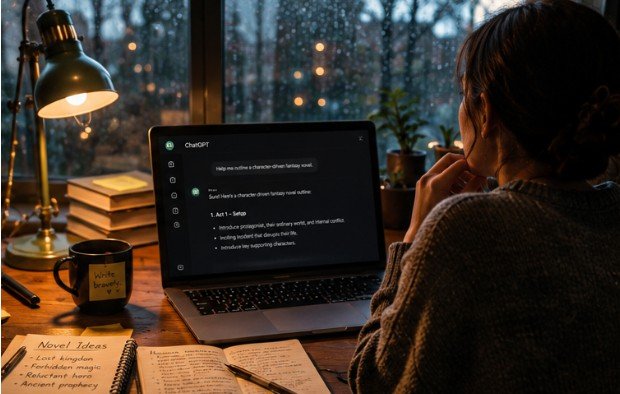
A strange thing happens when AI gives writers “better” story ideas: the individual story may improve while many writers’ stories start sounding more alike. In a 2024 Science Advances experiment with 293 writers, generative-AI ideas improved ratings for creativity, writing quality, and enjoyment, especially among less-creative participants, but reduced collective diversity.
That is the useful lesson in how to use ChatGPT for novel plotting. Treat it like a writers’ room that challenges your choices, not a machine that makes every choice for you.
Start With a Story Brief, Not “Give Me a Plot”
OpenAI’s current prompting guidance favors clear instructions, enough context, and iterative follow-ups over one oversized request.
Before asking for an outline, give ChatGPT a compact story brief: genre, setting, protagonist, visible goal, private fear, opposing force, stakes, tone, audience, and two things you do not want.
For photographers or cinematographers, think of it like defining a visual concept before a shot list. “Create a thriller” is the writing equivalent of “make it cinematic.”
Assign a Role That Creates Friction
Try: “Act as a developmental editor for psychological thrillers. Ask me one question at a time before proposing plot beats.”
Ask ChatGPT to question assumptions, identify missing information, and wait for your answer. That keeps the premise yours.
Build the Novel in Layers
Do not jump from premise to 40 chapters in one prompt. Start by asking for the central conflict, stakes, internal character problem, and three possible structural directions. Choose one yourself.
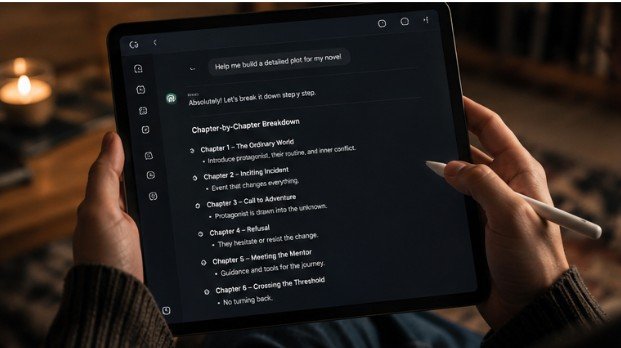
Next, map major turning points with the Hero’s Journey, three-act structure, or another beat-sheet method. Treat frameworks as scaffolding, not formulas.
Then move from acts to sequences and from sequences to scenes. For every scene, ask four questions: What does the viewpoint character want? What blocks them? What changes? Why must the reader keep going?
For high-tension scenes, tell it to stop before the conflict resolves; you choose the payoff instead of accepting its easiest answer.
Use ChatGPT as a Plot Stress Tester
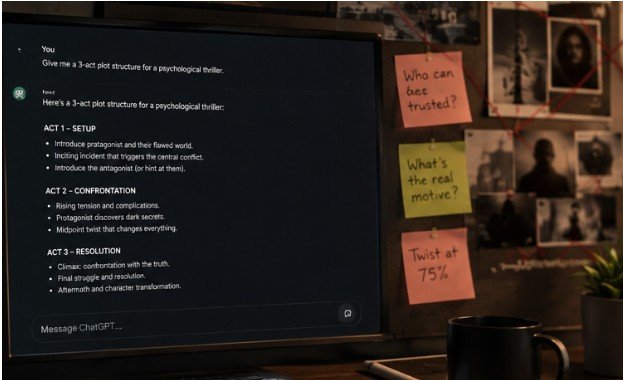
The tool becomes more useful when it attacks your outline instead of praising it. Feed it your current plot and ask:
“Where does my protagonist succeed too easily?”
“Which coincidence solves a problem that should require a decision?”
“Where does the antagonist logically need to apply more pressure?”
“Which character disappears for too long?”
“Give me three consequences that worsen Act Two without adding a new villain.”
If you work visually, ask for scene cards with location, objective, conflict, reversal, and visual motif. It feels closer to breaking down a film sequence.
After plotting, strengthen the human side of the manuscript by studying ways to develop a unique writing voice.
Run an Originality Test Before You Trust the Outline
The Science Advances findings suggest a trade-off: AI ideas can help one writer while nudging many writers toward similar solutions. Run a “genericity audit.”
Ask ChatGPT to name the five most conventional elements in its own outline. Then request alternatives that change cause-and-effect, not merely the decoration.
Changing a detective into a photojournalist is cosmetic. Changing why the investigation exists, what the truth would cost the protagonist, or who benefits from failure changes the story engine.
Try one more test: remove the most obvious twist. If the plot collapses, you may have built around a trope instead of a chain of character decisions. Look for ways to improve creative writing skills instead of asking AI to draft every scene.
Separate Brainstorming From Research and Copyright
ChatGPT can suggest research questions, but factual claims should be verified elsewhere. For suppressed literature or publishing controversies, the history of book censorship is a useful starting point.
Copyright also rewards keeping the human author in control. The U.S. Copyright Office AI study reported in 2025 that generative-AI output may receive protection only when sufficient human-authored expressive elements are present; prompting alone is not enough. AI assistance itself does not automatically block copyright protection for a larger human-created work.
OpenAI’s Terms currently say that, as between the user and OpenAI and to the extent permitted by law, the user owns output. They also warn that output may not be unique. Contractual ownership and U.S. copyright eligibility are therefore related but different questions.
For self-publishers, Amazon KDP currently requires disclosure of AI-generated text, images, or translations. It says brainstorming with AI while writing the actual text yourself is AI-assisted and does not require that disclosure.
A 20-Minute Plotting Workflow
Spend five minutes writing the premise yourself: protagonist, goal, opposition, stakes, and an ending possibility.
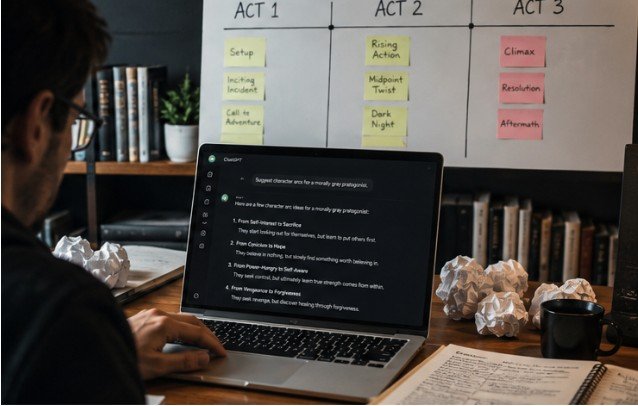
Spend five minutes asking ChatGPT for three structurally different routes. Reject anything that feels too familiar.
Spend five minutes stress-testing your favorite route for weak causality, passive characters, convenient twists, and sagging tension.
Spend the final five minutes rewriting the outline in your own words. Add one decision only your character would make and one consequence you did not ask AI to invent. The tool should widen your options; your taste should narrow them.
Frequently Asked Questions
1. Can I sell a book I wrote with ChatGPT?
Yes, subject to your platform or publisher’s rules. Amazon KDP allows AI-assisted and AI-generated books, but requires disclosure of AI-generated content. Copyright protection may depend on meaningful human authorship.
2. Is it legal to publish a novel written by AI?
Generally, publication is not automatically illegal in the United States. Copyright, infringement, disclosure, defamation, contract, and platform rules still apply, and fully AI-generated expression may receive limited or no copyright protection.
3. What is the best tool for plotting a novel?
There is no universal winner. ChatGPT is strong for brainstorming, structural alternatives, and plot diagnosis. Dedicated novel-writing software can be better for timelines, character databases, scene cards, and manuscript organization.
4. Are authors using ChatGPT to write books?
Yes. Some use it for brainstorming, outlining, editing, or drafting. Industry opinion remains divided; the Authors Guild, for example, promotes clear distinctions between human-authored work and AI-generated text.
The Plot Still Needs a Human Hand
The smartest way to use ChatGPT is not to ask it for your novel. Ask it to reveal the novel you have not solved yet. Use it to challenge stakes, expose logic gaps, generate structural options, and pressure-test scenes, then make the creative choices yourself. That balance matters because faster ideation is useful only if the result still feels specific to your characters and your imagination.
A camera can offer autofocus, stabilization, and exposure assistance, but it cannot decide what deserves the frame. Plotting works the same way: let the tool improve your control, not replace your point of view.