
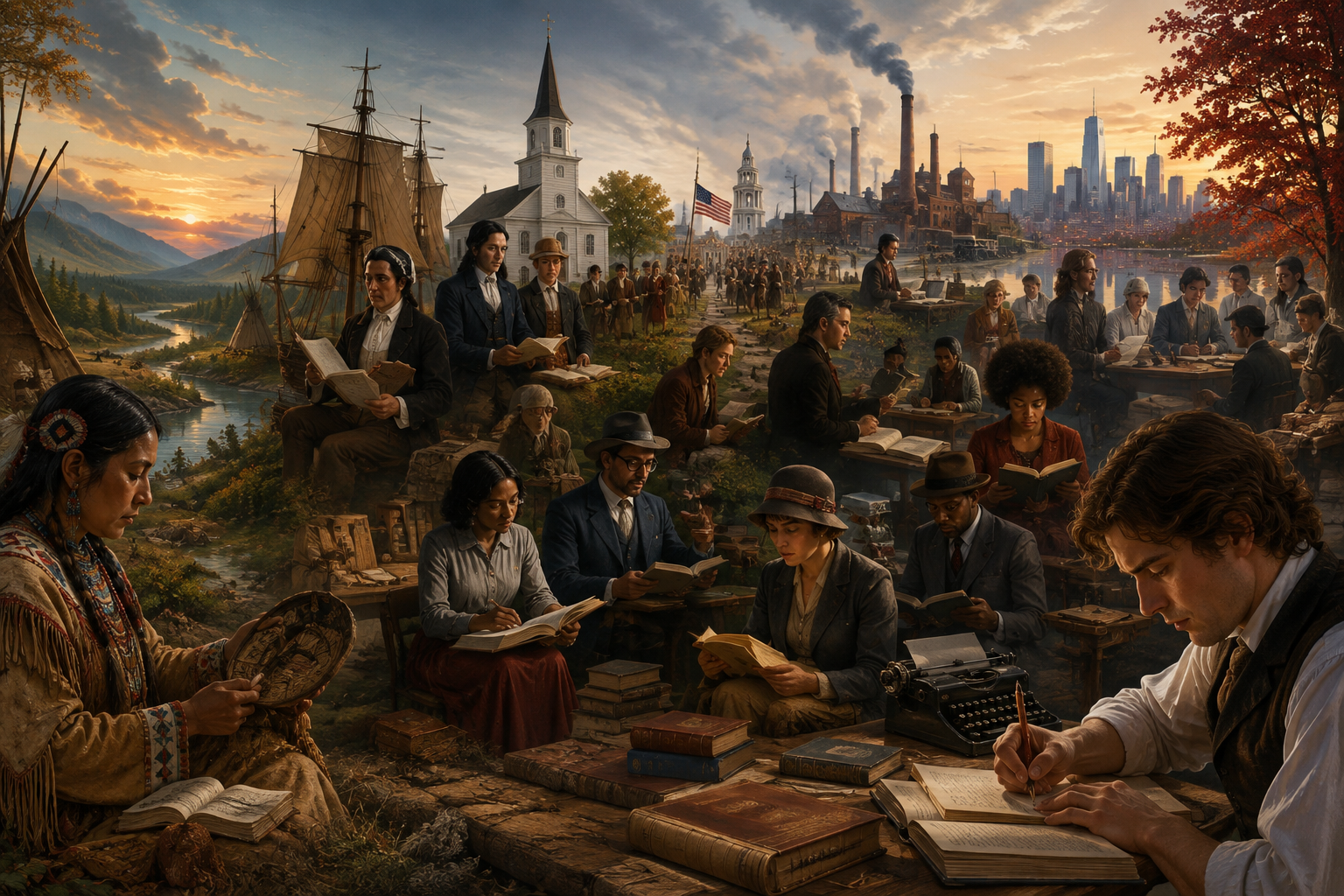
American literature changed as the United States changed through colonization, revolution, civil war, industrialization, migration, and technological change. Many literary movements in America developed partly in response to earlier values, although their dates and influences often overlapped.
When I study the major American literary movements and characteristics, I connect each period with its historical pressures, styles, genres, and representative writers. That approach makes the American literature timeline easier to understand and reveals how politics, religion, race, identity, war, and social change shaped US writing.
How Did Native American Traditions Shape American Literature?
American literary history begins long before European colonization. Native American communities preserved histories, spiritual beliefs, cultural values, and relationships with nature through oral storytelling, songs, ceremonies, creation narratives, and trickster tales.
These early traditions also provide valuable historical context for readers exploring the best classic American novels to read, since many later works engage with questions of land, identity, culture, and belonging.
These traditions frequently emphasize community, ancestry, spirituality, land, and interconnectedness. Native storytelling remains an important part of the characteristics of American literature rather than simply a historical tradition that disappeared after colonization.
What Defined Early American, Colonial, and Puritan Literature?
Early American and Colonial literature, particularly from the seventeenth century through the mid-eighteenth century, focused heavily on religious devotion, survival, settlement, and colonization.
Puritan writing generally used a plain, factual, instructional, and morally serious style. Sermons, diaries, personal journals, histories, captivity narratives, and religious poetry became important genres.
Anne Bradstreet brought personal feeling into Puritan poetry, while Jonathan Edwards, Cotton Mather, and William Bradford documented religious and colonial life.
How Did the Revolutionary Age of Reason Change American Writing?
From roughly 1750 to 1800, Enlightenment thinking shifted attention toward human reason, science, political freedom, and natural rights. American writing became persuasive, logical, and highly rhetorical.
Political pamphlets, essays, speeches, autobiographical writing, and state documents flourished. Benjamin Franklin represented practical reason and self-improvement, Thomas Paine argued forcefully for independence, and Thomas Jefferson helped shape the political language of the new nation.
The Early National period that followed encouraged writers to develop distinctly American settings, characters, folklore, and ideas of national identity.
What Are the Main Characteristics of American Romanticism?
American Romanticism flourished during the early and mid-nineteenth century. It moved away from the Enlightenment’s emphasis on reason and celebrated emotion, imagination, individualism, intuition, nature, and mystery.
Its style could be ornate, symbolic, emotional, and psychologically intense. Edgar Allan Poe, Nathaniel Hawthorne, Herman Melville, Walt Whitman, and Emily Dickinson became major American writers associated with this broad literary era.
How Did Gothicism and Dark Romanticism Develop?

American Gothic and Dark Romanticism explored the disturbing side of imagination. Writers examined madness, guilt, human decay, sin, death, isolation, psychological conflict, and supernatural forces.
Poe and Hawthorne became especially important because their fiction challenged optimistic assumptions about human nature.
What Did American Transcendentalists Believe?
Transcendentalism emphasized self-reliance, intuition, spiritual independence, and divinity in nature. Its writing was philosophical, reflective, essayistic, and deeply spiritual.
Ralph Waldo Emerson and Henry David Thoreau argued that people should trust personal conscience and direct experience rather than depend completely on established institutions. Transcendentalist thought often suggested that social institutions could restrict or corrupt human potential.
What Is the Difference Between American Realism and Naturalism?
After the Civil War, American Realism turned away from Romantic idealization and focused on everyday life, ordinary people, psychological truth, social problems, work, class, and regional speech.
Mark Twain and Edith Wharton became major Realist voices. Regionalism and local color also flourished, allowing writers to capture distinctive dialects, customs, landscapes, and communities across different parts of the United States.
Naturalism developed from Realism but adopted a grittier and often more deterministic perspective. Stephen Crane, Jack London, Theodore Dreiser, and Frank Norris portrayed characters as strongly influenced by environment, heredity, poverty, social class, fate, and forces beyond their control.
How Did American Modernism and the Harlem Renaissance Transform Literature?
American Modernism became especially influential from World War I through the 1940s. It reflected disillusionment, alienation, rapid modernization, and the fragmentation of post-WWI society.
Modernist writers experimented with stream of consciousness, non-linear narratives, free verse, symbolism, ambiguity, and fragmented structures. F. Scott Fitzgerald and Ernest Hemingway examined wealth, war, disappointment, and the American Dream. William Faulkner experimented with time and perspective, while US-born T. S. Eliot became an influential modernist poet.
The Harlem Renaissance deserves distinct attention within this period. Langston Hughes, Zora Neale Hurston, Claude McKay, and Countee Cullen celebrated African American identity, racial pride, culture, migration, and artistic independence. Jazz and blues rhythms also influenced the movement’s poetry and prose.
What Was the Beat Generation in American Literature?
After World War II, the Beat Generation rejected conformity, consumerism, conventional literary form, and many mainstream social expectations.
Jack Kerouac, Allen Ginsberg, and William S. Burroughs favored spontaneity, travel, spiritual experimentation, personal freedom, and rebellion. Their writing helped influence the American counterculture that expanded during the 1960s.
What Are the Characteristics of American Postmodernism?
Postmodernism became increasingly influential after 1945 and questioned stable meaning, absolute truth, traditional authority, and straightforward storytelling.
Writers often used metafiction, irony, pastiche, unreliable narrators, fragmented narratives, and mixtures of high and popular culture. Kurt Vonnegut, Thomas Pynchon, Don DeLillo, and John Barth are commonly associated with American Postmodernism.
Toni Morrison is also discussed in relation to postmodern techniques, although her work belongs more broadly to African American literature and explorations of race, history, memory, identity, and trauma.
What Defines Contemporary American Literature Today?
Contemporary American literature, broadly spanning the late twentieth century to the present, does not follow one dominant style. It is diverse, experimental, multicultural, and increasingly genre-bending.
Writers address identity, globalization, digital culture, intersectionality, immigration, race, gender, climate change, inequality, marginalized voices, and post-9/11 anxiety.
Jhumpa Lahiri, Jesmyn Ward, Colson Whitehead, and Cormac McCarthy represent very different strands of contemporary US writing, while many of their works continue conversations established by some of the best American novels of all time.
For me, the major American literary movements and characteristics become most meaningful when I see how each era expanded the subjects, identities, styles, and experiences that American writers could bring into literature.
Frequently Asked Questions About American Literary Periods and Characteristics
1. What are the major literary movements in American literature?
The major American literature periods generally include Colonial and Puritan writing, Enlightenment and Revolutionary literature, Romanticism, Transcendentalism, Realism, Naturalism, the Harlem Renaissance, Modernism, the Beat Generation, Postmodernism, and contemporary literature.
2. Which American literary movement focused most on individualism?
Romanticism strongly emphasized individual emotion and imagination, while Transcendentalism placed even greater emphasis on self-reliance, intuition, independence, and personal conscience.
3. How did Realism differ from Romanticism?
Romanticism favored emotion, imagination, symbolism, nature, and extraordinary experience. Realism focused more directly on everyday life, recognizable social conditions, ordinary speech, and psychologically believable characters.
4. Why do American literary movements overlap?
Literary movements and historical context do not change on fixed dates. Writers often continue using earlier styles while new ideas emerge, so literary periods work best as approximate frameworks rather than rigid boundaries.
Conclusion
Understanding the major American literary movements and characteristics gives me a clearer picture of how writers responded to religion, independence, war, industrialization, race, migration, modernity, and changing ideas about American identity.
These shifts also reveal how authors created greater emotional depth in fiction by exploring personal conflict, memory, identity, loss, and social pressure.
From Native oral traditions and Puritan sermons to Gothic fiction, Harlem Renaissance poetry, Modernist experimentation, Postmodern skepticism, and contemporary multicultural writing, American literary history is not a collection of isolated periods. It is an evolving conversation in which each generation of writers inherits, questions, challenges, and transforms what came before.